Clear Sky Science · en
High Open-Circuit Voltage–Fill factor product in perovskite solar cells enabled by ferroelectric heterojunction modulation
Why smarter solar cells matter
Solar panels are now a familiar sight on rooftops and in fields, but the technology behind them is still rapidly evolving. A leading newcomer, called a perovskite solar cell, has leapt in efficiency over the past decade and could help make solar power cheaper and more widely available. Yet small energy losses inside these cells still keep them from reaching their full potential. This study shows a new way to rearrange the active layers of perovskite cells so that electricity flows more easily and less energy is wasted, pushing performance very close to the theoretical limit for this type of material. 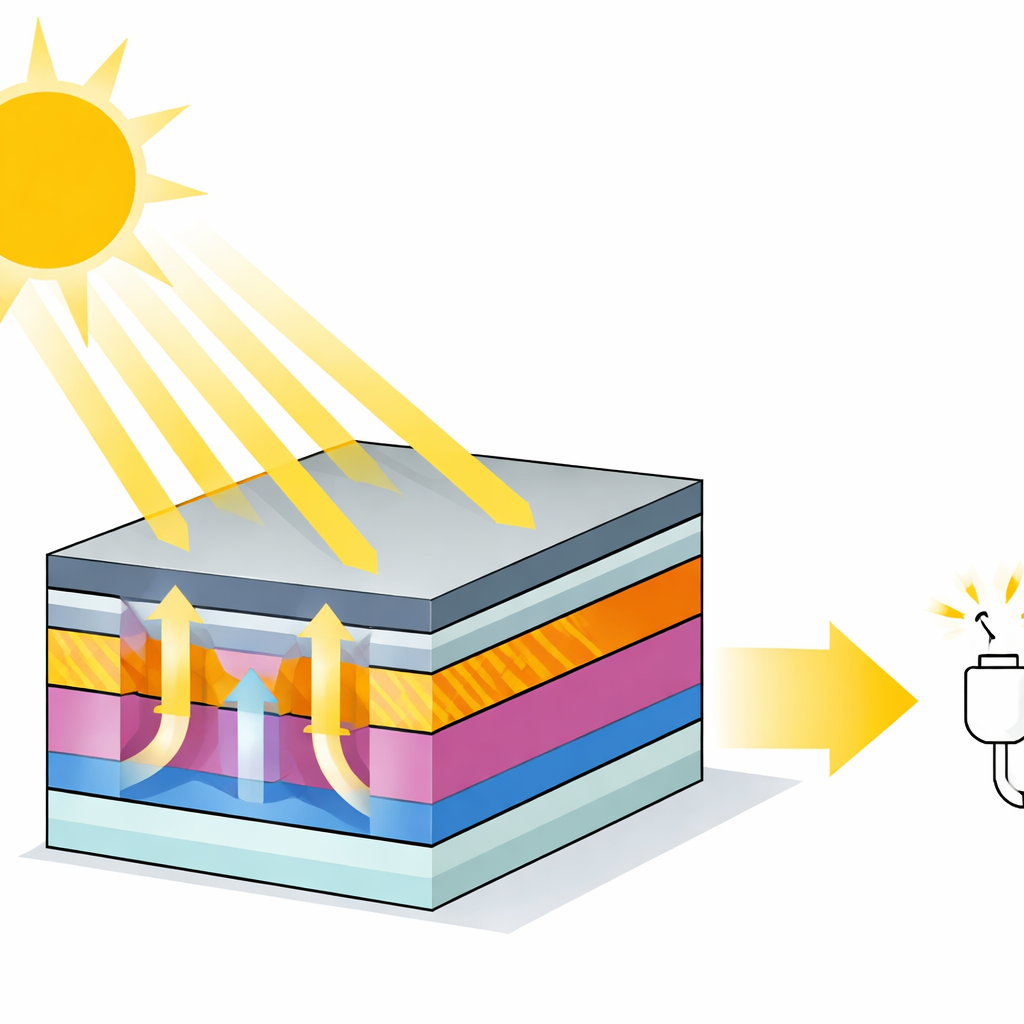
Making the most of every ray of light
Any solar cell works by turning incoming sunlight into separated electrical charges that can be drawn off as current. Two key numbers describe how well it does this: the open-circuit voltage, which tells us how much “push” each charge has, and the fill factor, which reflects how efficiently that push is turned into usable power. In today’s best perovskite devices, both numbers are held back by internal flaws. Tiny defects inside the light-absorbing film and at its interfaces act as traps where charges fall back together, wasting energy as heat instead of electricity. At the same time, the internal electric field that should guide charges to the contacts is often weaker than ideal, especially in the popular “inverted” device design. The challenge is to boost this built-in driving force while also removing the traps that cause recombination.
Adding a tiny helper layer
The researchers tackled this problem by inserting extremely thin layers of special “ferroelectric” perovskites into the main light-absorbing perovskite. Ferroelectric materials carry tiny built-in electric dipoles that can line up to create strong internal fields. Here, the team blended two-dimensional ferroelectric perovskite structures—known as Dion–Jacobson and Ruddlesden–Popper phases—into a standard three-dimensional perovskite film. The result is a ferroelectric-based heterojunction, where slightly different perovskite types sit next to each other inside the same layer. These embedded regions do double duty: they strengthen the internal electric field that separates charges, and they act as seeds that guide how the rest of the film crystallizes as it forms.
Cleaning up the crystal landscape
To see how this new design affects the material, the team watched the perovskite layer grow in real time using light-based probes. They found that tiny ferroelectric crystals help control when and where the main perovskite nucleates and grows. Instead of forming in a rushed, uneven way, the film develops more gradually and uniformly. Imaging and electrical tests confirmed that the finished films have larger, more regular grains, fewer leftover lead iodide pockets, and a far lower density of defects where charges could be lost. The average time that charges survive before recombining lengthened significantly, showing that the traps were effectively suppressed.
Stronger internal push for charges
Beyond cleaner crystals, the ferroelectric additions reshape the electrical landscape of the device. Surface potential measurements revealed a more uniform electric environment across the film, while energy level measurements showed that the absorbing layer now lines up better with the hole-collecting contact. This alignment, together with polarization from the ferroelectric regions, increases the built-in potential—the internal “voltage” that helps pull electrons and holes toward opposite sides. As a result, charges move more quickly and are less likely to be caught by defects or forced back together. Device-scale measurements confirmed these gains: both the open-circuit voltage and fill factor improved, and unwanted recombination under light was reduced. 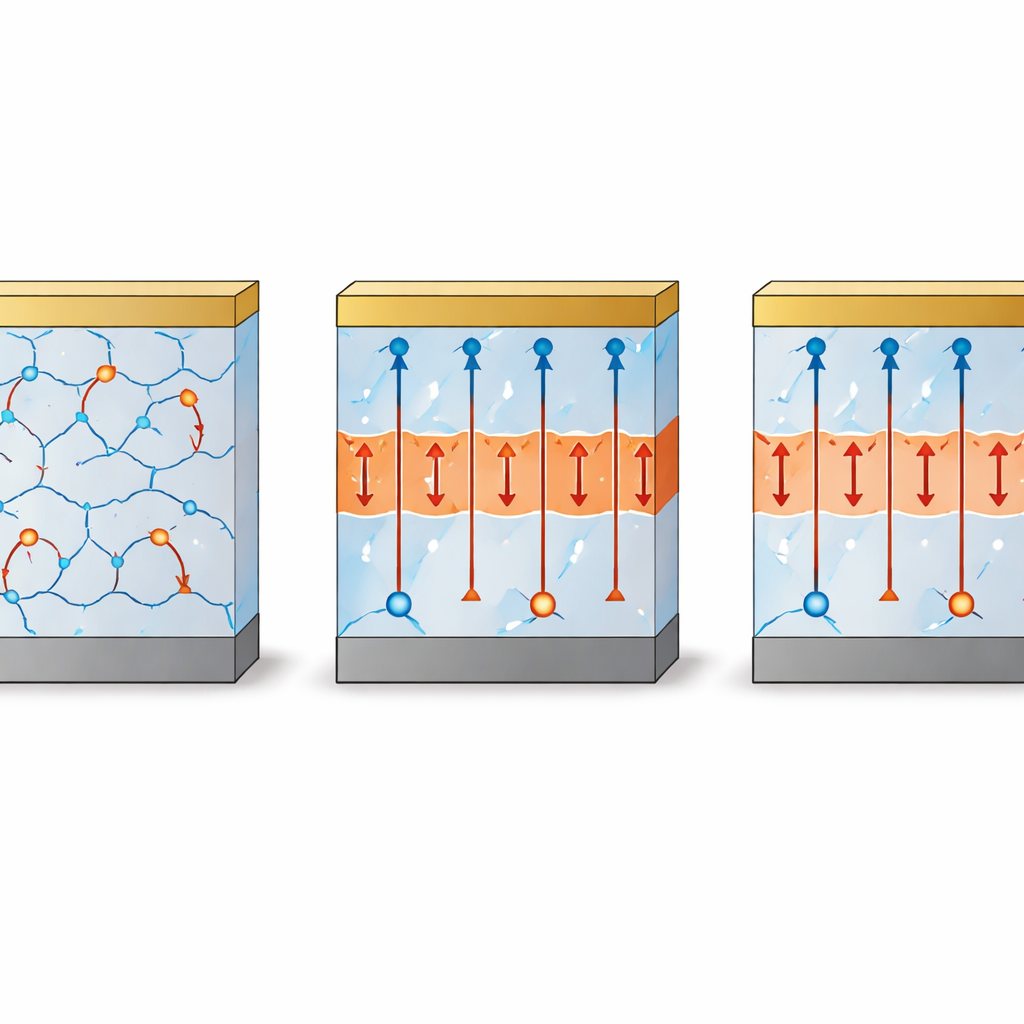
Pushing toward ideal solar performance
When these effects are combined in complete solar cells, the benefits are striking. The best devices reached a power conversion efficiency of 26.62%, with an independently certified value of 26.07%. Even more telling, the product of voltage and fill factor reached about 90% of the fundamental Shockley–Queisser limit for this material’s bandgap, meaning the cells leave very little room for further loss in those two key parameters. The devices also held more than 85% of their initial efficiency after 500 hours of continuous operation, indicating good stability. In plain terms, carefully weaving ferroelectric regions into perovskite solar cells gives the charges a clearer, stronger path to follow and reduces the places they can get stuck, bringing practical solar modules a step closer to their theoretical best.
Citation: Wu, N., Ni, H., Niu, T. et al. High Open-Circuit Voltage–Fill factor product in perovskite solar cells enabled by ferroelectric heterojunction modulation. Nat Commun 17, 2897 (2026). https://doi.org/10.1038/s41467-026-69391-3
Keywords: perovskite solar cells, ferroelectric materials, crystal defects, solar cell efficiency, thin-film photovoltaics