Clear Sky Science · en
An aqueous battery using an electrolyte with a pH of 7 and suitable for direct environmental discard
Why safer water-based batteries matter
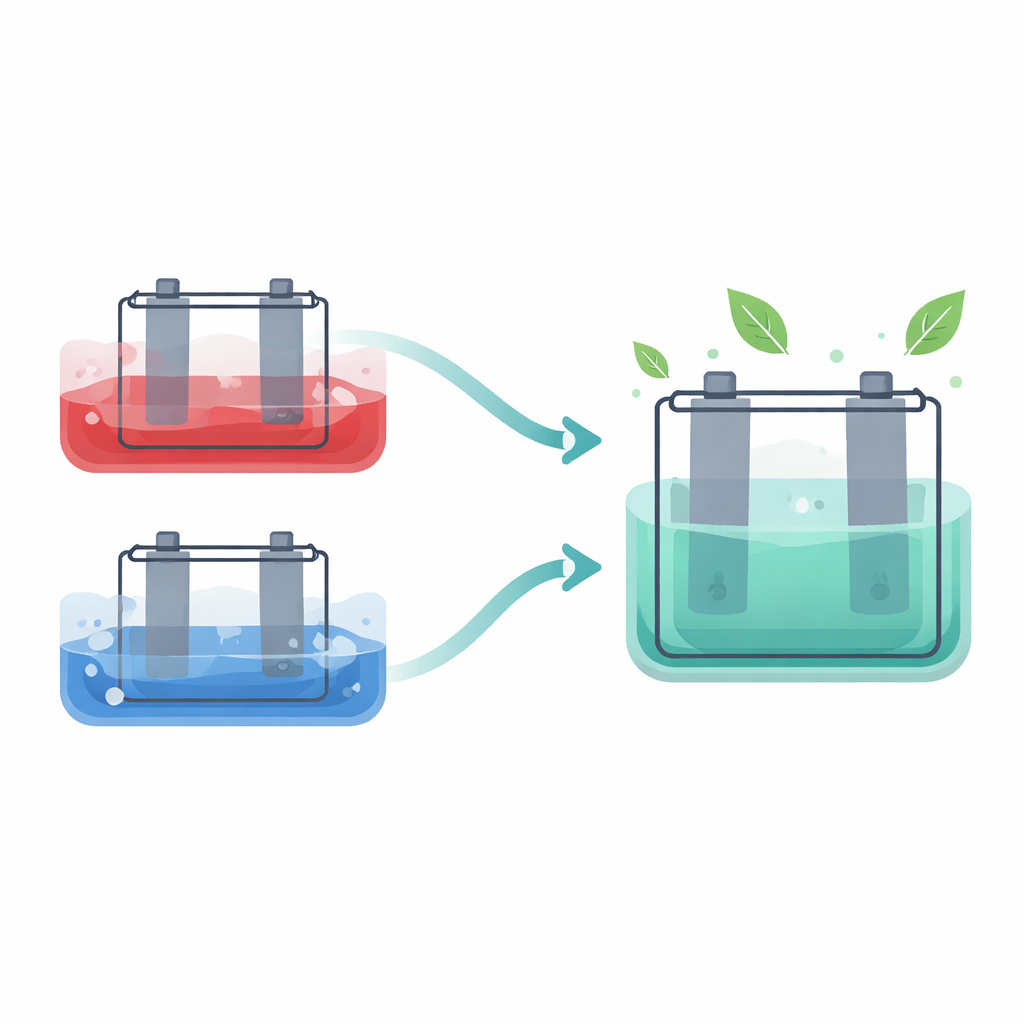
Most rechargeable batteries today rely on flammable liquids or harsh acids and bases, which raise safety and environmental concerns. This study explores a new kind of water-based battery that runs in a gentle, nearly neutral solution—similar in acidity to drinking water or the brine used to make tofu. Because the liquid is mild and the solid ingredients avoid heavy metals, these batteries aim to store energy for a very long time and then be discarded without harming the environment.
Problems with today’s water-based batteries
Water-based, or “aqueous,” batteries have long been seen as a safer alternative to standard lithium-ion cells because water does not burn. However, most existing designs use liquids that are either quite acidic or strongly alkaline. Under those conditions, the water itself splits into hydrogen and oxygen gas at the surfaces of the electrodes. This wastes energy, slowly dries out the cell, and builds up bubbles that damage the electrodes. When such batteries are thrown away, their corrosive liquids can also hurt soils and waterways. The authors set out to design a battery that keeps the advantages of water, but works at a pH of about 7, close to neutral, to reduce these side reactions.
A new gentle liquid and matching solid materials
The team chose common salts of magnesium and calcium—MgCl₂ and CaCl₂—as the basis of the liquid inside the battery. These salts form concentrated solutions that can store and move a lot of charge, yet remain nearly neutral and are already used safely in food processing. To work with these liquids, the researchers synthesized a family of porous organic solids, called covalent organic polymers, to act as the negative electrode. By slightly changing the chemical link that joins the building blocks of these polymers, they could tune how easily the material accepts and releases electrons and how strongly it attracts magnesium or calcium ions. One version, named Hex-TADD-COP, stood out because it combined fast charge transport, good thermal stability, and a low operating voltage, which is desirable for pairing with high-voltage positive electrodes.
How the new battery stores charge
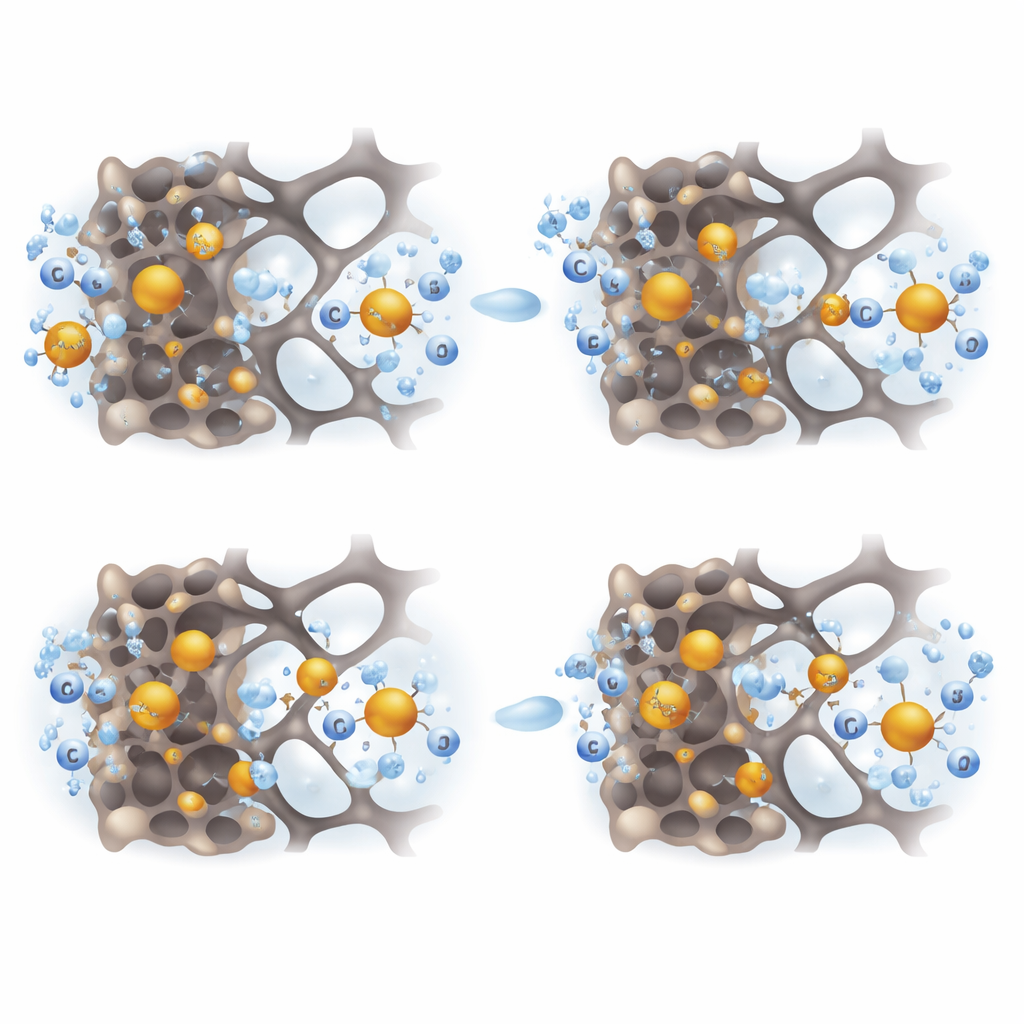
In the chosen polymer, repeating units contain nitrogen atoms arranged so that they can briefly grab and release magnesium or calcium ions as the battery charges and discharges. Using a mix of computer modeling and several types of spectroscopy, the researchers showed that these nitrogen sites reversibly coordinate the divalent ions without tearing the polymer apart. Crucially, the nearly neutral liquid contains very few free protons, so hydrogen ions play almost no role in the charge-storage process. Experiments in more acidic solutions revealed that when extra protons are present, they trigger unwanted reactions, form insulating deposits on the electrode surface, and rapidly shorten the device’s life. At pH 7, in contrast, the electrode retains more than 70 percent of its capacity even after about 120,000 rapid charge–discharge cycles, an exceptionally long lifetime for an aqueous battery.
Building a full battery and testing its life span
To demonstrate a complete working device, the team combined the new polymer negative electrode with a positive electrode made from a Prussian blue–like compound containing copper and iron. In the neutral magnesium or calcium salt solutions, this pair produced a working voltage of up to about 2.2 volts—high for a water-based multivalent battery. When the total mass of the electrodes and the liquid was taken into account, the cells delivered specific energies up to roughly 40–50 watt-hours per kilogram, comparable to or better than many other magnesium or calcium systems. Just as important, the full cells preserved useful capacity over 120,000 cycles at high current, and pouch-style prototypes with thicker electrodes also ran stably over thousands of cycles, hinting at practical potential.
What this means for cleaner energy storage
The study shows that it is possible to build a long-lasting rechargeable battery that uses a neutral, food-grade salt solution and an organic negative electrode designed to avoid destructive side reactions. By keeping the pH near 7 and relying on abundant, non-toxic elements such as magnesium, calcium, carbon, nitrogen, and iron, the authors create a device that can, in principle, be thrown away without special treatment and still meet strict environmental standards. While more work is needed to raise the energy content further and optimize large-scale manufacturing, this approach points toward safer, greener batteries for applications where extreme longevity and low environmental impact are more important than squeezing out every last unit of energy.
Citation: Chen, H., Feng, S., Wang, Y. et al. An aqueous battery using an electrolyte with a pH of 7 and suitable for direct environmental discard. Nat Commun 17, 2895 (2026). https://doi.org/10.1038/s41467-026-69384-2
Keywords: aqueous batteries, magnesium ion storage, calcium ion batteries, neutral electrolytes, covalent organic polymers