Clear Sky Science · en
Cellulose nanofibers and limestone filler enable high-performance, sustainable, and cost-efficient printable concrete
Building Stronger, Greener Concrete
Concrete is the backbone of modern cities, but making it pumps enormous amounts of carbon dioxide into the atmosphere. At the same time, a new wave of 3D-printing technologies promises faster, less wasteful building—if only the printable concrete itself can be made strong, stable, affordable, and climate friendly. This paper shows how combining wood-derived cellulose nanofibers with simple ground limestone can create a new kind of printable concrete that holds its shape during printing, matches the strength of conventional mixes, and cuts both cost and carbon footprint.
Why 3D-Printed Concrete Needs a Makeover
3D-printed concrete dispenses with traditional wooden molds and can build intricate, curved walls and overhangs layer by layer. But current printable mixes rely on large amounts of cement and costly chemical additives to flow through pumps yet harden quickly enough to stack up without collapsing. This makes them expensive and carbon intensive, since cement manufacturing alone accounts for about 8% of human-made CO₂ emissions. The challenge is to design a material that flows smoothly when it leaves the nozzle, then stiffens rapidly to support its own weight—all while using less cement and fewer high-impact ingredients.
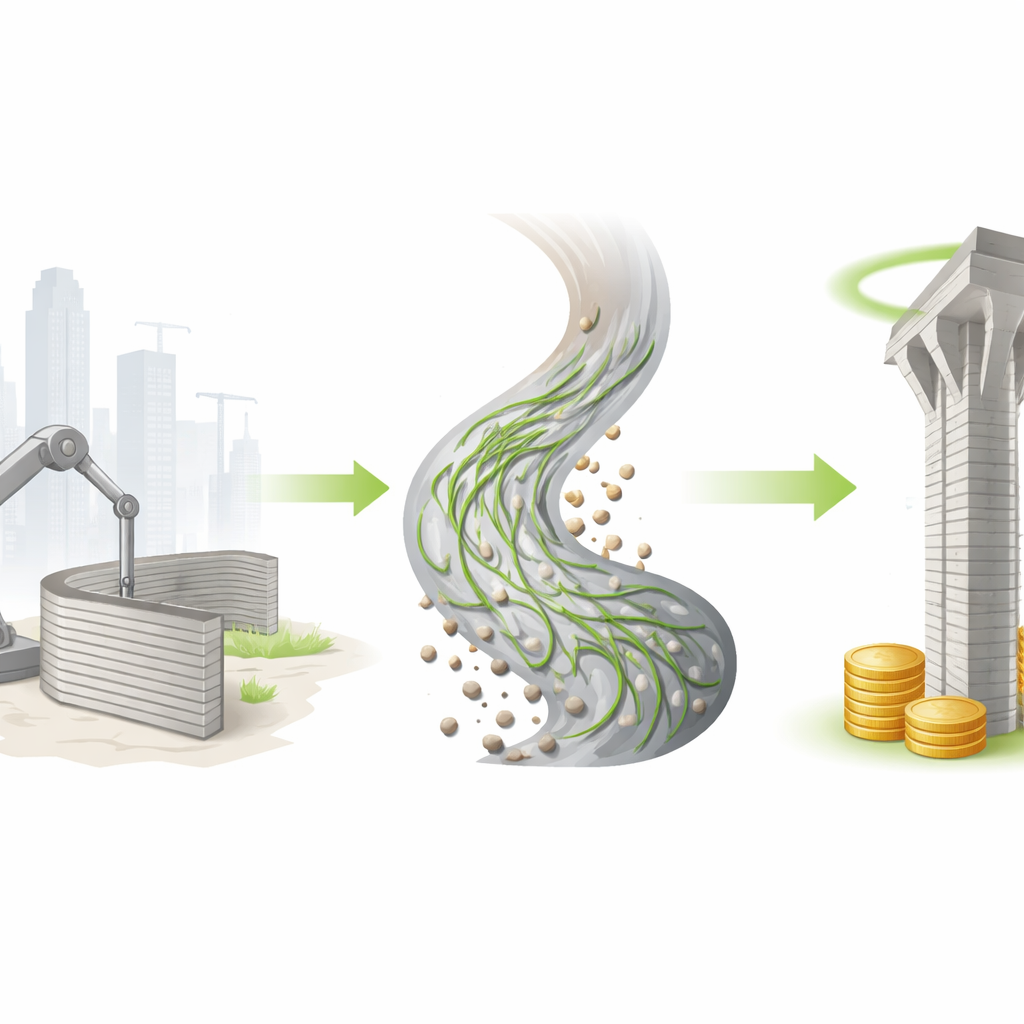
Wood Fibers and Limestone as Smart Ingredients
The researchers tackled this by blending two accessible materials into a cement-based mix: limestone powder that partly replaces cement, and ultra-thin cellulose nanofibers made from wood. Limestone is far cheaper and cleaner to produce than cement, and its fine particles help pack the mix more efficiently and speed up the early chemical reactions that stiffen fresh concrete. The nanofibers, just nanometers wide but micrometers long, act like a microscopic web. They interact with cement particles through surface charges, tying them together and dramatically increasing the stress the material can resist before it starts to flow, without making it so thick that it clogs the printer.
How the New Mix Behaves While Printing
Careful lab tests showed just how powerful this combination is. Replacing 29% of the cement with limestone and adding only 0.3% cellulose nanofibers (by binder weight) raised the initial “yield stress” of the fresh paste by more than twelvefold, meaning each printed layer can carry much more weight from the layers above. The stiffness and ability to stretch slightly without permanent deformation also improved, both critical for printing shapes with overhangs. At the same time, the viscosity—the resistance to flow while being extruded—increased only moderately. Microscopy and heat-flow measurements revealed that limestone mainly speeds up the formation of rigid hydration products, whereas the nanofibers boost strength through physical and electrostatic interactions, rather than by changing the underlying chemistry.
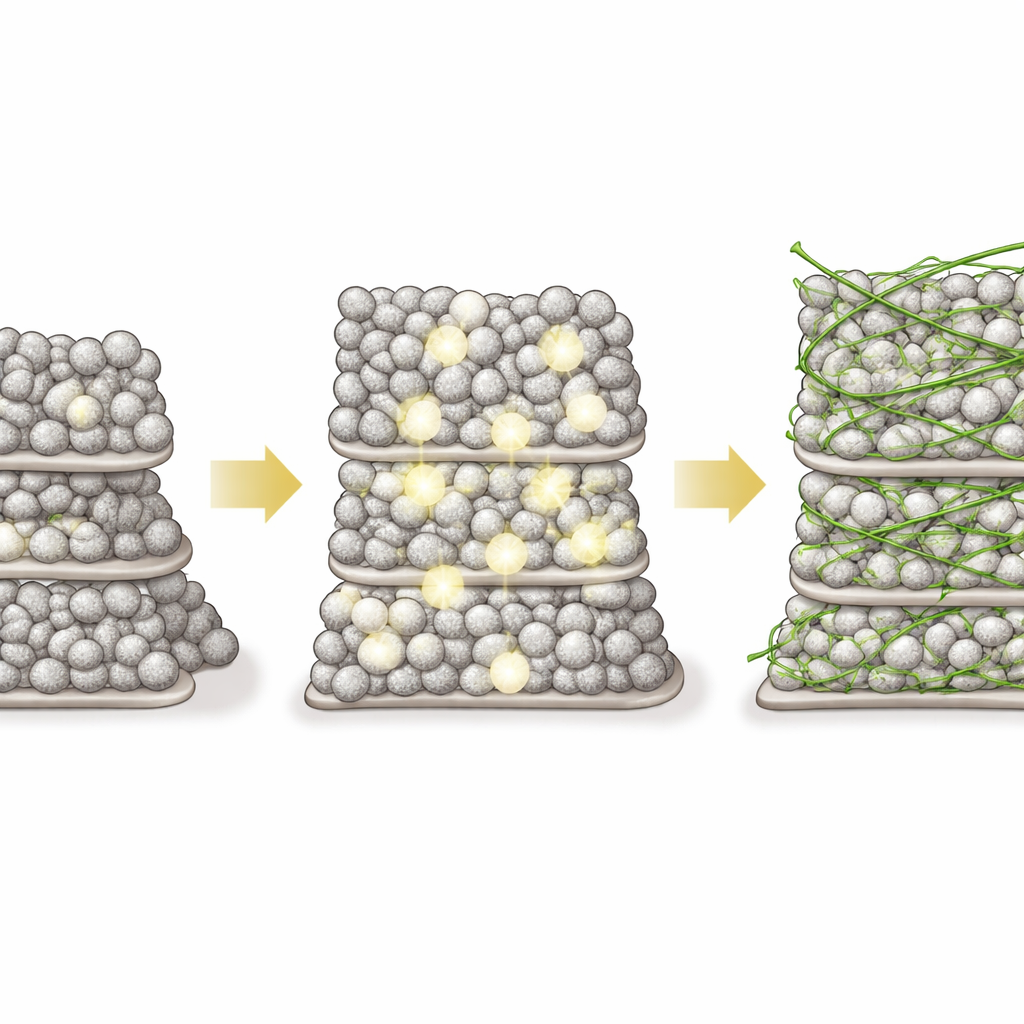
From Lab Paste to Real-World Printed Structures
To see whether these gains matter outside the rheology lab, the team printed hollow columns with challenging overhangs at two scales. In small printer tests, a basic mix without the new ingredients failed after just a few layers, while the limestone-only version did somewhat better. The full limestone–nanofiber mix, however, reached 46 layers without failure. In large-scale trials using an industrial robotic arm, this same mix printed a half-meter-wide column with a 25-degree overhang and survived 78 layers before buckling—far outperforming two commercial high-performance printable concretes tested under identical conditions. Mechanical tests on hardened samples showed that, despite using 40% less cement, the new mix matched the compressive and flexural strength of the conventional reference material, helped by nanofibers that bridge microcracks inside the hardened matrix.
Lower Carbon, Lower Cost, Same Strength
Beyond performance, the authors assessed how the new recipe affects cost and climate impact over the full production chain. Because cement dominates both expense and emissions, swapping a large fraction of it for limestone brings substantial savings. Techno-economic analysis found that, when strength is taken into account, the minimum selling price of the optimized mixture drops by about 12% compared with a standard printable mortar, while life-cycle assessment shows a roughly one-third reduction in global warming impact per unit strength. The tiny dose of nanofibers adds little to cost or carbon but delivers a large boost in printability and strength, making it one of the most efficient additives studied to date. In simple terms, the work demonstrates that a smart blend of wood-based fibers and ground rock can make 3D-printed concrete sturdier, cheaper, and significantly greener without sacrificing the reliability builders need.
Citation: Wang, Y., Douba, A.E., Rajendiran, N. et al. Cellulose nanofibers and limestone filler enable high-performance, sustainable, and cost-efficient printable concrete. Nat Commun 17, 3481 (2026). https://doi.org/10.1038/s41467-026-69373-5
Keywords: 3D-printed concrete, cellulose nanofibers, limestone filler, low-carbon construction, rheology