Clear Sky Science · en
Engineering non-exponential proliferation in Escherichia coli using functionalized protein aggregates
Why slowing microbes can matter
We often hear how bacteria multiply at breakneck speed, doubling their numbers again and again in a runaway chain reaction. That explosive growth is helpful in a lab or factory, but it can become a problem when living, engineered microbes are sent into the body to deliver drugs or perform other medical tasks. This study explores a way to tame that growth, building bacteria that expand in a steady, predictable way and then simply stop—without needing any outside switch or drug to tell them what to do.
From runaway growth to steady steps
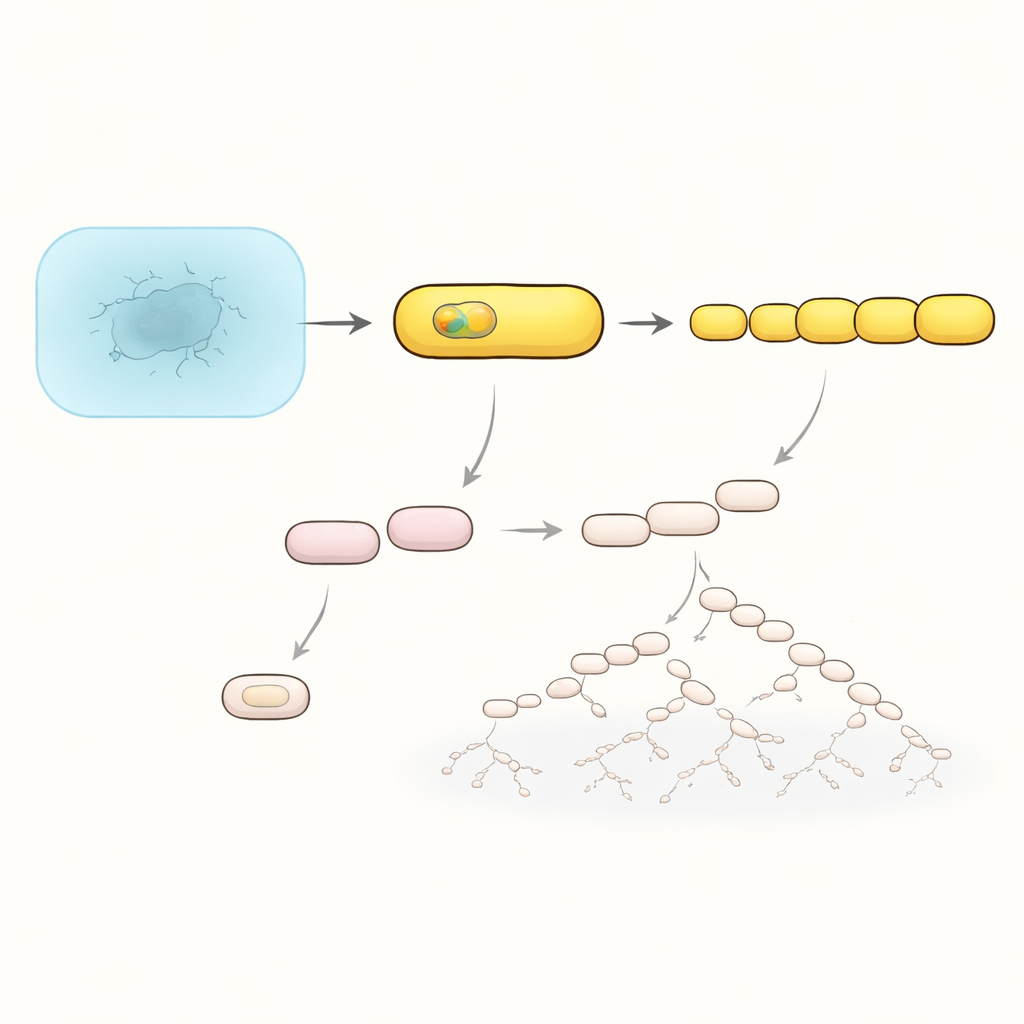
In nature, most microbes follow exponential growth: each cell divides into two, those two into four, then eight, and so on. For genetically modified microorganisms, especially those considered for therapies inside animals or humans, such uncontrolled expansion could make dosing unpredictable and biocontainment difficult. Existing safety systems usually rely on special chemicals, light, or complex sensing circuits that can be hard to control in the messy reality of the body. The authors set themselves a more fundamental challenge: redesign a standard laboratory strain of Escherichia coli so that its population grows only in a straight, linear fashion for a limited time, and does so entirely on its own.
A tiny growth engine built from clumped proteins
To achieve this, the team turned a weakness of cells into a design feature: protein clumps. Many cellular proteins can form dense aggregates that tend to collect at one end of a bacterium and are passed on unevenly during cell division. The researchers engineered two matching protein pieces that only become active when they sit next to each other inside such a clump. Together they rebuild an enzyme that produces cAMP, a small signaling molecule that E. coli needs to grow on certain food sources. They placed both pieces on a shared “sticky” tail that forces them into a single aggregate and added fluorescent tags so the clump can be seen under the microscope. Crucially, they removed the cell’s natural ability to make cAMP, so the engineered aggregate became the only source of this growth-enabling molecule.
Asymmetric inheritance sets the growth limit
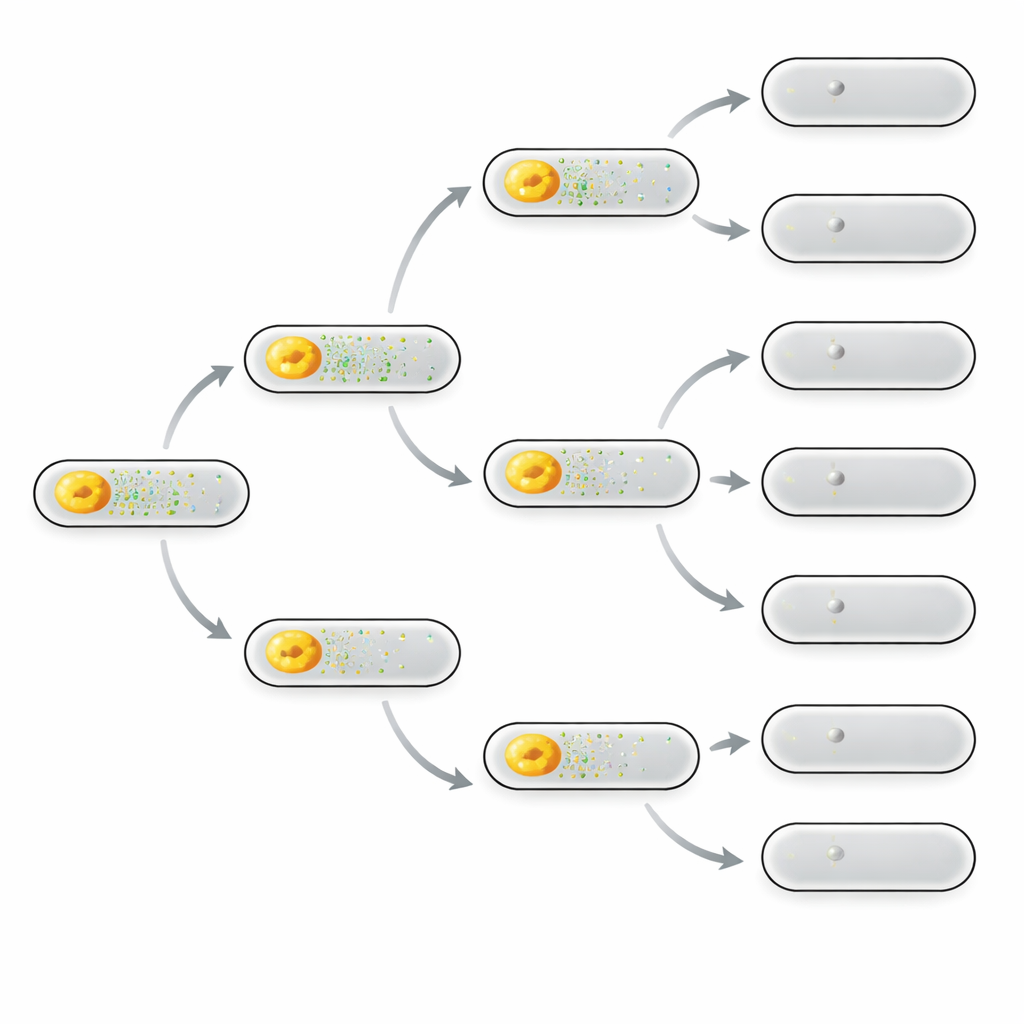
When the engineered bacteria are briefly induced, they form one bright protein aggregate that acts as a cAMP factory. As these bacteria grow on media where cAMP is essential, the aggregate sits at one cell pole and is passed almost entirely to just one daughter at each division. That daughter keeps the clump and continues to divide; its sibling receives no clump and soon runs out of cAMP, halting its growth after only a few divisions. Over time, normal cellular machinery slowly breaks up the aggregate, shrinking the cAMP supply in the “founder” lineage. The researchers observed that each aggregate typically supports only a few dozen cell divisions before disappearing, at which point growth stops even for the aggregate-bearing branch. The size of the original clump determines how many divisions are possible, and reintroducing a natural disaggregation protein lets the designers tune this maximum by speeding up or slowing down clump decay.
From single cells to whole populations
To understand how millions of such cells would behave, the authors built a computer model that follows individual cells, their enzyme-bearing aggregates, and the cAMP levels they produce. The model predicts that, in contrast to normal exponential expansion, only a fixed number of aggregate-bearing founder cells continue to divide at any time. The total population therefore increases in a straight, linear line, rather than an accelerating curve, until all aggregates vanish. Bulk growth experiments, tracked by optical density and viable cell counts, matched this prediction: in media where cAMP production was required, populations of engineered bacteria grew linearly over many hours instead of exploding exponentially. The same behavior appeared on several different carbon sources, suggesting that the design principle is robust across various nutrient conditions.
What this means for future living medicines
By wiring essential growth signals to a single, slowly fading protein aggregate that is inherited by only one daughter cell at a time, the researchers created a bacterial “chassis” with built-in limits: it grows in a predictable linear fashion for a defined number of generations and then shuts itself down. For potential therapeutic microbes that might one day patrol our guts, tumors, or other hard-to-reach sites, such self-limiting behavior could make dosing more reliable and containment more secure. While this is still a proof-of-concept in a laboratory strain, the strategy opens a path toward living treatments whose population size is governed not by chance and environment, but by an internal growth clock encoded in their own proteins.
Citation: Van Eyken, R., Oome, D., Broux, K. et al. Engineering non-exponential proliferation in Escherichia coli using functionalized protein aggregates. Nat Commun 17, 3005 (2026). https://doi.org/10.1038/s41467-026-69334-y
Keywords: synthetic biology, engineered bacteria, growth control, protein aggregates, biocontainment