Clear Sky Science · en
Pt size-dependent reverse oxygen spillover on Sn-doped Pt/TiO2 for CO oxidation
Cleaning Dirty Air with Tiny Metal Particles
Air pollution from car exhaust and industrial furnaces contains carbon monoxide (CO), a poisonous gas that must be removed before release into the atmosphere. Catalysts made from tiny particles of platinum on metal oxides are widely used for this job, but scientists still debate what exact atomic arrangements make these catalysts most effective. This study reveals how the size of platinum particles controls a subtle oxygen‑shuttling process at the surface, offering a new recipe for more efficient and durable air‑cleaning materials.
How the Catalyst Surface Shares Oxygen
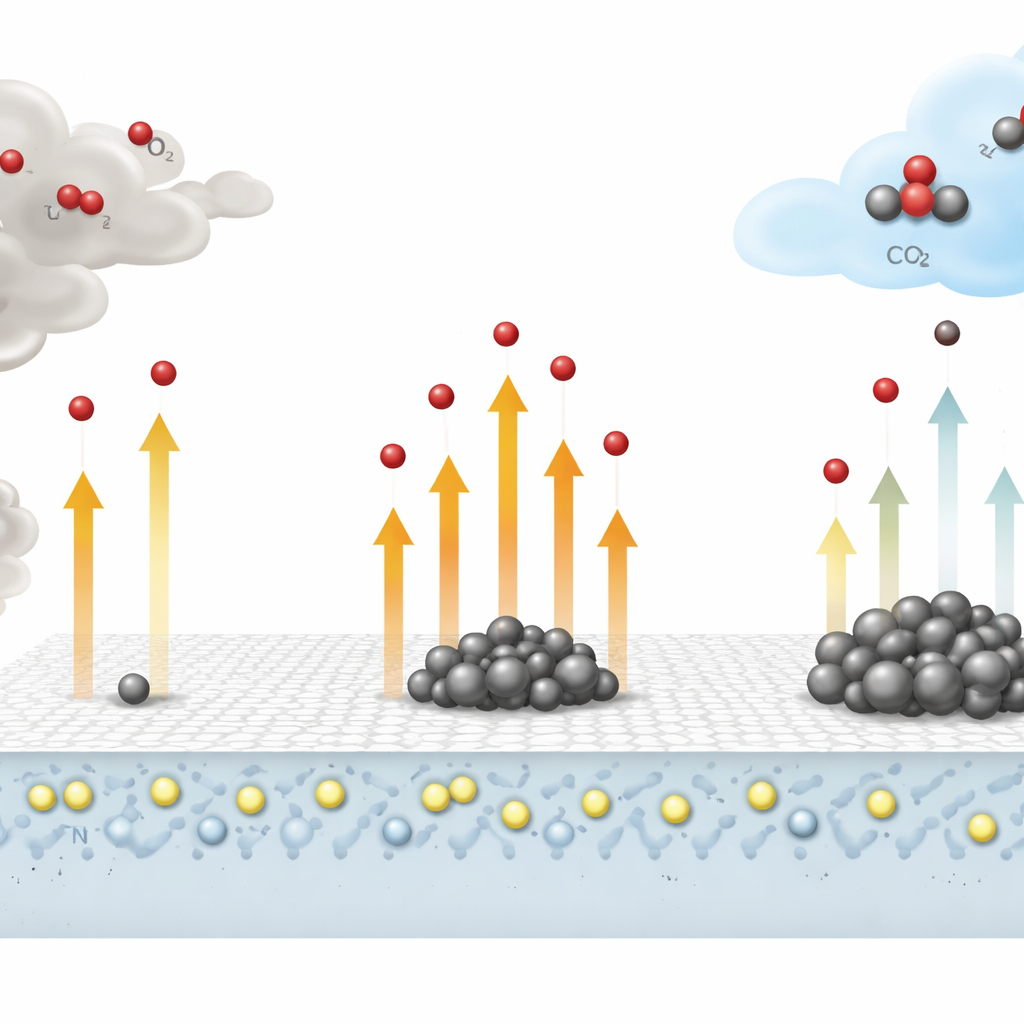
Platinum atoms are placed on a support made of titanium dioxide that is deliberately altered by adding tin atoms. This creates slightly unbalanced oxygen sites that can move more easily. During CO cleanup, oxygen can travel in an unusual direction: instead of oxygen leaving the metal and moving onto the support, oxygen atoms jump from the support up to the platinum. This "reverse oxygen spillover" temporarily turns platinum into a more oxygen‑rich form that can quickly burn CO into carbon dioxide, even at low temperatures. Understanding when and how this oxygen sharing happens is crucial for designing better catalysts.
Why Particle Size Matters
The researchers prepared a family of catalysts in which platinum appears as isolated single atoms, small clusters containing several atoms, or larger nanocrystals. They confirmed these structures using advanced electron microscopy and X‑ray techniques, while keeping the underlying support nearly identical. By flowing CO over the catalysts and carefully tracking how much CO and CO2 appeared, they could estimate how much active oxygen was involved in the reaction. Platinum arranged as nanoclusters stood out, providing the highest amount of reactive oxygen and the fastest turnover of CO, roughly twice that of single atoms or large crystals.
Watching Oxygen Move in Real Time
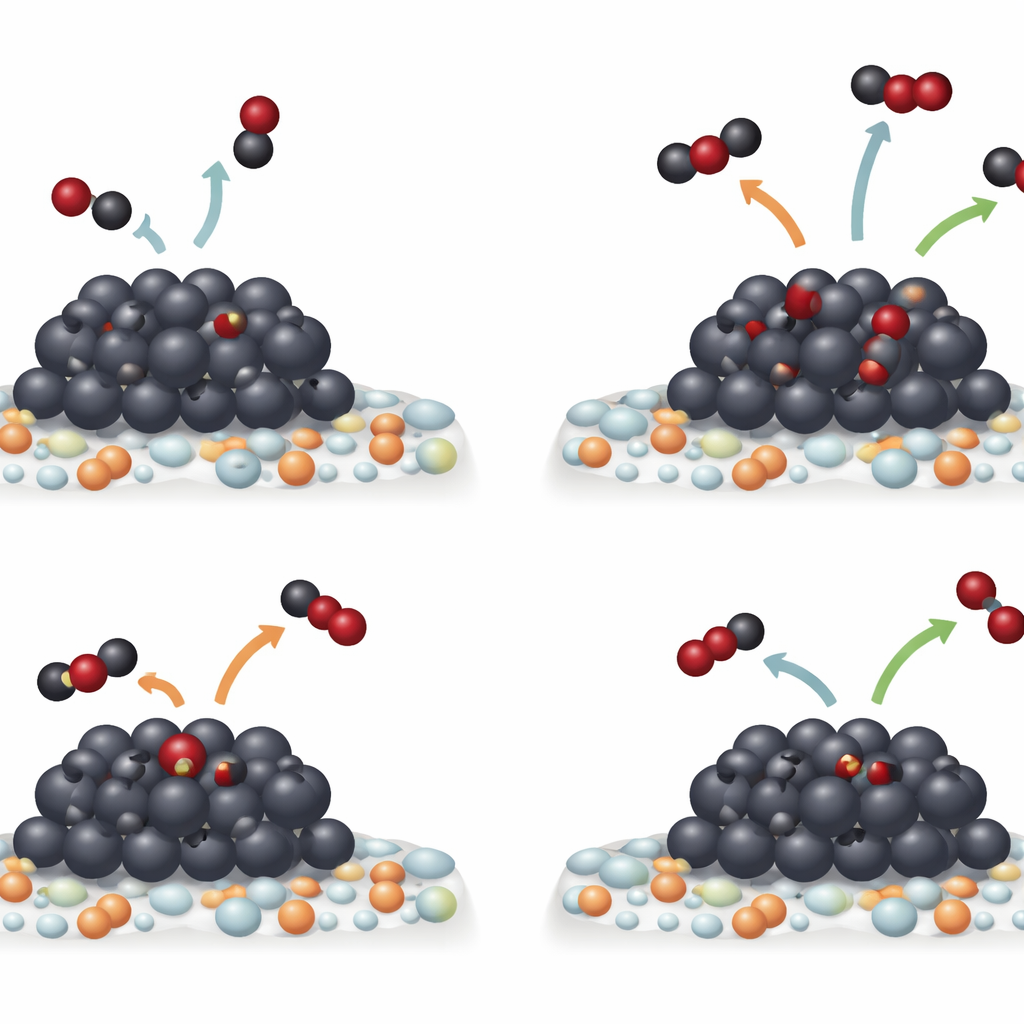
To see what happens during the reaction, the team used in situ methods that probe the catalyst while it is working. Near‑ambient pressure X‑ray photoelectron spectroscopy and Raman spectroscopy showed that under oxygen alone, platinum stayed in a moderately oxidized state and the support lattice was stable. Once CO was introduced, however, oxygen atoms from the tin‑doped support migrated to the platinum, increasing its oxidation state—direct evidence of reverse oxygen spillover. This effect was strongest for nanocluster platinum, weaker for nanocrystals, and essentially absent for isolated single atoms. Infrared measurements of adsorbed CO confirmed that the electronic state of platinum changed most dramatically on nanoclusters as temperature rose, again signaling more active oxygen motion.
Simulations Reveal the Atomic Dance
Computer simulations based on quantum mechanics helped explain why different sizes behave so differently. For single platinum atoms, CO binds so strongly that the structure becomes locked, preventing oxygen from moving from the support to the metal. For large platinum crystals, CO adsorption tends to break the connection between platinum and the support, so oxygen no longer flows across the interface. By contrast, on nanoclusters CO binding is moderate: it triggers a strong flow of electrons toward the interfacial oxygen, weakening its ties to the support and encouraging it to hop onto the platinum. This step lowers the energy barrier for converting CO to CO2, creating a faster and more efficient reaction cycle.
Designing Better Catalysts for Cleaner Air
Together, the experiments and simulations paint a clear picture: platinum nanoclusters on a tin‑doped titanium dioxide support hit a sweet spot where oxygen can shuttle back and forth easily, powering low‑temperature CO oxidation without destabilizing the catalyst. Single atoms hold CO too tightly to use this pathway, while large particles lose contact with the oxygen‑rich support. By tuning particle size and support composition to maximize reverse oxygen spillover, engineers can design more effective catalysts for cleaning exhaust gases from vehicles and industrial furnaces, helping to reduce toxic emissions and improve air quality.
Citation: Xiong, S., Gong, Z., Wang, H. et al. Pt size-dependent reverse oxygen spillover on Sn-doped Pt/TiO2 for CO oxidation. Nat Commun 17, 3380 (2026). https://doi.org/10.1038/s41467-026-69327-x
Keywords: carbon monoxide oxidation, platinum nanoclusters, oxygen spillover, emission control catalysts, titanium dioxide support