Clear Sky Science · en
Dual reaction strategy for in-situ conductivity enhancement to enable high-performing aqueous zinc-based micro-batteries
Power for Tiny Devices
As our gadgets shrink—from wearable health patches and smart clothing to millimeter-scale sensors in the brain or in toy cars—they still need serious power. Conventional tiny batteries either store too little energy, deliver it too slowly, or rely on flammable, toxic liquids. This paper introduces a new kind of safe, water‑based zinc micro‑battery that squeezes far more energy into a tiny area than previous designs, while still delivering bursts of power strong enough to run wireless electronics.

The Limits of Today’s Small Batteries
Most micro‑batteries work through a single chemical reaction that shuttles charged particles back and forth during charging and discharging. This caps how much energy they can pack into a chip-sized footprint. Organic lithium or sodium micro‑batteries can store more energy than many water‑based versions, but they depend on flammable, volatile electrolytes and bulky packaging. Aqueous zinc micro‑batteries are safer and cheaper, yet even the best typically fall short of 7,500 microwatt‑hours per square centimeter—insufficient for long‑lived, self‑powered sensors or dense arrays of on‑chip devices.
A Two‑Stage Battery in One Tiny Package
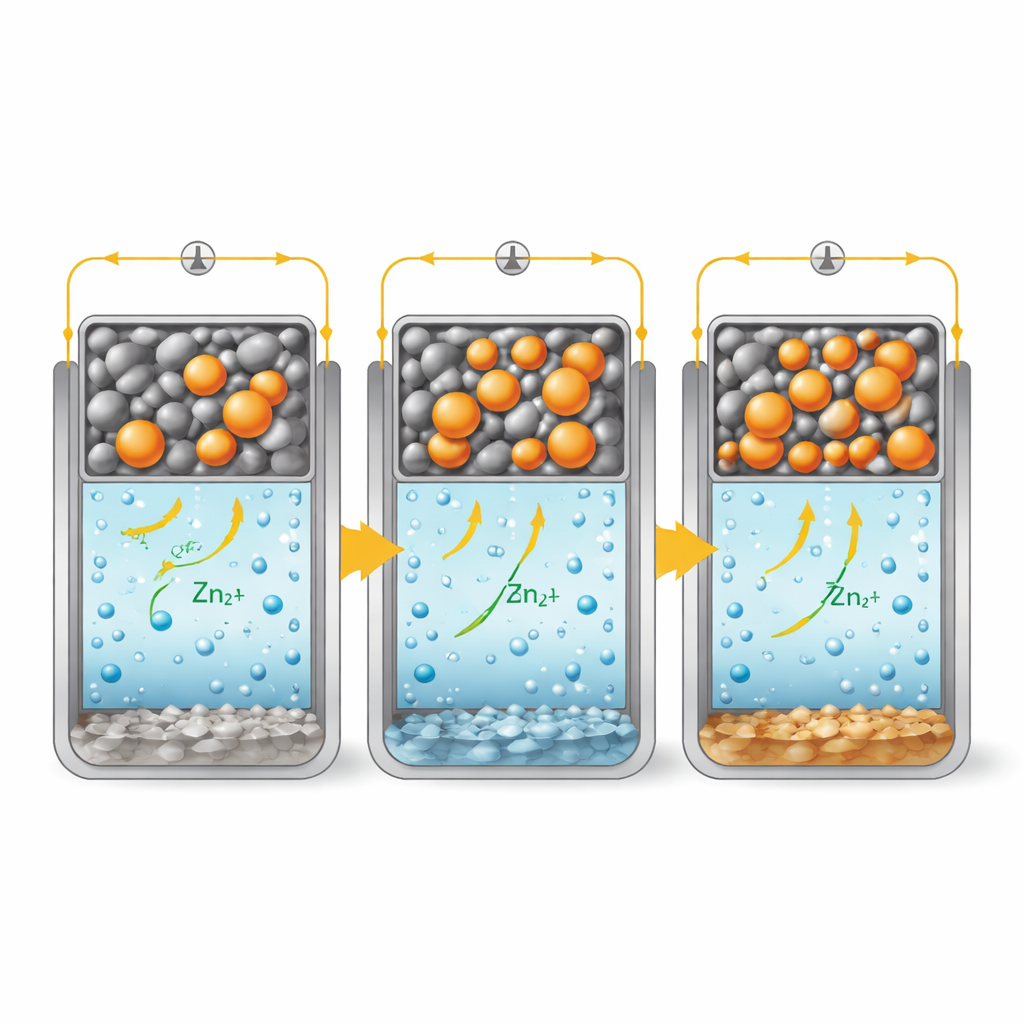
The researchers tackle this bottleneck by building two battery reactions into a single microscopic device instead of wiring two separate cells together. Their design pairs a zinc negative electrode with a specially engineered positive electrode made from a mixture of bismuth oxide and silver oxide. Both reactions run in the same alkaline, gel‑like electrolyte. During discharge, silver oxide reacts first, and then bismuth oxide follows in a second step, so the same piece of hardware delivers two successive bursts of stored energy without adding extra casings, separators, or dead space.
Turning Poor Conductors into Powerhouses
A key insight is how the first reaction prepares the way for the second. On its own, bismuth oxide can, in theory, move six electrons per unit during a charge–discharge cycle, but in practice it conducts electricity poorly, so much of that potential goes unused. Silver oxide is also not very conductive at the start—but when it reacts, it turns into metallic silver, an excellent conductor. In this micro‑battery, that newly formed silver spreads through the positive electrode and wraps around the bismuth oxide particles, creating a dense network of electrical pathways. This in‑place transformation slashes internal resistance and lets the bismuth oxide finally operate near its theoretical limit, boosting its usable capacity by more than a factor of ten compared with a similar device that lacks silver oxide.
Record Energy and Real‑World Demonstrations
Because the two reactions are stacked in the same tiny footprint and the bismuth oxide is so effectively activated, the resulting zinc–bismuth oxide–silver oxide micro‑battery reaches an areal capacity above 16,000 microamp‑hours per square centimeter and an areal energy density around 19,000 microwatt‑hours per square centimeter—more than double the combined output of separate zinc–silver oxide and zinc–bismuth oxide cells, and several times higher than many state‑of‑the‑art organic micro‑batteries. It can also deliver power densities on par with or better than micro‑supercapacitors, meaning it can handle fast charge–discharge demands. In demonstrations, a single device powered a digital timer continuously for more than two and a half days, and just two cells in series were enough to light 200 LEDs of different colors. Arrays of these flexible batteries also powered a commercial wireless motion sensor that sent real‑time data on toy cars and human movement to a mobile phone.
What This Means for Everyday Tech
In simple terms, this work shows that a cleverly staged, two‑step reaction can turn a small, safe, water‑based battery into an energy and power “overachiever” without making the device larger. By allowing one material to transform into a built‑in wiring network that supercharges the other, the authors push zinc micro‑batteries to record‑high energy densities while keeping them flexible and robust enough for wearables and embedded sensors. This strategy could help future smart patches, medical implants, and distributed wireless sensors run longer and more safely, bringing us closer to truly autonomous miniaturized electronics.
Citation: Xiu, X., Song, L., Li, M. et al. Dual reaction strategy for in-situ conductivity enhancement to enable high-performing aqueous zinc-based micro-batteries. Nat Commun 17, 2755 (2026). https://doi.org/10.1038/s41467-026-69317-z
Keywords: zinc microbatteries, wearable electronics, dual reaction energy storage, aqueous batteries, flexible sensors