Clear Sky Science · en
Distinct genetic profiles influence body mass index between infancy and adolescence
Why your child’s growth pattern matters
Parents often worry when a child seems too heavy or too skinny, especially these days when childhood obesity is on the rise. This study asks a deeper question: are the genes that influence a child’s body mass index (BMI) the same throughout childhood, or do different genes shape weight at different ages? By tracking thousands of children from age one to 18, the researchers show that our genetic makeup steers growth in changing ways across infancy, childhood, and adolescence — and that these patterns are linked to later risk of heart disease and diabetes.
Following thousands of children as they grow
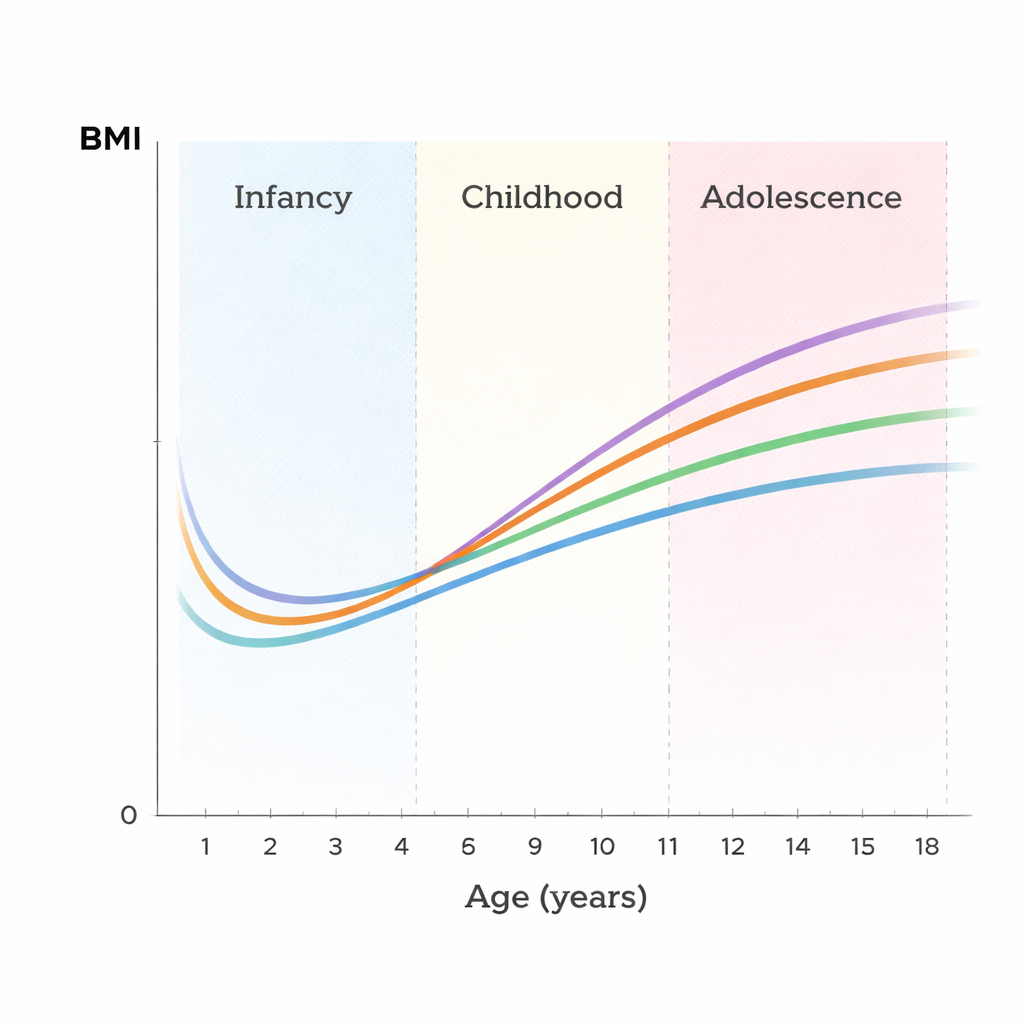
The team analysed data from more than 6,200 children in the long-running Avon Longitudinal Study of Parents and Children in the United Kingdom. Each child had, on average, ten BMI measurements taken between ages one and 18. Instead of looking at a single measurement, the researchers used a statistical approach called a random regression model to treat each child’s BMI as a smooth growth curve over time. This allowed them to separate genetic influences from other individual factors and to estimate how much of the variation in BMI at each age is explained by common genetic differences.
Genes that keep mattering versus genes that fade
The study found that common genetic variants explain roughly one quarter to one third of the differences in BMI between children at any given age, and this proportion stays fairly constant from early childhood through adolescence. However, the actual genetic influences change with age. Genes that help set BMI around age one hardly overlap with those that matter in the teenage years. For example, genes affecting BMI at age one and at age ten were, statistically speaking, almost uncorrelated, whereas genes at nearby ages (such as one and two) were highly correlated. This means that having “high-BMI genes” in infancy does not necessarily imply having the same kind of genetic risk as a teenager or adult.
Two main genetic growth patterns
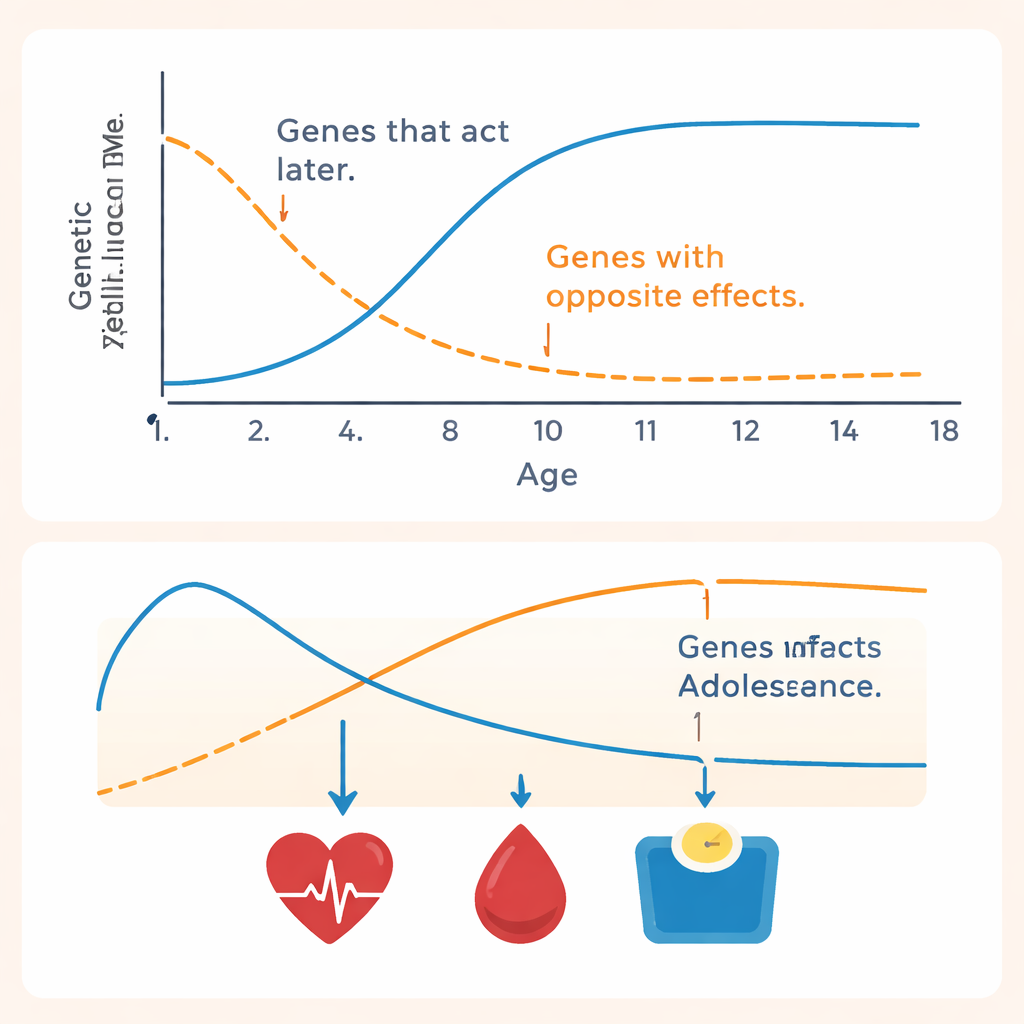
To understand these age-specific effects, the researchers looked for broad patterns in the genetic data. They discovered two main genetic “axes” that together explain almost all of the inherited variation in BMI growth. The first pattern starts weakly in early childhood, grows steadily stronger, and then plateaus around age ten. Children who score high on this pattern tend to have higher BMI throughout childhood, gain weight more quickly, and show less of the usual “dip” in body fat around age six. The second pattern works in an almost opposite way: its genetic effects are strong in infancy but weaken later, even flipping direction so that some variants that raise BMI in babies may be linked to lower BMI in late adolescence.
Links to adult weight and disease
The team also asked how these childhood patterns relate to known genes for adult obesity and to adult health. When they adjusted their models for a polygenic score built from adult BMI studies, much of the genetic variation in BMI at age 18 could be explained, but the genetic influence in early childhood changed very little. This supports the idea that infancy has its own distinctive genetic drivers. The researchers then searched the genome for variants shaping overall BMI level and rate of change in childhood, confirming the importance of several well-known obesity genes such as FTO, ADCY3 and OLFM4. They also found that faster BMI gain in childhood shares genetic roots with higher adult BMI, worse blood fat and sugar levels, and greater risk of type 2 diabetes and high blood pressure.
What this means for families and prevention
In simple terms, this work shows that there is no single, lifelong “obesity gene profile” acting from cradle to adulthood. Instead, different sets of genes are more important at different ages, with a strong and persistent genetic push emerging from later childhood onwards. At the same time, the rate at which BMI increases during childhood has its own genetic component and is tied to later cardio-metabolic risk. These findings support focusing on healthy growth patterns across the whole of childhood, not only at one critical age, and suggest that future gene-based tools for predicting obesity and related diseases may need to be tailored to specific stages of development.
Citation: Wang, G., McEwan, S., Zeng, J. et al. Distinct genetic profiles influence body mass index between infancy and adolescence. Nat Commun 17, 1594 (2026). https://doi.org/10.1038/s41467-026-69310-6
Keywords: childhood obesity, body mass index, genetics, growth trajectories, cardiometabolic risk