Clear Sky Science · en
Inbreeding and demography interact to impact the recovery of a bottlenecked crested ibis population
Why saving a few birds matters
Imagine trying to rescue a species when only seven birds are left in the wild. Any mating will be between close relatives, which can hurt survival, yet waiting to act could mean losing the species forever. This study uses the dramatic comeback of the crested ibis in East Asia to ask a simple but vital question: under what conditions can tiny, inbred populations not only survive, but flourish again? The answers help conservationists design smarter recovery and reintroduction plans for endangered animals worldwide.
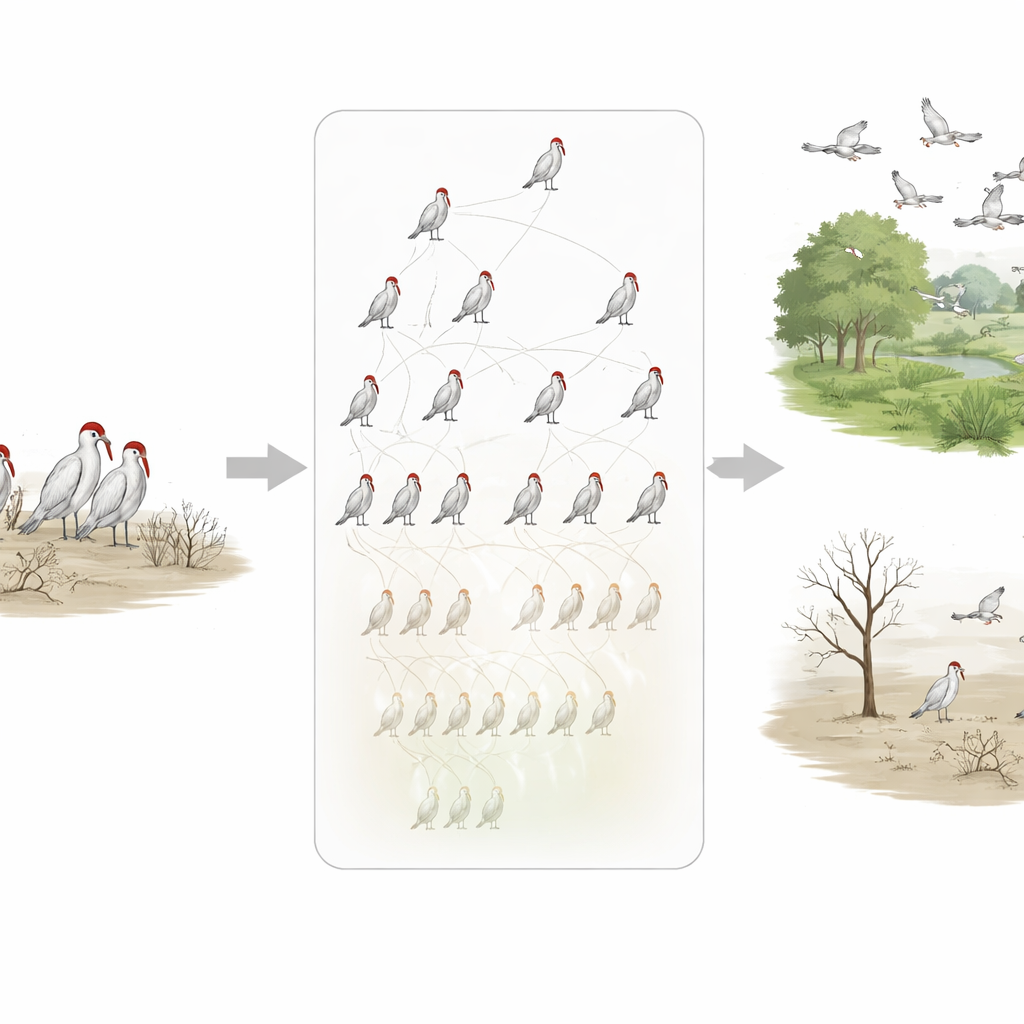
From seven birds to thousands
The crested ibis was once almost gone, pushed to the brink by habitat loss and pollution. In 1981, just two breeding pairs and three chicks were found in a Chinese village. Today, thanks to intensive protection and breeding, more than 9000 ibises live in the wild and in captivity. At first glance this looks like a lucky escape from extinction. The authors set out to test whether the ibis recovery was mostly good fortune or whether it followed predictable rules that could be understood and used elsewhere.
A virtual population in the computer
The team built an individual-based computer model that follows each bird through life: pairing, laying eggs, hatching, surviving as a chick, and living as an adult. The model also tracks how closely related each pair is and how that relatedness reduces hatching success when inbreeding is high. They fed the model with real data from wild and captive ibises, including clutch size, chick survival, and death rates at different ages. Starting the simulations with the original seven-bird bottleneck, they ran hundreds of virtual histories to see which populations recovered and which failed.
What the simulations revealed
The model’s predictions closely matched reality. In almost all simulations, the virtual ibis populations rebounded to around 9000 birds in roughly the same number of years as observed in the wild. Inbreeding did increase early on, as expected when there are few possible partners, but then levelled off once the population grew and close relatives became less likely to mate. Even when the authors varied key assumptions—such as how strongly inbreeding reduced hatching or how related the original founders were—the broad outcome stayed the same. This suggests that the ibis recovery was not a fluke, but a largely deterministic result of its life history and the strong conservation effort.
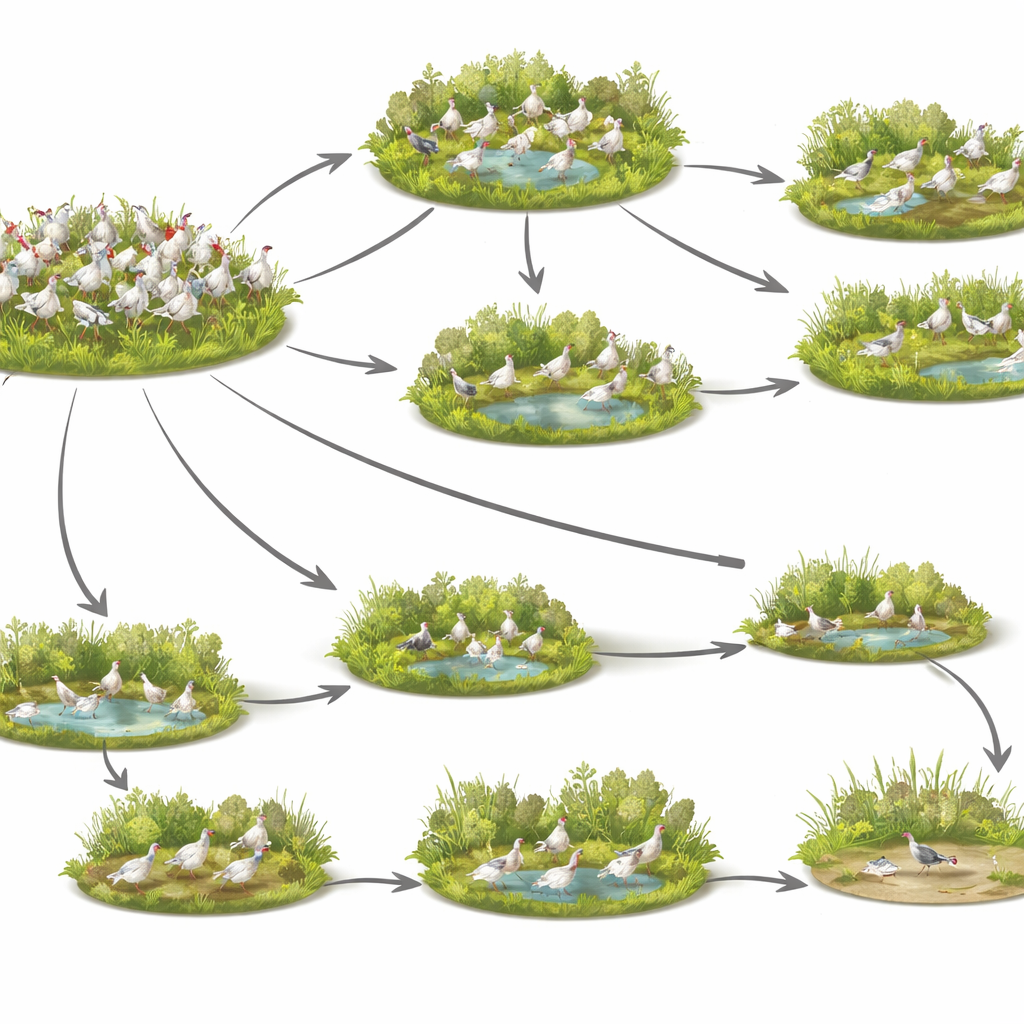
Different ways to start new populations
Many conservation projects try to spread risk by founding several new populations from a successful source. The study compared two idealized strategies. In the “firework” approach, managers release small groups directly from the original healthy population into several new sites, sometimes topping them up later with more birds from the source. In the “sequential” approach, each new site is founded from birds taken from the most recently established population, passing through a chain of repeated small bottlenecks. Simulations showed that as founder group size increased, both strategies improved, but the firework approach consistently produced faster growth, lower inbreeding, and fewer collapses. Sequential chains, especially with very small founder groups, accumulated inbreeding and were prone to sudden failures after a few steps.
Why species differences matter
To see how general these lessons are, the authors widened their model beyond ibises and explored combinations of clutch size, chick death rates, and adult death rates typical of many bird species. They found three broad patterns. Some species, like the crested ibis, have such favorable survival and reproduction that inbreeding has little effect on whether they recover—they are robust once given protection. Others have such poor survival or reproduction that they are unlikely to rebound even without inbreeding. In between lies a sensitive group for which inbreeding makes the difference between recovery and extinction. For these species, ignoring inbreeding when planning reintroductions could be disastrous.
What this means for saving species
In everyday terms, the study shows that “how many, how often, and from where” we move animals during rescues can strongly shape their future. The crested ibis succeeded because it is long-lived, can breed many times, and faced relatively mild genetic harm from inbreeding under present conditions. But not all species are so forgiving. The work suggests that conservation planners should pair genetic data with basic life-history information—such as how many young are produced and how long adults live—before choosing reintroduction strategies. Thoughtfully designed programs, especially those resembling the firework approach, can tilt the odds so that even very small, inbred populations have a real chance to recover.
Citation: Zheng, J., Rees-Baylis, E., Janzen, T. et al. Inbreeding and demography interact to impact the recovery of a bottlenecked crested ibis population. Nat Commun 17, 2785 (2026). https://doi.org/10.1038/s41467-026-69278-3
Keywords: species reintroduction, inbreeding depression, population bottleneck, crested ibis, conservation planning