Clear Sky Science · en
Solar-driven co-production of C2H4 and H2O2 from CO2 and H2O
Turning Sunlight and Waste Gases into Useful Chemicals
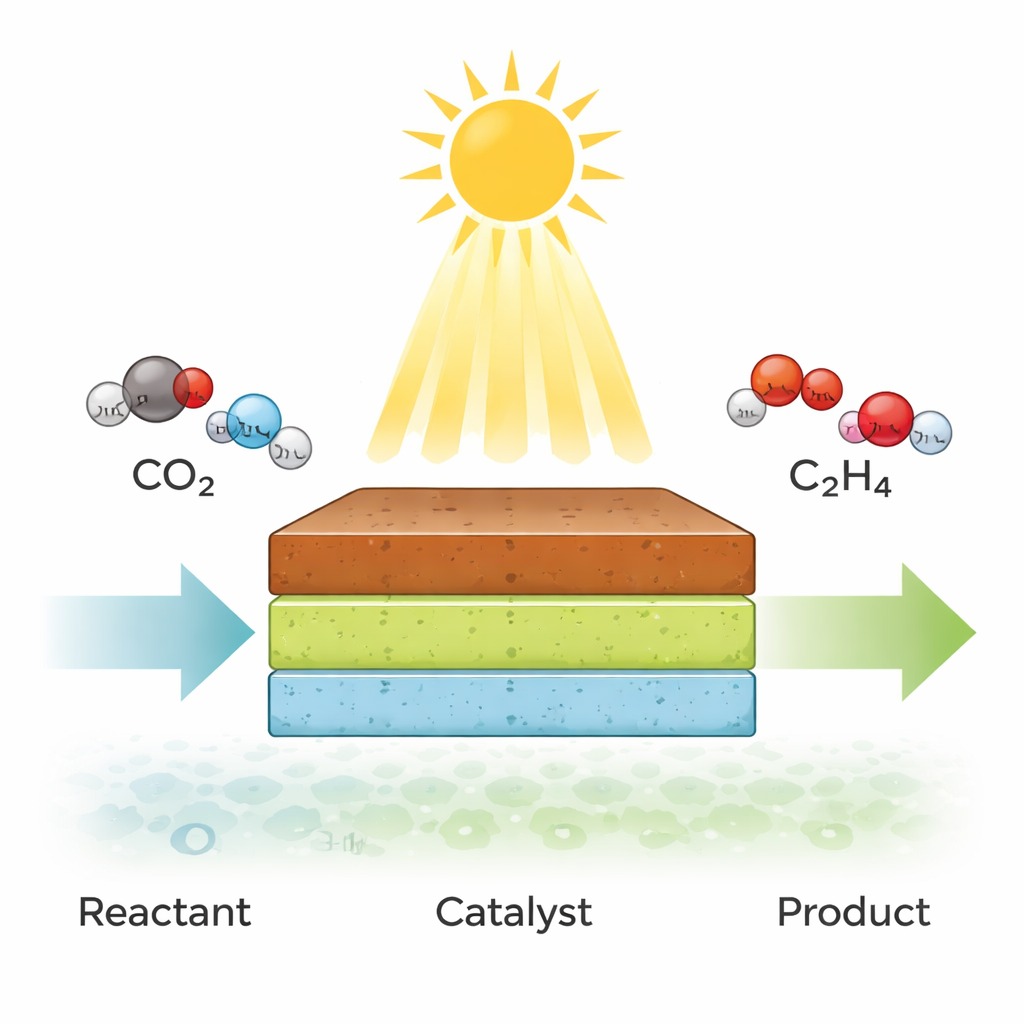
Ethylene and hydrogen peroxide are workhorse chemicals behind everyday products, from plastics and textiles to disinfectants and water-treatment agents. Today they are mostly made from fossil fuels in energy-hungry plants that emit large amounts of carbon dioxide (CO2). This study explores a different route: using sunlight to transform CO2 and water (H2O) directly into ethylene and hydrogen peroxide at the same time, offering a way to both recycle a greenhouse gas and reduce the environmental cost of chemical manufacturing.
Why Ethylene and Hydrogen Peroxide Matter
Ethylene is a cornerstone of the petrochemical industry; its derivatives make up roughly three-quarters of global petrochemical output. Hydrogen peroxide is a versatile oxidant widely used for disinfection, bleaching, and environmental cleanup. Being able to make both simultaneously from cheap, abundant CO2 and water using sunlight could dramatically improve the economics of solar-driven chemistry. Yet until now, systems that favor multi‑carbon fuels like ethylene tended to produce oxygen as a by-product, while those optimized for hydrogen peroxide mainly yielded simpler carbon products such as carbon monoxide or methane.
The Core Idea: Two Couplings at Once
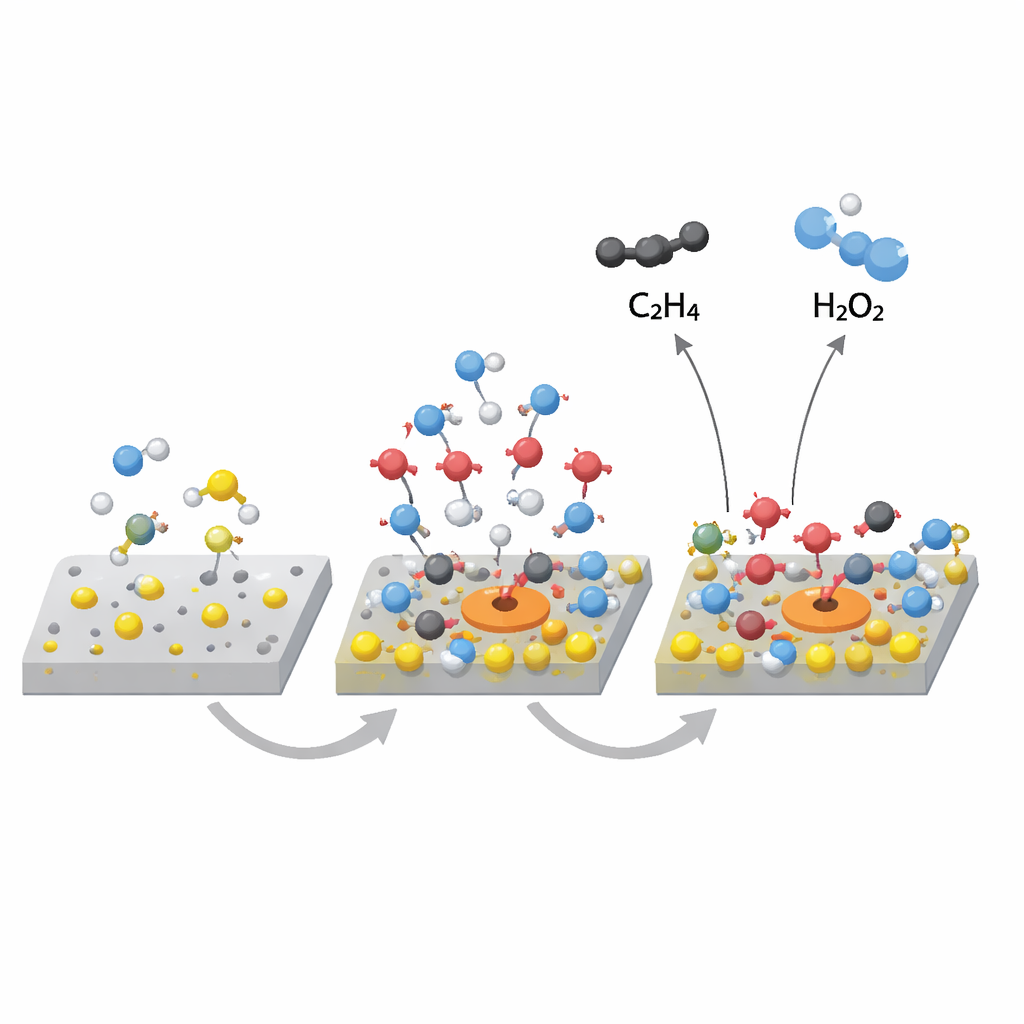
At the heart of the challenge is how reactive fragments behave on a catalyst surface. To build ethylene from CO2, two carbon-containing pieces must join, a process called carbon–carbon coupling. To form hydrogen peroxide, two oxygen‑containing fragments must pair. Most existing photocatalysts are tuned for just one type of coupling, so they either encourage carbon–carbon pairing (giving multi‑carbon fuels plus oxygen gas) or oxygen–oxygen pairing (giving hydrogen peroxide plus mainly single‑carbon products). The authors propose a dual strategy: place sites that encourage oxygen fragments to pair right next to sites that help carbon fragments join, while also preventing wasteful side reactions that turn valuable intermediates back into water or oxygen.
Building a Layered Light-Driven Catalyst
To realize this strategy, the team designed a carefully structured material made of three components: titanium dioxide (TiO2), silver bromide (AgBr), and tiny copper clusters (Cu). TiO2 is a well-known light‑absorbing mineral that generates electrons and holes when illuminated. AgBr particles are grown on the TiO2 surface, creating junctions that steer photo‑generated charges so that electrons preferentially move toward the AgBr. Copper nanoclusters are then anchored almost exclusively on the AgBr, forming closely spaced copper–silver sites. Advanced electron microscopy and X-ray techniques confirm that the copper atoms sit as small metallic clusters on the AgBr rather than scattering randomly on TiO2, creating well-defined regions where charge and reactive molecules accumulate.
How the Catalyst Steers the Reaction
When CO2 and a small amount of water vapor contact this catalyst under simulated sunlight, TiO2 absorbs light and drives electrons toward AgBr and then to the copper sites, while holes remain on the oxide side. AgBr helps generate a high surface coverage of carbon monoxide fragments, the building blocks for larger molecules. Copper plays two key roles: it strongly holds onto hydroxyl groups derived from water, preventing them from being over‑oxidized to oxygen gas or simply recombining with hydrogen to form water again; and it pulls nearby carbon monoxide fragments together, making it easier for pairs to join into two‑carbon intermediates that can become ethylene. Spectroscopic measurements and computer simulations show that on copper‑modified surfaces, these oxygen fragments are more likely to couple into hydrogen peroxide, while the carbon fragments are more likely to pair into ethylene.
Performance and Stability in Practice
Under laboratory conditions, the optimized version of the catalyst, labeled Cu(9)/AgBr(10)/TiO2, produces ethylene at a rate more than 300 times higher than bare TiO2 and also far outperforms AgBr‑modified TiO2 without copper. At the same time, it generates hydrogen peroxide at rates that rival or exceed other systems designed only for simpler carbon products. Tests over multiple days show that the activity remains high and that the crystal structure and nanoscale arrangement of copper and silver bromide stay intact. Control experiments confirm that both ethylene and hydrogen peroxide truly originate from the incoming CO2 and water, rather than from impurities.
What This Means for Cleaner Chemistry
To a non‑specialist, the main message is that by arranging common materials in a precise way, it is possible to use sunlight to convert waste CO2 and water into two valuable products at once: a fuel‑like building block (ethylene) and a green oxidant (hydrogen peroxide). The smart placement of copper on silver bromide, supported by titanium dioxide, lets the catalyst capture and guide fleeting reaction fragments instead of losing them as heat, oxygen gas, or water. While this is still a laboratory system, the work points toward future solar reactors that could both curb greenhouse emissions and supply important chemicals more sustainably.
Citation: Xie, Z., Luo, H., Gong, S. et al. Solar-driven co-production of C2H4 and H2O2 from CO2 and H2O. Nat Commun 17, 3057 (2026). https://doi.org/10.1038/s41467-026-69277-4
Keywords: solar photocatalysis, carbon dioxide conversion, ethylene production, hydrogen peroxide synthesis, Cu AgBr TiO2 catalyst