Clear Sky Science · en
Scalable solution soaking quenching technique unlocks efficient and durable wide bandgap perovskite solar modules
Turning Sunlight into Everyday Power
Imagine phone chargers woven into backpacks, solar windows in office towers, and greenhouse roofs that both grow food and make electricity. All of these visions rely on solar panels that are light, efficient, and cheap to manufacture over large areas. This paper presents a new way to treat next‑generation perovskite solar films so they work better and last longer when scaled up from tiny lab cells to real‑world modules.
The Promise and Problem of New Solar Materials
Perovskite solar cells have surged in performance over the past decade, now rivaling commercial silicon cells while using low‑cost solution processing. A special class called wide‑bandgap perovskites is particularly attractive for see‑through panels, portable electronics, and tandem devices that stack two solar cells for higher efficiency. But when researchers try to make these materials over large areas, the films often become patchy: crystal grains vary in size, chemical ingredients clump into richer and poorer regions, and defects form at surfaces and grain boundaries. These flaws waste energy as heat instead of electricity and make the devices degrade faster, especially under light and heat.
Borrowing a Trick from the Steel Factory
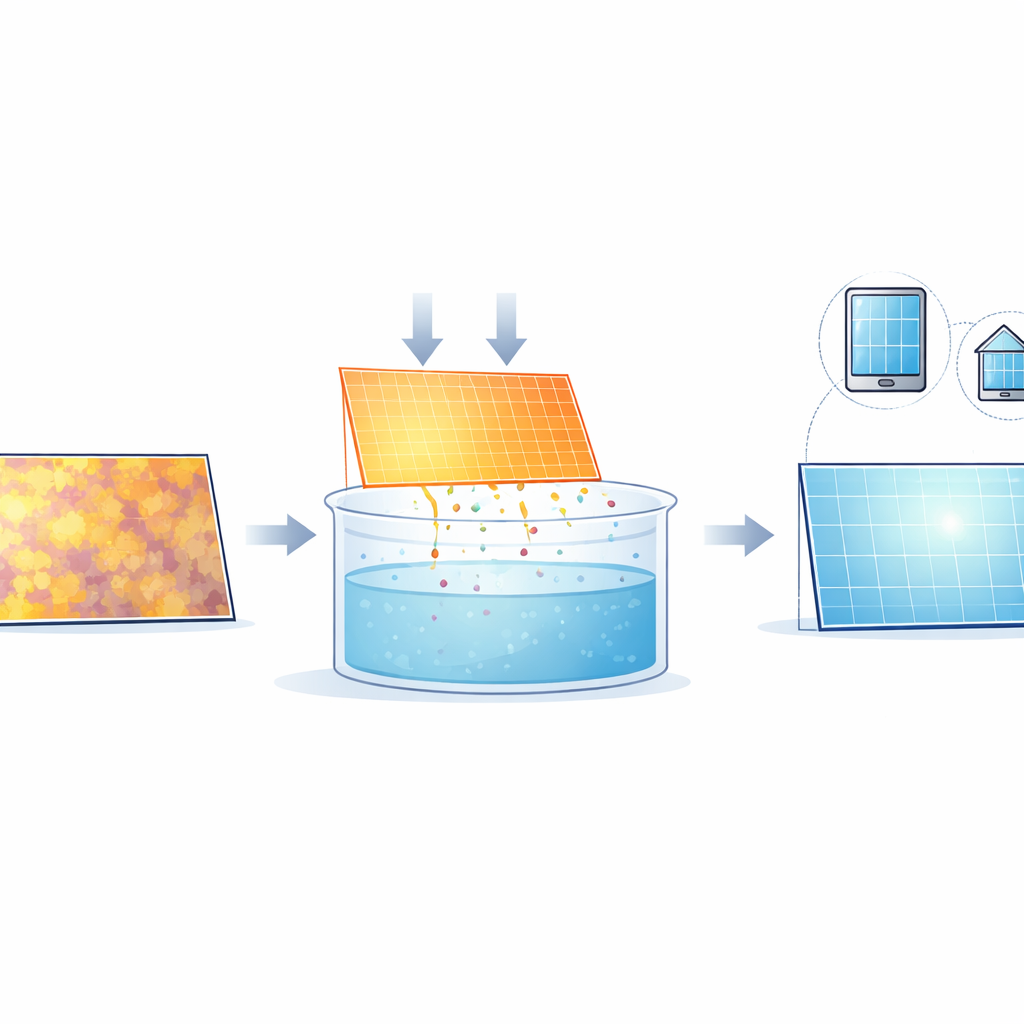
The authors borrow an idea from metalworking known as quenching—rapidly cooling hot metal in a bath to harden and toughen it—and apply it to perovskite films. After coating a hot wide‑bandgap perovskite layer over areas of about 30 square centimeters, they plunge it into a cold bath containing a dissolved salt of strontium iodide in isopropanol. This “solution‑soaking quenching” simultaneously cools the film and supplies helpful ions at its surface. A brief follow‑up heating step then lets these ions settle into the crystal lattice in a controlled way. The result is a kind of surface reconstruction: grains knit together more tightly, roughness drops by more than half, and the chemical makeup becomes much more even across the whole film.
Smoothing Out the Interior and Calming Wayward Ions
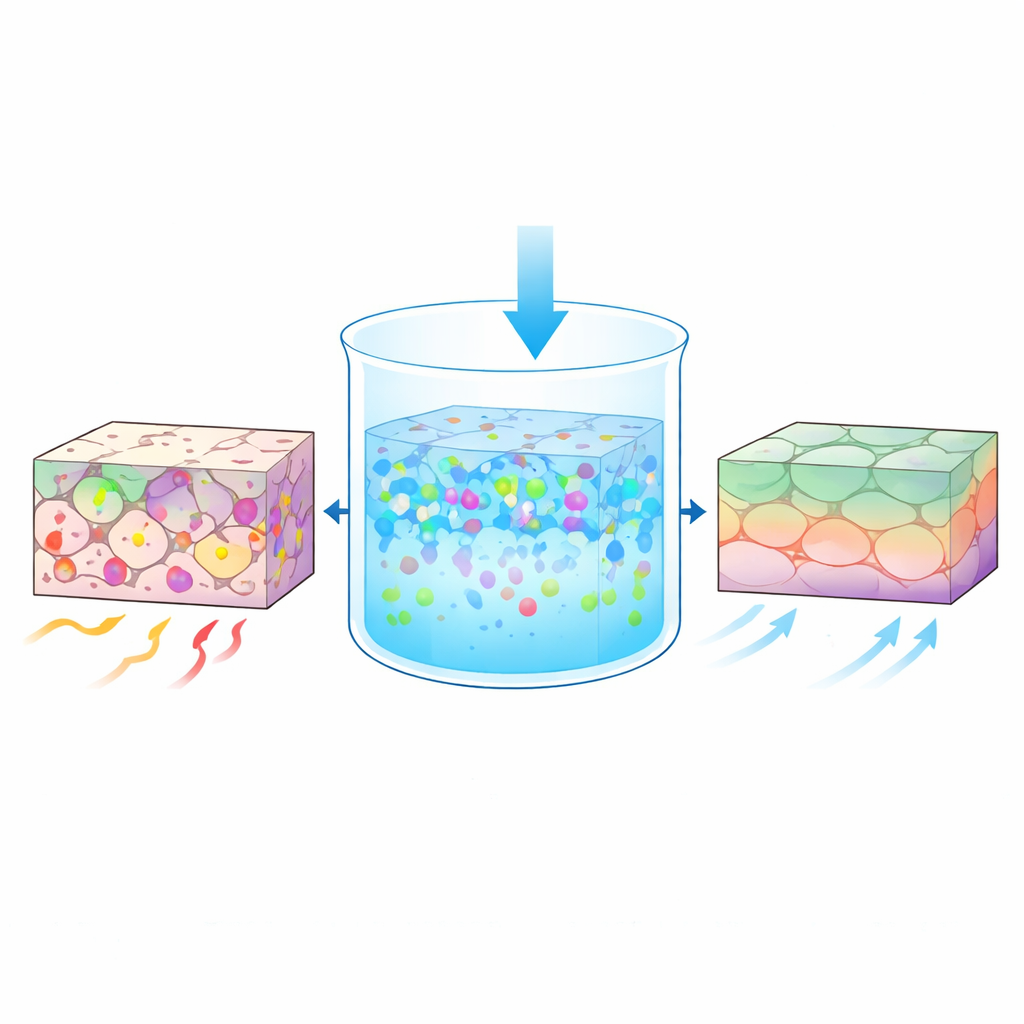
Looking deeper, the team shows that strontium ions from the bath seep from the surface into the bulk of the film, gently replacing some lead and binding more strongly to the halide ions (iodide and bromide) that set the material’s color and voltage. This gradient of strontium helps fill empty sites, reduces the tendency of iodide and bromide to separate into richer and poorer patches, and eases built‑in tensile stress that can stretch the lattice and open pathways for ion motion. Optical measurements reveal that light emission becomes brighter and more uniform, and it stays sharp even as the film is warmed or illuminated for long periods. In other words, the treated perovskites are less prone to the slow, light‑induced rearrangements that typically plague wide‑bandgap compositions.
From Better Grains to Better Solar Panels
These microscopic improvements show up clearly at the device level. Small perovskite cells made with this quenching step reach efficiencies above 22% without using the thermally fragile methylammonium component, and they move charges across the film more than five times faster than untreated devices. When the method is applied to mini‑modules with active areas just over 10 square centimeters, the efficiency climbs to about 20%, with almost no drop compared to tiny test cells—a major hurdle in bringing perovskites to market. Electrical resistance inside the modules falls dramatically, and the fill factor, a key measure of how effectively a solar cell delivers power, rises to roughly 80%, unusually high for large‑area perovskite modules.
Ready for Windows, Farms, and Gadgets
Because the treatment can be applied after coating and works for several perovskite recipes, it fits naturally into scalable manufacturing. The authors demonstrate semi‑transparent modules suitable for building windows, solar glazing that can power fans and portable chargers, and greenhouse‑style panels that let through plant‑friendly red light while still generating electricity. The quenched modules keep more than 96% of their starting performance after over 1000 hours of continuous operation at room temperature, and retain most of their power after hundreds of hours at elevated temperatures. In simple terms, the study shows that a quick cold bath can turn fragile, uneven perovskite films into tough, uniform solar modules that come much closer to the demands of everyday use.
Citation: Fang, Y., Sun, J., Tan, Y. et al. Scalable solution soaking quenching technique unlocks efficient and durable wide bandgap perovskite solar modules. Nat Commun 17, 2824 (2026). https://doi.org/10.1038/s41467-026-69264-9
Keywords: perovskite solar modules, wide bandgap photovoltaics, solution soaking quenching, large area solar manufacturing, tandem and semitransparent solar cells