Clear Sky Science · en
Serotonin modulates nucleus accumbens circuits to suppress aggression in mice
Why a brain chemical of calm matters
Many of us know someone whose temper seems to flare too easily. Doctors have long suspected that serotonin, a brain chemical often linked to mood, can help keep aggression in check. Yet it has been unclear exactly how and where in the brain serotonin steps in to cool an attack once it starts. This study in mice pinpoints a specific circuit in a reward center of the brain that serotonin uses to shorten aggressive outbursts, offering clues that could one day inform more precise treatments for harmful aggression in people.
A closer look at anger in the brain
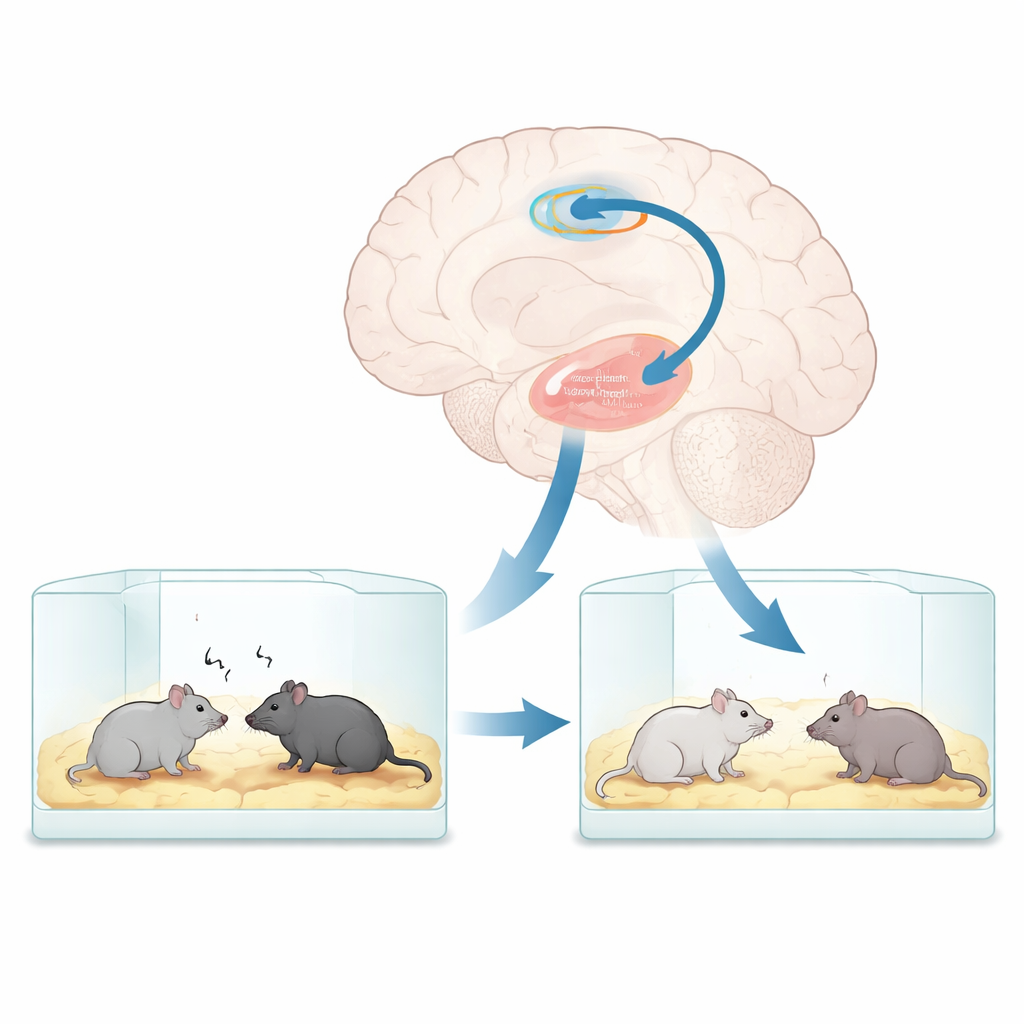
The researchers focused on the nucleus accumbens, a deep brain region best known for processing pleasure and motivation. Previous work showed that both serotonin and another chemical, dopamine, flood this area during social encounters. Using tiny light-based sensors in freely moving mice, the team measured real-time changes in both chemicals during a classic "resident-intruder" test, where a mouse defends its home cage from a weaker newcomer. They discovered that serotonin levels stayed low as the resident approached but rose steadily during the attack, peaking just as the aggression ended. The faster this serotonin ramped up, the shorter the attack.
Serotonin, not dopamine, ends the fight
At the same time, dopamine also increased, but with a different timing: it spiked during the approach and at attack onset, and its levels were only weakly linked to how long attacks lasted. To see which chemical actually changes behavior, the scientists used optogenetics, a technique that activates specific brain connections with light. Turning on dopamine-releasing fibers in the nucleus accumbens did not alter how often or how long the mice attacked. In contrast, boosting serotonin release in this region left the number of attacks unchanged but made each aggressive episode significantly shorter, without making the animals sluggish or less social overall. These experiments show that serotonin in the nucleus accumbens is sufficient to curb ongoing aggression, especially by helping terminate an attack.
The key cells that drive and stop attacks
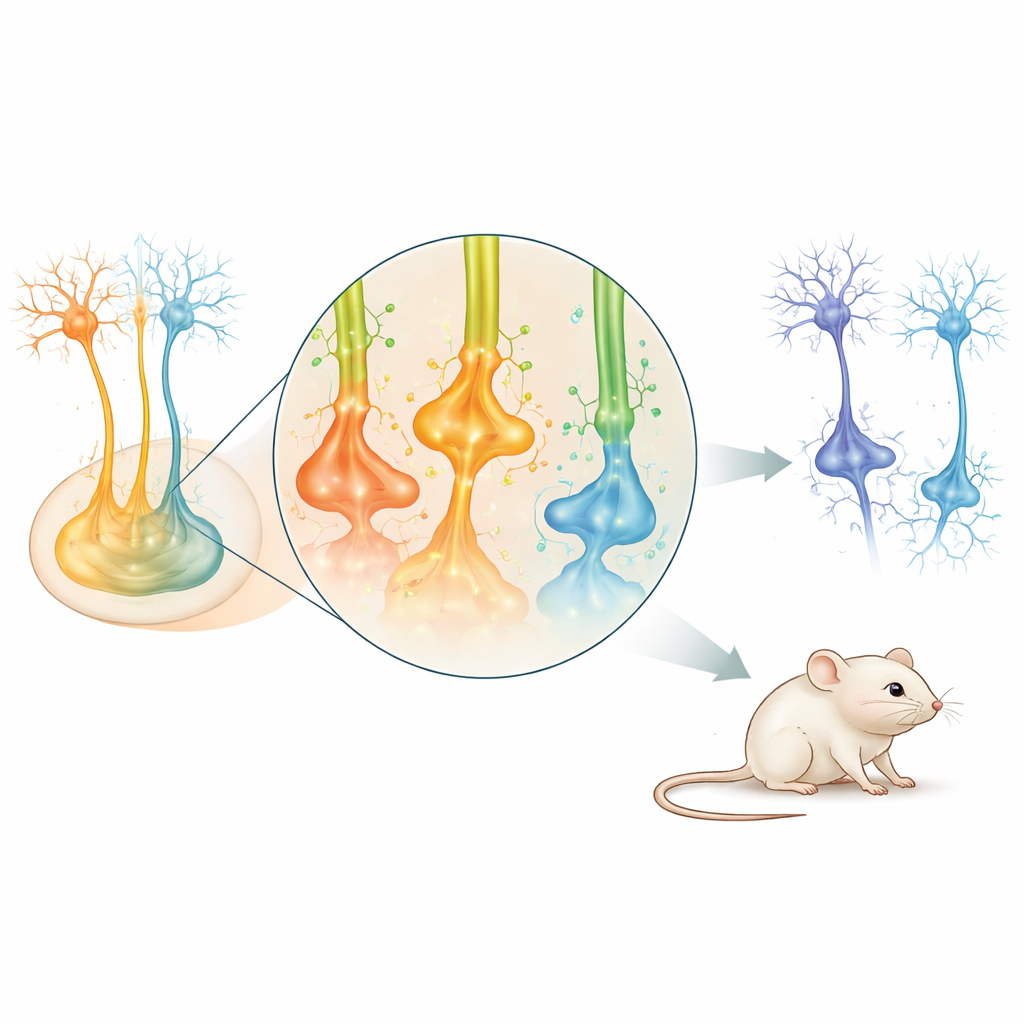
The nucleus accumbens is packed with two main types of nerve cells called medium spiny neurons, which can be thought of as output switches. One group, known as D1 cells, generally promotes action; the other, D2 cells, tends to oppose it. Using miniaturized microscopes mounted on the animals’ heads, the team recorded the activity of hundreds of identified D1 and D2 cells during aggressive encounters. Both cell types became more active during attacks, but D1 cells were more strongly engaged, and only D1 activity tracked closely with how long each aggressive episode lasted. Silencing D1 cells with light-driven inhibitors shortened attacks, while silencing D2 cells had little effect, indicating that D1 cells are the main drivers that sustain aggression.
How serotonin selectively quiets aggression cells
Next, the scientists asked whether serotonin damps down aggression by acting directly on these D1 cells. They combined their microscope recordings with precise stimulation of serotonin fibers that project from a region called the dorsal raphe to the nucleus accumbens. When they raised serotonin levels with the drug MDMA, D1 cells fired less, whereas D2 cells were largely unaffected. More targeted light activation of local serotonin inputs confirmed this pattern: serotonin strongly inhibited D1 cells but left D2 cells mostly unchanged. Importantly, D1 cells that were most active during attacks turned out to be the ones most strongly shut down by serotonin, revealing a selective brake applied to the very neurons that sustain aggression.
What this means for controlling harmful aggression
Taken together, the findings show that serotonin released into the nucleus accumbens does not prevent fights from starting, but instead helps bring them to an end by switching off a specific group of aggression-promoting D1 neurons. Dopamine in the same region rises during aggression but lacks this targeted, calming effect. By mapping this finely tuned circuit, the study helps explain why broadly boosting serotonin in the brain can have mixed results and underscores the need for treatments that act on the right pathways at the right time. Although this work was done in mice, understanding how serotonin shapes aggressive behavior at the circuit level may eventually guide safer, more focused therapies for people whose aggression causes serious problems at home, at school, or in clinical settings.
Citation: Zhang, Z., Touponse, G.C., Alderman, P.J. et al. Serotonin modulates nucleus accumbens circuits to suppress aggression in mice. Nat Commun 17, 2769 (2026). https://doi.org/10.1038/s41467-026-69254-x
Keywords: serotonin, aggression, nucleus accumbens, dopamine, mouse behavior