Clear Sky Science · en
Discovery of tunable and soluble organic emitters for solid-state lasers with a self-driving laboratory
Lighting Up the Future of Tiny Lasers
From wearable medical sensors to lab-on-a-chip diagnostics, many emerging technologies need tiny, low-cost lasers that can be printed like ink rather than built in clean rooms. This study shows how combining smart chemistry with an automated “self-driving” laboratory can rapidly discover new light‑emitting organic molecules that are both easily processed from solution and capable of producing laser-like light across colors from violet to the near‑infrared.
Why New Light-Making Molecules Are Needed
Organic solid-state lasers are attractive because they can emit extremely pure colors, can be tuned across the spectrum, and can be made from carbon-based materials similar to those in OLED displays. Yet one stubborn problem has slowed their spread: many of the best-performing molecules are bulky and dissolve poorly in common solvents. That makes them hard to process into thin films using scalable techniques like spin coating or printing, often forcing researchers to rely on slow, vacuum-based methods. The authors set out to design a new family of molecules that keep strong laser performance while dissolving well, enabling high-quality films to be made quickly and cheaply.
A Robot Chemist Searches Chemical Space
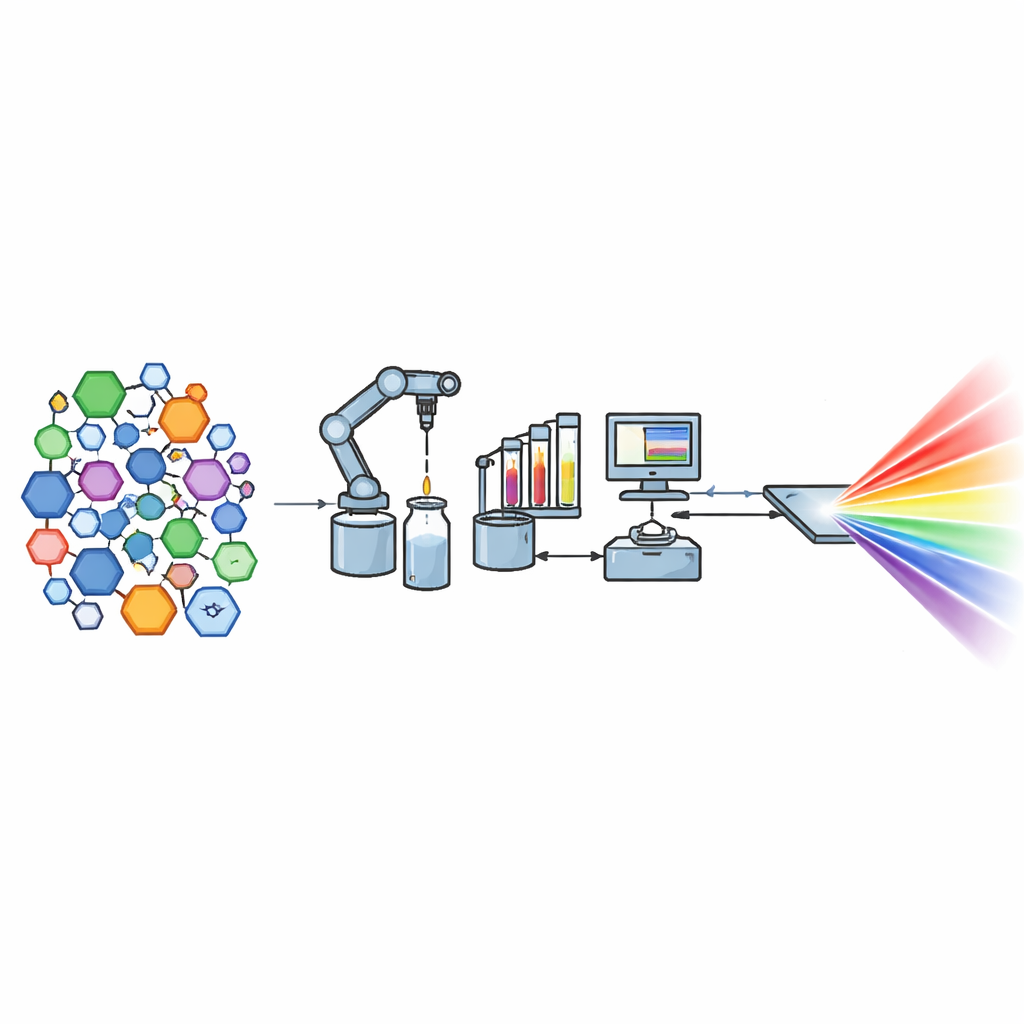
The team built their search around a modular “A–B–A” molecular design. The outer “A” units are fixed light-emitting building blocks based on fluorene, known for rigidity and bright fluorescence. The central “B” unit is a plug-in fragment that can be swapped to tune color and performance. Using computer calculations rooted in quantum chemistry, they first screened a virtual library of 252 possible B units. Candidates were ranked by how strongly they absorb light and how likely they are to emit it at longer wavelengths, a prerequisite for reaching warm colors and near‑infrared. From this virtual triage, 51 promising molecules were selected for real-world testing.
These 51 candidates were then handed off to a Level 3 self-driving lab: a network of automated instruments for weighing solids, running reactions, purifying products, and measuring optical properties with minimal human intervention. The system could synthesize each A–B–A molecule in a single step, clean it up, then record how efficiently it fluoresced and how suitable it might be for lasing, quantified by an “emission gain cross-section” that combines brightness and speed of emission. This closed loop allowed the researchers to explore chemical space far faster and more systematically than manual experimentation.
Design Tricks for Tuning Color and Brightness
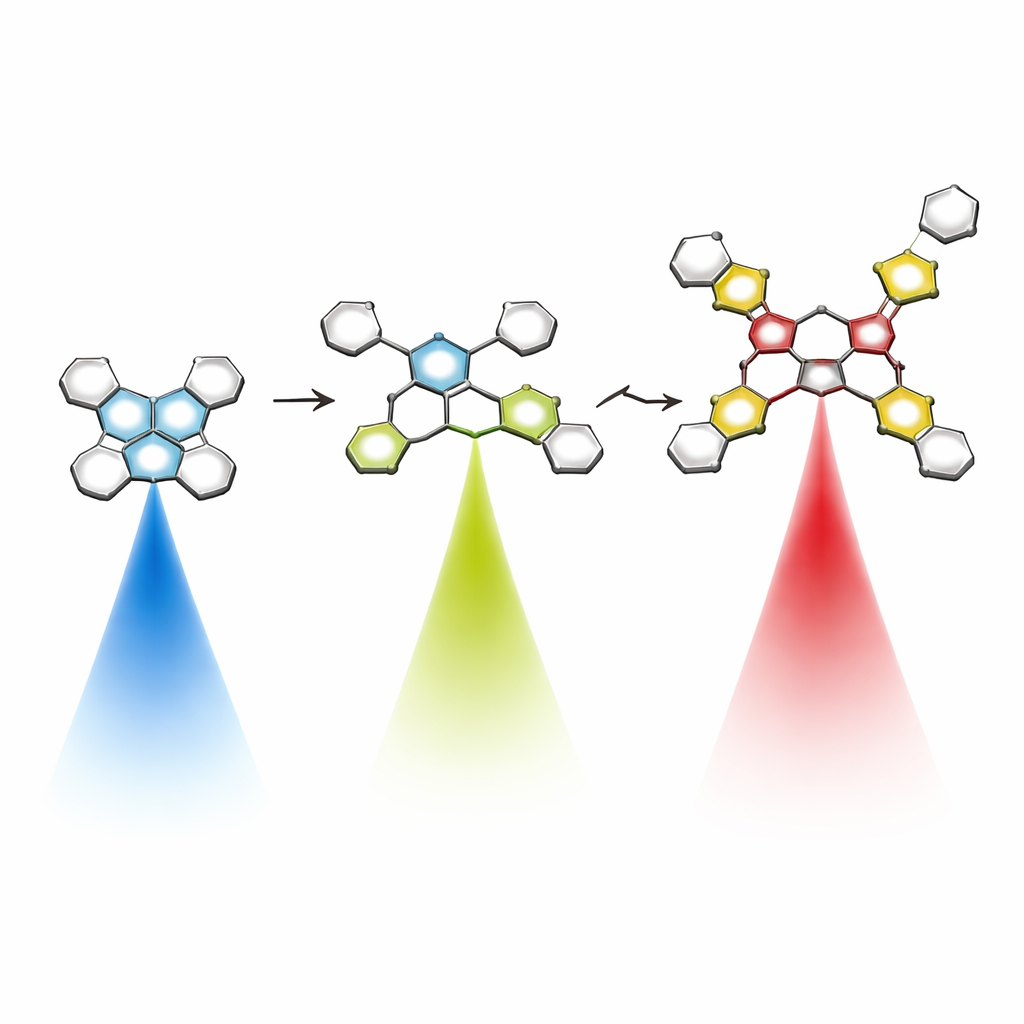
The scientists first examined simple hydrocarbon versions of their molecules, which mostly glowed in violet and blue. They then introduced nitrogen, sulfur, oxygen, and combinations of these “heteroatoms” into the B fragment. This changed how electrons move within the molecule and slightly pushed colors toward green and cyan, but large red shifts remained elusive. A breakthrough came with two richer design families. In the first, the team used a ring system called diketopyrrolopyrrole as the central B unit and attached thiophene rings and fluorene ends. One standout molecule, labeled AM03, shifted emission deep into the red and near‑infrared while maintaining strong gain, a rare combination.
The second family was built from benzodiazole-based fragments, long used for green-yellow emitters. Here, the researchers systematically permuted which heteroatoms sit in the ring (for example, swapping sulfur for oxygen, nitrogen, or selenium), added fluorine atoms, and coupled extra thiophene rings. Each change nudged the light color and efficiency in predictable ways: fluorine generally blue-shifted emission by tightening the energy gap, while added thiophene rings extended the conjugated backbone and drove strong red shifts. One benzoselenadiazole derivative, BD12, coupled to thiophene and fluorene units, pushed emission beyond 700 nanometers, entering the technologically important near‑infrared region.
From Solutions to Working Thin Films
To test whether these new molecules could function in real devices, the team embedded AM03 and BD12 into thin films of a standard host material that helps funnel energy into the guest emitters. Both molecules remained brightly emissive in the solid state, and AM03 in particular showed exceptionally efficient light amplification. When pumped with short laser pulses, thin films containing just 1% AM03 exhibited amplified spontaneous emission—a step toward lasing—at around 720 nanometers with a very low threshold energy, outperforming previous red-emitting benchmarks. BD12 also produced near‑infrared emission, though with a higher threshold, indicating that additional losses like molecular aggregation still need to be controlled.
What This Means for Everyday Technology
Overall, the study demonstrates that a robot-assisted, computation-guided approach can uncover families of organic molecules that are both easy to process and capable of producing tunable, laser-like light from blue to the near‑infrared. For a lay audience, the key message is that we are learning how to “dial in” color and performance by rearranging molecular building blocks, much like swapping parts in a construction kit, and we can let automated labs do much of the trial‑and‑error work. These advances bring us closer to printable, inexpensive lasers that could be embedded in medical diagnostics, environmental sensors, flexible displays, and compact optical communications, shrinking sophisticated photonic tools into everyday devices.
Citation: Park, H.S., Mazaheri, M., Choi, C. et al. Discovery of tunable and soluble organic emitters for solid-state lasers with a self-driving laboratory. Nat Commun 17, 2920 (2026). https://doi.org/10.1038/s41467-026-69233-2
Keywords: organic lasers, self-driving laboratory, light-emitting molecules, near-infrared emission, materials discovery