Clear Sky Science · en
Injectable hydrogel bioelectrostimulator for wireless deep brain neuromodulation
A softer way to reach deep into the brain
For people with conditions like Parkinson’s disease, deep brain stimulation can ease symptoms but currently relies on stiff metal electrodes and implanted batteries. This study explores a gentler option: a soft, injectable material that can be wired from outside the head without surgery every time, opening the door to less invasive treatment for brain disorders. 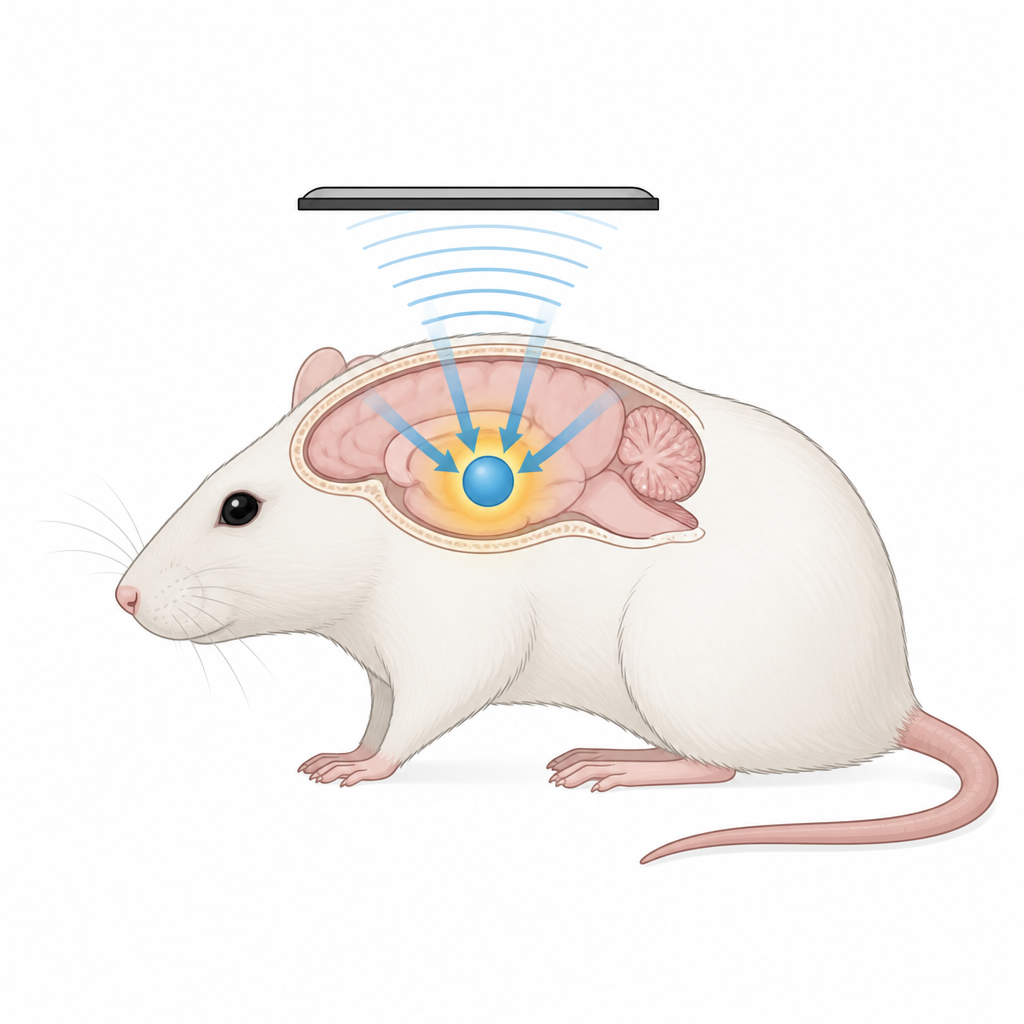
A tiny soft implant instead of rigid hardware
The researchers created a special gel that starts as a liquid and turns into a soft, electrically conductive solid once injected into brain tissue. The ingredients react with natural sugar in the brain to form a flexible network that is about as soft as the brain itself. Because it is squishy and water rich, this hydrogel fits closely with surrounding cells instead of scraping or tearing them like rigid metal parts can, and tests showed low immune reaction and good long term compatibility in rats.
How outside signals find their way to the deep brain
Instead of threading wires through the skull, the team used a flat pad placed on the scalp to send high frequency electrical pulses through the head. On their own, these pulses spread out and stay too weak to strongly affect any one spot. The hydrogel changes that. Thanks to its much higher conductivity than normal brain tissue, it gathers electric charges at its surface and concentrates the field right where it sits. Computer simulations and ex vivo measurements showed that current density rises sharply at the gel–tissue interface while remaining low elsewhere, and overall energy absorption stayed within accepted safety limits.
From concentrated fields to living nerve signals
To find out whether this focused energy truly affects nerve cells, the scientists first tested cultured human like nerve cells exposed to signals routed through the gel. Only when both the gel and the external stimulation were present did cells show large, reversible bursts of calcium activity, a hallmark of nerve firing, while cell growth and survival remained intact. In anesthetized rats, the hydrogel was injected into a motor control hub called the subthalamic nucleus, and activity was recorded in connected brain regions. With stimulation, neurons near the target showed increased activity, downstream structures became more active, and motor cortex neurons became less synchronized, a pattern similar to that produced by clinical deep brain stimulation.
Helping Parkinsonian rats move and protecting their neurons
The most striking test came in rats given a standard toxin that produces Parkinson’s like movement problems and loss of dopamine producing neurons. Animals received daily wireless stimulation through the scalp pad after a single deep injection of the hydrogel. Over four weeks, only the group with both gel and stimulation showed steady gains in walking distance, speed, and time spent in active motion, approaching the behavior of healthy rats. Brain tissue analysis revealed that these animals preserved more dopamine neurons, showed stronger signs of supportive astrocyte activity and growth factors, and maintained healthier gray and white matter structure. Functional MRI, made possible because the gel does not distort images like metal, showed that treated rats also regained more balanced communication among motor related brain regions. 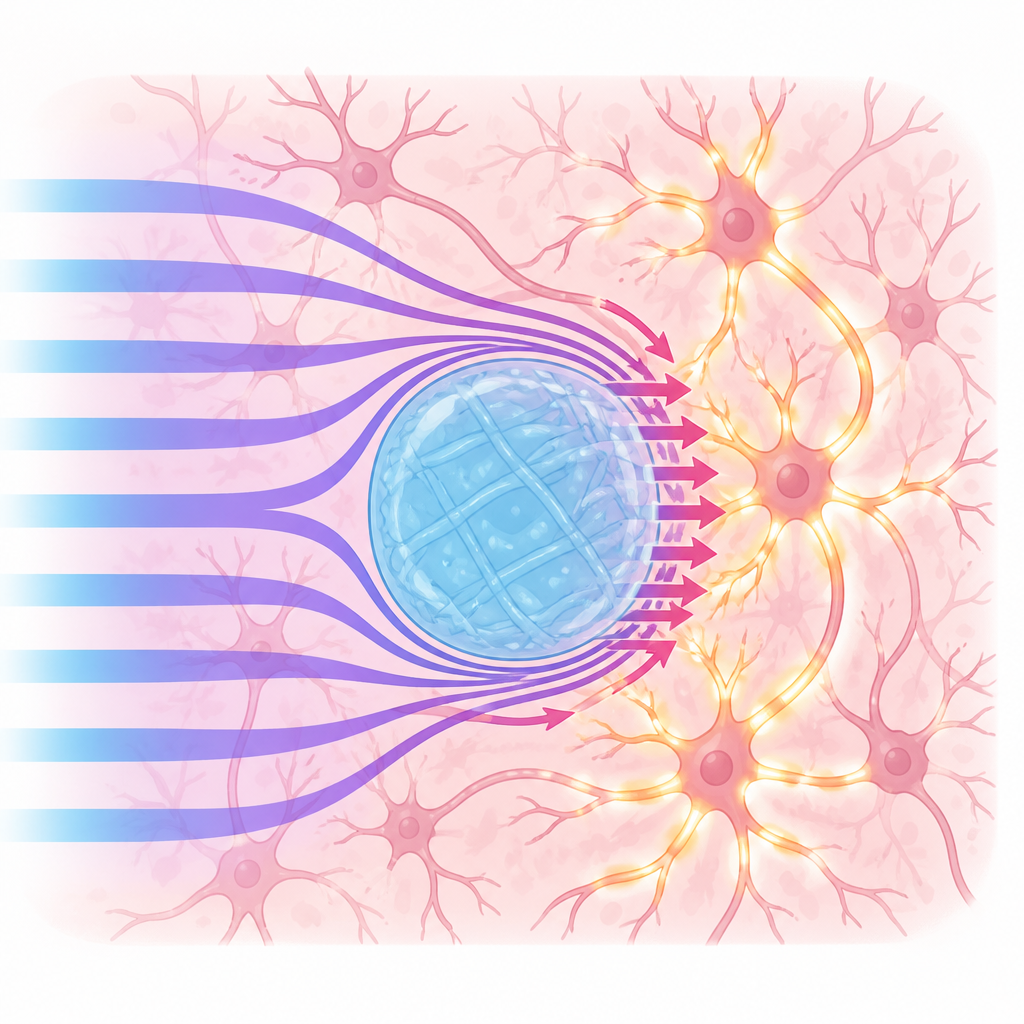
What this could mean for future brain therapies
In simple terms, this work shows that a tiny blob of soft, conductive gel can act like a hidden antenna inside the brain, gathering gentle electrical signals sent from outside the head and turning them into focused nerve stimulation. In rats, this wireless approach eased movement problems and helped protect vulnerable brain cells without the bulk and rigidity of traditional hardware. While much testing remains before use in people, the concept points toward deep brain treatments that are less invasive, more compatible with imaging, and potentially easier to adjust over time.
Citation: Yang, M., Liu, W., Chen, P. et al. Injectable hydrogel bioelectrostimulator for wireless deep brain neuromodulation. Nat Commun 17, 4526 (2026). https://doi.org/10.1038/s41467-026-69226-1
Keywords: deep brain stimulation, conductive hydrogel, wireless neuromodulation, Parkinson’s disease, brain implants