Clear Sky Science · en
Exponential crystallization in corals
Why coral skeletons matter to all of us
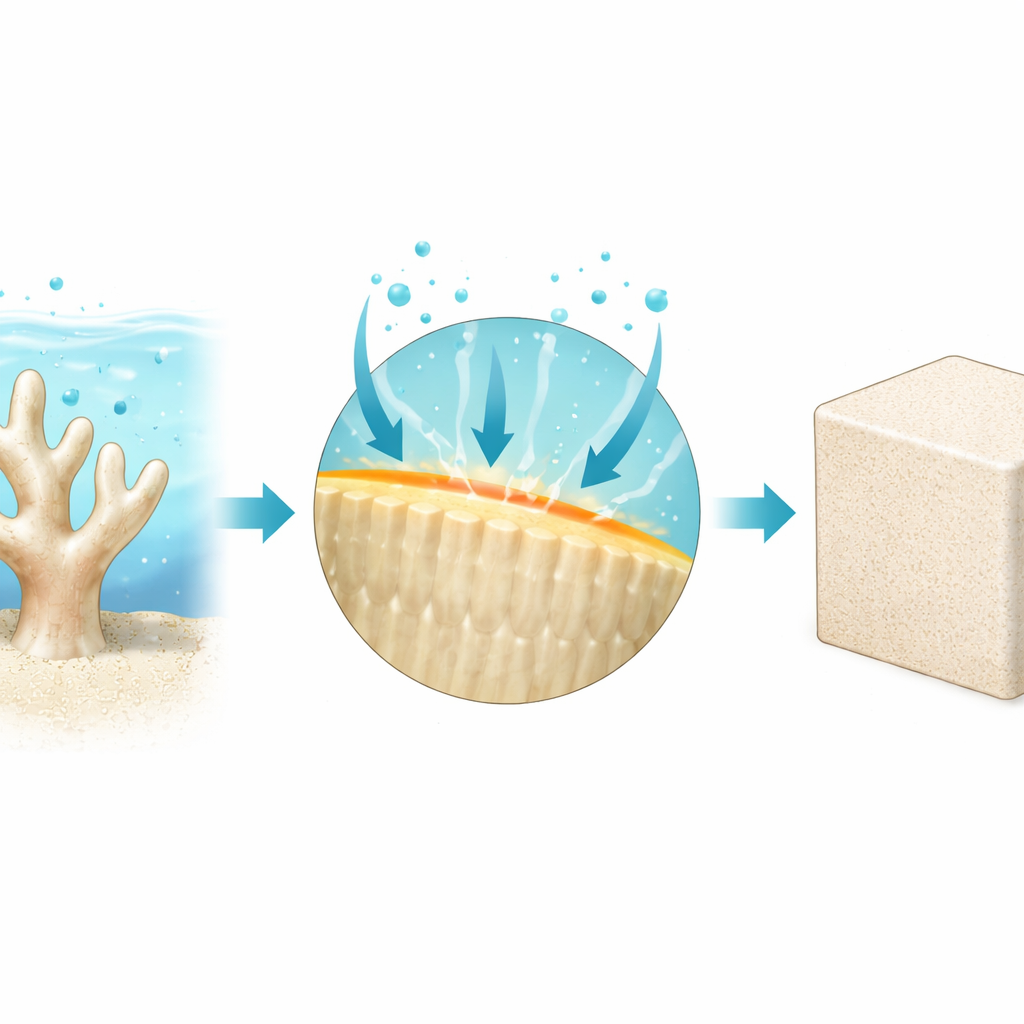
Coral reefs are the rocky cities of the sea, built over centuries by tiny animals that slowly lay down mineral skeletons. These structures protect coastlines, support fisheries, and host an enormous variety of marine life. Yet we still do not fully understand how corals turn dissolved ingredients in seawater into solid rock, especially under the stress of a changing, more acidic ocean. This study peeks into the first few minutes of skeleton formation and discovers that corals build their mineral framework much faster and more simply than scientists had realized.
Looking close at the growing edge
The researchers focused on a common reef-building coral called Stylophora pistillata, grown in aquaria at today’s normal seawater acidity and at a more acidic level expected in future oceans. They examined the very tips of the coral skeletons, where growth is fastest. Using a specialized X-ray microscope, they could map what minerals were present at the surface and just below it, with a resolution of about fifty billionths of a meter. This approach, called myriad mapping, lets them color-code different mineral forms of calcium carbonate in each tiny pixel and see how these forms change with distance from the fresh growing edge.
Hidden stepping stones in coral rock
Instead of a single mineral turning directly into hard coral rock, the team found a mixture of “stepping stone” phases near the surface. These include several amorphous (disordered) and crystalline forms of calcium carbonate that eventually convert into aragonite, the stable mineral making up nearly all mature coral skeletons. Surprisingly, the main precursor was not the highly unstable, watery form previously thought to dominate, but a crystalline phase called calcium carbonate hemihydrate. At the moment of deposition, the skeleton is already more than eighty percent aragonite, with the remaining few percent divided among four different, short‑lived precursors.
A fast, simple countdown from soft to hard
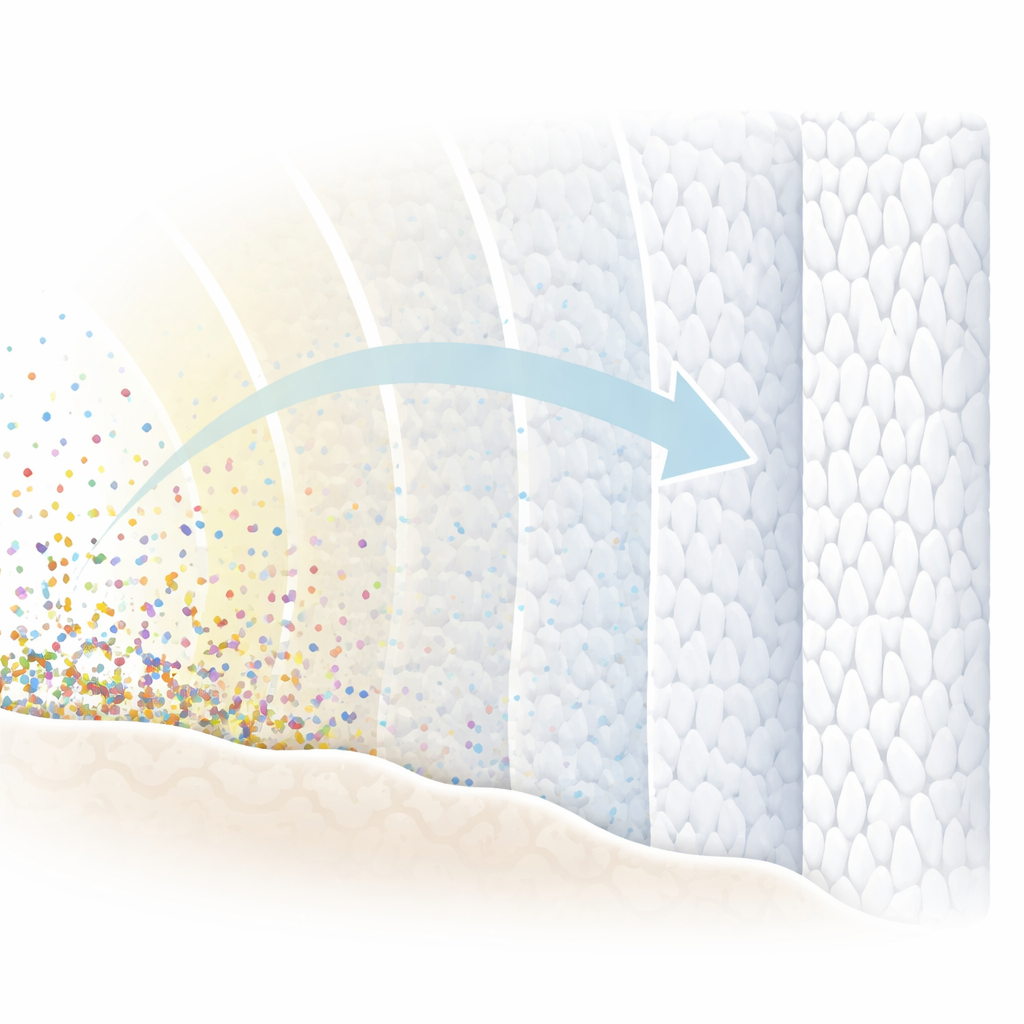
By measuring how the abundance of each precursor dropped with distance from the edge, and combining this with independent measurements of how quickly the skeleton grows outward, the authors could translate space into time. They found that all precursor phases—despite their different chemistry—disappear following the same exponential law, with a characteristic “lifetime” of only about five minutes and a decay length of roughly seven‑tenths of a micrometer. In other words, within just a few minutes and over a distance thinner than a human hair, almost all of the transient material has transformed into solid aragonite. This simple exponential behavior rules out more complicated growth scenarios that would leave an S‑shaped or diffusion‑controlled pattern instead.
Replaying the first moments after they are gone
A striking aspect of the work is that these patterns were measured long after the corals had died—weeks to months after the skeletons were removed, fixed, and embedded in resin. Because exponential decay has a built‑in time scale, the researchers could “rewind the tape” and reconstruct what the mineral mix must have been in the first minutes after deposition, much as geologists infer the age of rocks from radioactive decay. A simple computer model that assumed only exponential conversion of precursors into aragonite reproduced the observed mineral profiles quite well, suggesting that this lone process captures the essence of how the skeleton hardens.
What this means for reefs and beyond
The picture that emerges is of coral skeleton growth governed by rapid, memoryless crystallization: every tiny patch of precursor has the same chance per unit time of turning into aragonite, leading to a smooth exponential cleanup of unstable material. This uniform and very fast hardening may help explain why Stylophora pistillata tolerates more acidic seawater—its fleeting, highly soluble phases vanish quickly, leaving behind a tougher, less soluble skeleton. The authors propose that such exponential crystallization could be a common feature in many natural and synthetic minerals, and that similar spatial mapping methods could reveal the early, otherwise invisible steps of solid formation in systems far beyond coral reefs.
Citation: Rechav, Z., Tambutté, E., LeCloux, I.M. et al. Exponential crystallization in corals. Nat Commun 17, 2870 (2026). https://doi.org/10.1038/s41467-026-69215-4
Keywords: coral skeleton formation, biomineralization, calcium carbonate phases, ocean acidification resilience, crystallization kinetics