Clear Sky Science · en
Tough transparent glass ceramics for multi-mode programmable dynamic tunable persistent luminescence via phase engineering
Glassy Materials That Remember Light
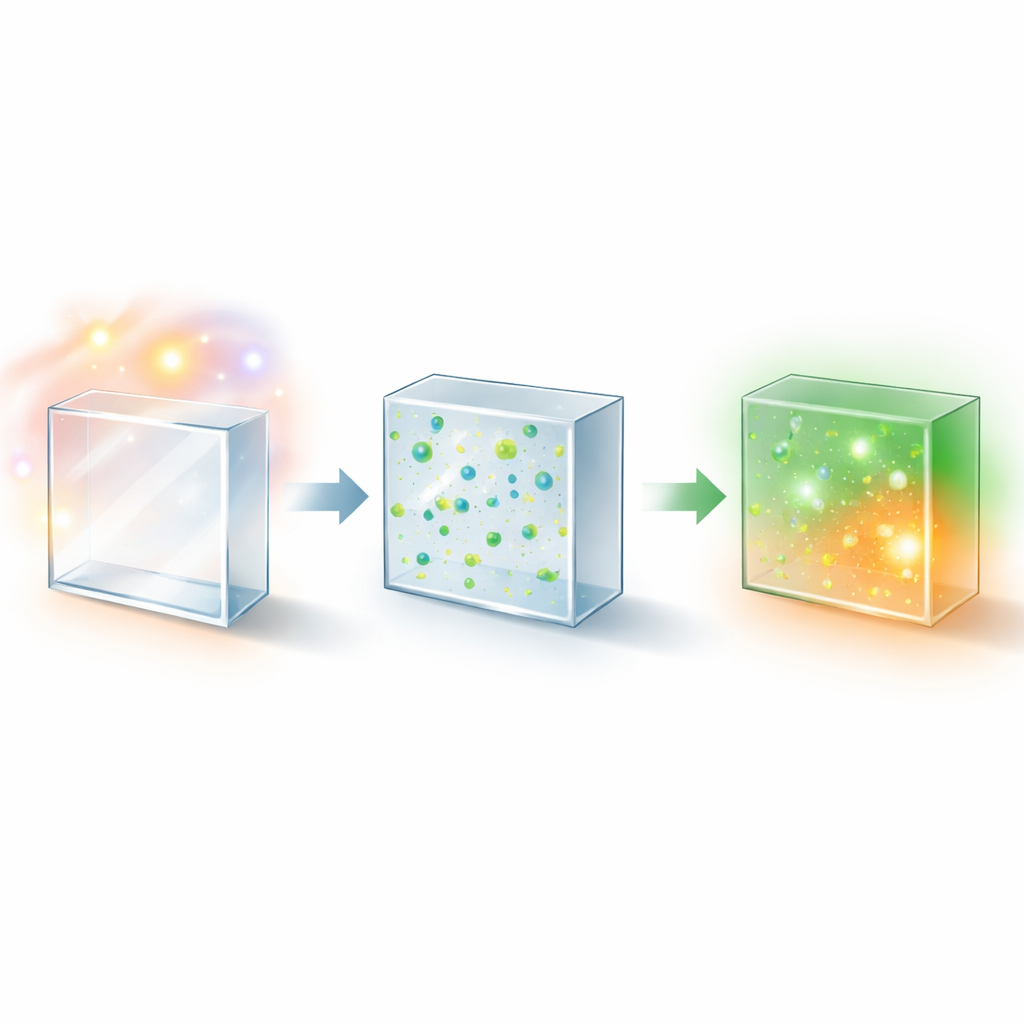
Imagine a window that keeps glowing softly long after the lights go out, and whose color you can change just by warming it up or switching the kind of lamp you use. This study describes exactly that sort of material: a tough, transparent glass ceramic that can “remember” light, store it as energy, and then release it as a controllable, long‑lasting afterglow. Such materials could one day store information in glowing patterns, help fight counterfeiting, or enable new kinds of 3D optical devices, all inside a single solid block of glass.
Why Afterglow Matters
Persistent luminescence—an afterglow that lingers after light is switched off—is already used in emergency exit signs and glow‑in‑the‑dark decorations. But most existing materials glow in only one fixed color and are often fragile or unstable when heated or exposed to strong light. Many promising organic systems fade quickly or degrade in harsh conditions, while some inorganic powders are opaque and must be mixed into plastics or inks, which can dull their performance. The dream is a single, robust material whose afterglow color and brightness can be programmed and re‑programmed by light and temperature, enabling complex, multi‑layered information to be written and read without contact.
Building a Two‑Worlds Glass
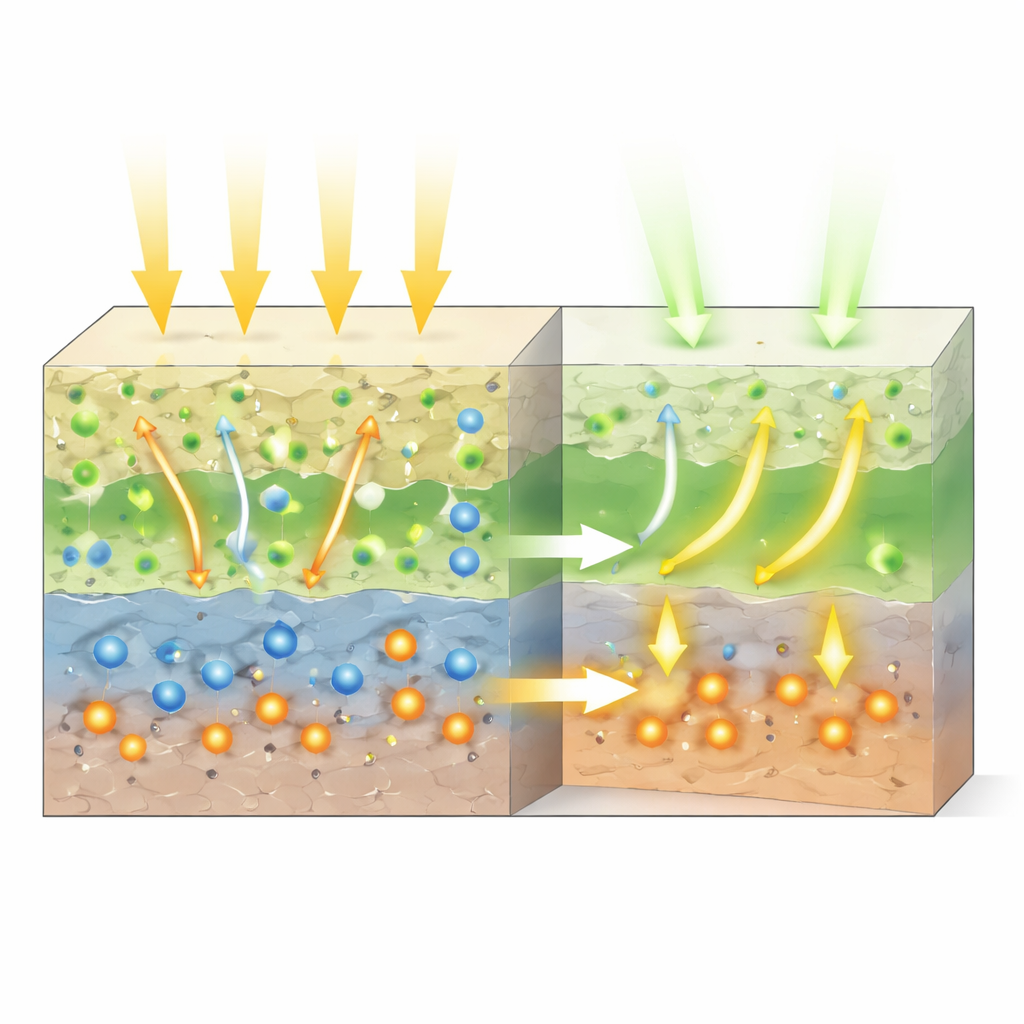
The researchers tackled this problem using a special glass ceramic—a transparent glass that contains tiny crystals inside. By adding lithium ions and carefully heat‑treating the glass, they triggered a controlled phase separation: the solid splits into two intimately mixed “worlds.” One is an amorphous glassy background; the other is a swarm of nanometer‑scale crystals made of a slightly off‑balance zinc silicate composition. Manganese ions, which are responsible for the glow, are deliberately distributed between these two worlds. Because manganese sits in different local environments in glass and in nanocrystals, it can emit in different colors. Just as important, the defects and empty sites that trap and release electric charge are different in each phase, creating a rich landscape of shallow and deep energy traps.
Programming Color with Light and Heat
This dual‑phase design lets the material behave like a library of light‑storage shelves with different depths. When the material is excited with higher‑energy ultraviolet light, many traps in both phases are filled, and the afterglow is dominated by greenish light from manganese in the crystals. When gentler excitation is used, carriers are guided into a different mix of traps, and the afterglow shifts toward orange, mainly from manganese in the glassy phase. Heating the sample during charging further changes which traps are filled and how quickly they empty. At higher temperatures, deeper traps in the nanocrystals become favored, and the persistent glow shifts from orange to green and lasts longer. The color can even drift over a few seconds as carriers gradually leak from shallow to deep traps, giving a time‑dependent chromatic “fade.”
Strength and Stability in Tough Conditions
Unlike many glow‑in‑the‑dark plastics or perovskite crystals, this glass ceramic is built to survive harsh use. It remains highly transparent, yet its hardness—around 9 to 11 gigapascals—is significantly higher than that of common transparent glass ceramics, thanks in part to aluminum strengthening the glass network. The material also shows remarkable thermal robustness: both its immediate glow and its afterglow intensity remain strong, or even improve slightly, at temperatures around 100 °C, and they stay stable over repeated heating and cooling cycles. This combination of optical tunability, mechanical toughness, and thermal reliability makes it suitable for real‑world devices and demanding environments.
Glowing Codes and Hidden Messages
To show what their material can do, the team created patterned images—leaves, eagles, stems—inside or on the surface of the glass using masks, lasers, and localized heating. The same pattern can reveal different hidden messages depending on the excitation wavelength or the temperature field: a design that glows orange at room temperature can turn green when warmed, or switch between green and yellow‑orange when illuminated by different ultraviolet lamps. Because the glass is transparent, 3D patterns can be written inside the volume, enabling stacked or overlapping information that only appears under specific reading conditions. All of this is achieved without mixing multiple separate phosphors; the multicolor behavior emerges from the engineered internal phases and traps in a single solid.
What This Work Ultimately Shows
At its core, the study proves that by carefully engineering how tiny crystals form and how defects and activator ions are arranged inside glass, it is possible to build a tough, transparent material whose afterglow color and timing can be finely tuned by light and heat. This single‑block glass ceramic can store complex, multi‑mode optical information and reveal it on demand, offering a powerful platform for future high‑density data storage, anti‑counterfeiting features, and advanced optical devices. The same design principles could likely be applied to other multiphase materials, opening a broader family of smart solids that remember and process light in ways we can program.
Citation: Wu, Y., Li, X., Ruan, C. et al. Tough transparent glass ceramics for multi-mode programmable dynamic tunable persistent luminescence via phase engineering. Nat Commun 17, 3267 (2026). https://doi.org/10.1038/s41467-026-69202-9
Keywords: persistent luminescence, glass ceramics, optical data storage, anti-counterfeiting, nanocrystals