Clear Sky Science · en
Earthquake dynamics sustained by seismic CO2
Hidden gas in earthquakes
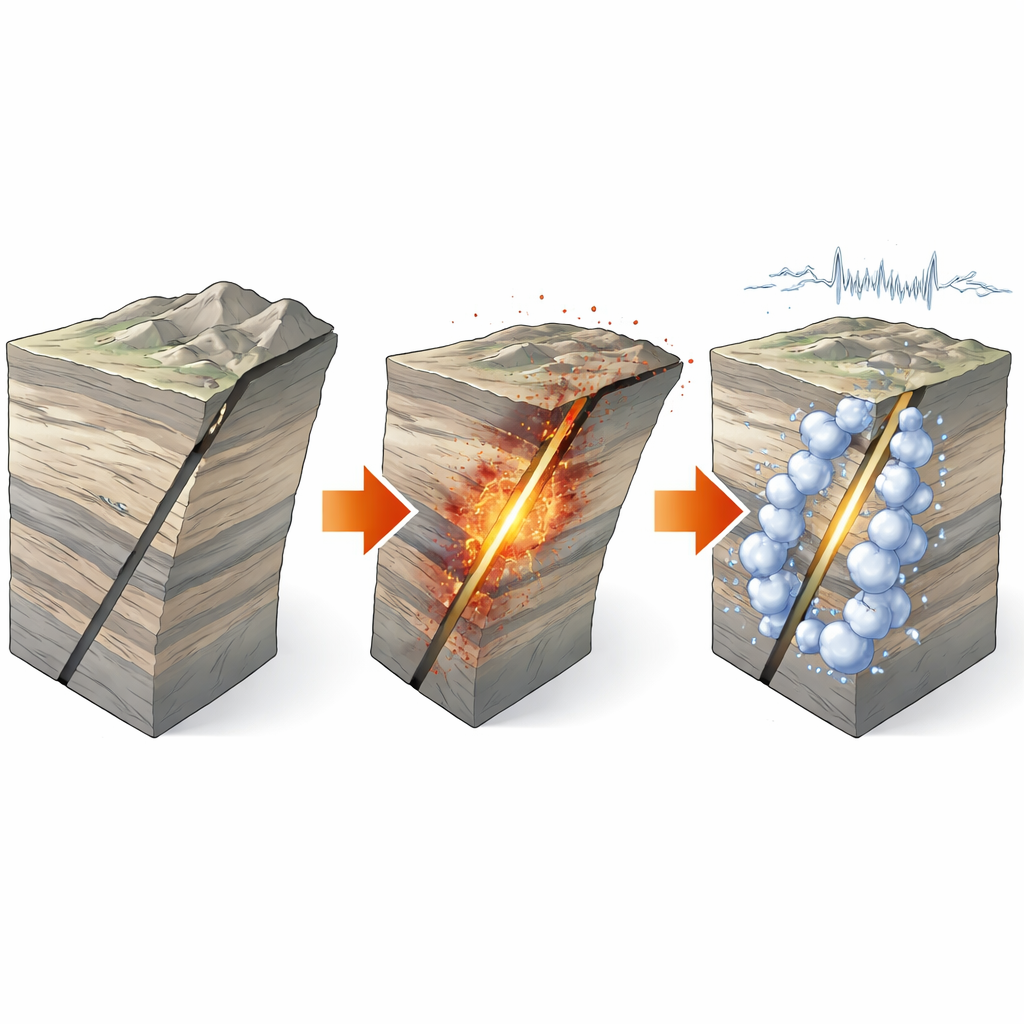
Most of us picture earthquakes as rocks grinding past each other deep underground. This study adds a surprising character to that scene: ordinary carbon dioxide gas. The authors show that during powerful earthquakes in limestone-rich mountains, heat from friction can briefly turn solid rock into a source of high‑pressure CO₂. That gas, in turn, helps the fault slip more easily, potentially making quakes larger and more destructive.
Where the quakes strike
The research focuses on normal faults cutting through carbonate rocks in Italy’s Apennine Mountains, an area that has produced several damaging earthquakes in recent decades, including the 2009 L’Aquila and 2016 Amatrice–Norcia events. These faults slice through thick layers of limestone and related rocks rich in the mineral calcite. At the surface today, the scientists can walk along the very planes that slipped in past earthquakes and examine how those ancient breaks in the crust have been altered by heat and fluids.
Clues written in broken rock
By combining field observations with powerful microscopes, X‑ray diffraction, and measurements of stable isotopes, the team identified ultra-thin layers—only 2–10 micrometers thick—immediately beneath the main slip surfaces. These layers contain corroded carbonate grains lined with rounded pores and trails that match textures produced in high‑speed laboratory earthquake experiments. The slip surfaces also show slightly lower calcite content than the rock just below, and their carbon and oxygen isotope signatures shift in ways expected when hot rock releases CO₂ and later partially “heals” as new calcite cements fill in cavities. Together, these lines of evidence point to repeated, fast decarbonation of the rock right where sliding is most intense.
How much gas and how much pressure
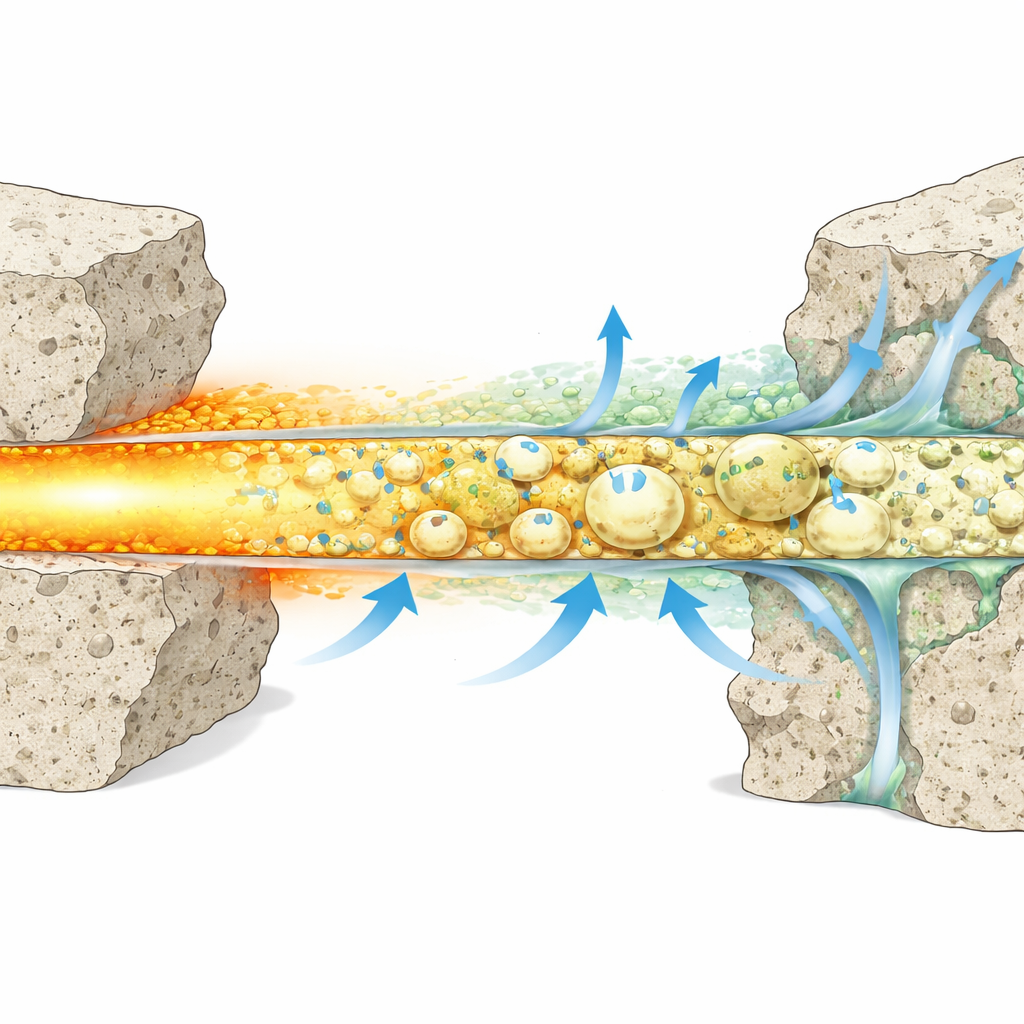
Using these microscopic observations as constraints, the authors built a stoichiometric and thermodynamic model to estimate how much CO₂ large Apennine earthquakes could generate. Even with deliberately conservative assumptions—using the thinnest observed reaction layers and the smallest measured loss of calcite—they find that a magnitude 5.9–6.5 event can produce roughly 6–12 metric tons of CO₂ along the slipping section of the fault. They then calculated the resulting pressures for two end‑member situations. If the gas is briefly trapped in an almost sealed fault zone (an “undrained” condition), pressures can approach those exerted by the surrounding rock at several kilometers depth, on the order of hundreds of megapascals. If pathways open and the fault allows fluid flow (“drained” conditions), pressures drop but still remain well above normal groundwater levels, staying in a hydrostatic to supra‑hydrostatic range.
Why pressurized gas matters
Such high pore pressures reduce the effective squeezing force holding the fault shut. In other words, CO₂ generated by rapid heating acts like a temporary lubricant: it weakens the fault, encourages continued sliding, and may even allow rupture to race along the fault at unusually high speeds. The authors suggest that earthquake sequences in carbonate terrains may therefore be strongly shaped by these short‑lived CO₂ pulses. As the event winds down and pressures fall, external fluids can be drawn back into the hot, damaged zone, precipitating fresh calcite that locks in a microscopic record of the quake.
What this means for people
The study concludes that during earthquakes in limestone-rich regions, seismic CO₂ is not just a harmless by‑product but an active player in fault mechanics. Transient gas pressurization can sustain rapid fault slip and enhance shaking, while also turning faults into temporary CO₂ reservoirs that connect deep carbon to the surface. Recognizing this hidden gas cycle improves our physical understanding of how some earthquakes grow large and destructive, and it points to the need for future hazard models to account for fluid-driven weakening inside the Earth’s crust.
Citation: Curzi, M., Billi, A., Aldega, L. et al. Earthquake dynamics sustained by seismic CO2. Nat Commun 17, 2766 (2026). https://doi.org/10.1038/s41467-026-69174-w
Keywords: earthquakes, carbon dioxide, fault zones, carbonate rocks, seismic hazard