Clear Sky Science · en
Accurate prediction of tensorial spectra using equivariant graph neural network
Why this research matters for future gadgets
From smartphones and solar panels to sensors and lasers, many modern devices rely on how a material bends, absorbs, and transmits light. These optical behaviors are often highly directional: a crystal can respond very differently to light coming from different angles or with different polarization. Accurately calculating these complex light–matter interactions is usually so time‑consuming that it slows down the search for better materials. This work introduces a machine‑learning tool that can predict these rich optical responses much faster, potentially speeding up the design of next‑generation optoelectronic technologies.
Seeing crystals as networks
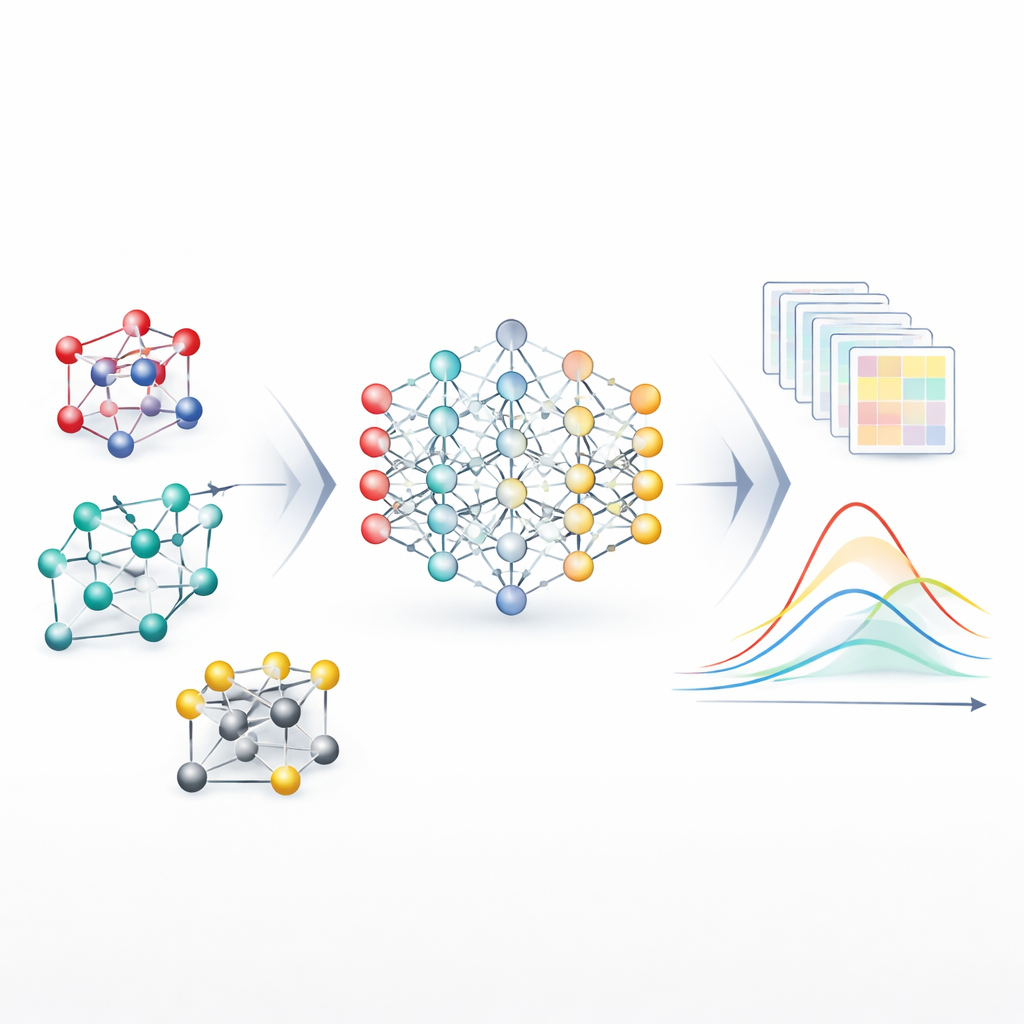
The authors focus on optical properties that are best described not by single numbers, but by tensors—mathematical objects that capture how a material responds differently to light along different directions. Instead of performing heavy quantum‑mechanical calculations for every new material, they build a model called the Tensorial Spectra Equivariant Neural Network (TSENN). TSENN treats each crystal as a graph: atoms are nodes, and the bonds or near‑neighbor connections between them are edges. This graph is then processed by a special type of neural network that is designed to respect the symmetries of three‑dimensional space, such as rotations and reflections, so that rotating the input crystal simply rotates the predicted optical response in a consistent way.
Breaking light response into simple building blocks
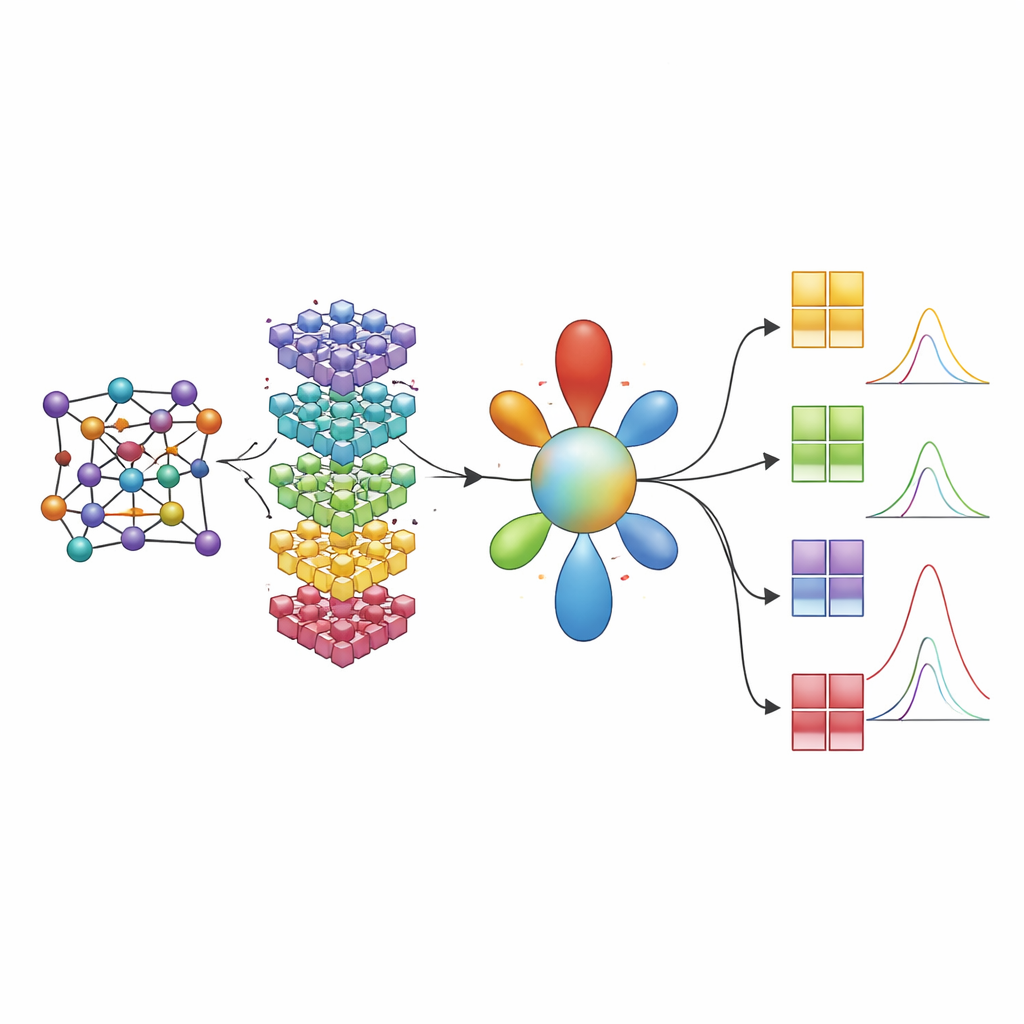
To handle the directional complexity of light response, the team rewrites the optical tensor in terms of spherical components. One part is isotropic and describes the overall strength of light interaction, while another captures anisotropic features like how much more strongly a crystal responds along one axis than another. By separating the tensor into these two channels, TSENN can learn both the overall magnitude and the directional nuances while strictly obeying the crystal’s symmetry rules. The model is trained on data from 1,432 semiconductors with a range of band gaps relevant to technologies such as light‑emitting diodes and solar cells, where understanding how light is absorbed across many photon energies is essential.
Fast and accurate predictions across many materials
Once trained, TSENN predicts the full frequency‑dependent optical tensor with impressive accuracy. The average deviation from detailed quantum calculations is about one‑eighth of a typical signal unit, and the model reliably reproduces both strong diagonal responses and more subtle off‑diagonal, direction‑mixing effects. It also preserves the characteristic fingerprints of each material’s spectrum—the positions and shapes of peaks that reveal how electrons move and absorb light. Because the model respects symmetry by design, it automatically recovers the correct pattern of which tensor components should vanish in high‑symmetry crystals and how they emerge when symmetry is reduced, for example when strain is applied.
Following symmetry under strain
To test how physically realistic its predictions are, the authors simulate what happens when a crystal is stretched or sheared. In one case, a perfectly cubic material is elongated along one axis, turning it into a slightly less symmetric form. TSENN’s predictions show the expected growth of directional differences in light response in a near‑linear fashion, closely mirroring additional first‑principles calculations. In another case, they tilt one of the crystal angles so that new “off‑axis” light responses appear. The strength of these new responses grows with the distortion in a way that matches the textbook expectations. These tests show that the model not only fits static data, but also tracks how optical behavior evolves under realistic structural changes.
From spectra to device‑relevant quantities
Although TSENN is trained on the imaginary part of the dielectric tensor—the component directly tied to absorption—it predicts this quantity so well that the authors can reconstruct the complementary real part using standard mathematical relations. Together, these two parts provide a full description of how a material polarizes and absorbs light. From this, one can derive practical quantities like refractive indices, absorption edges, and measures of anisotropy that are crucial for designing photovoltaics, modulators, sensors, and nonlinear optical devices.
What this means for material discovery
In practical terms, this framework turns a calculation that used to take more than half an hour on a powerful computing cluster into a task that runs in about a second on a single graphics card. That speedup makes it feasible to scan vast libraries of potential materials for desirable directional optical properties instead of examining them one by one. Because the method is built around a general way of decomposing tensors, it can be extended beyond optical responses to other directional properties, such as how a crystal deforms under stress or generates electric currents under light. For non‑experts, the key takeaway is that TSENN offers a symmetry‑aware shortcut to predicting how crystals interact with light, opening the door to much faster discovery and optimization of materials for advanced optoelectronic technologies.
Citation: Hsu, TW., Fang, Z., Bansil, A. et al. Accurate prediction of tensorial spectra using equivariant graph neural network. Nat Commun 17, 3330 (2026). https://doi.org/10.1038/s41467-026-69159-9
Keywords: optical spectra, graph neural networks, anisotropic materials, dielectric tensor, materials discovery