Clear Sky Science · en
Experimentally separating vacuum fluctuations from source radiation
Mysterious energy in empty space
Empty space is not really empty. According to quantum physics, it seethes with tiny, ever‑changing electric and magnetic fields known as vacuum fluctuations. These hidden jitters help explain subtle effects in atoms and light, but until now they have been hopelessly tangled with ordinary radiation that comes from real particles and light sources. This paper reports the first experiment that cleanly teases apart these two ingredients of the quantum world, turning a long‑standing thought experiment into a table‑top reality.
Turning a thought experiment into a real test
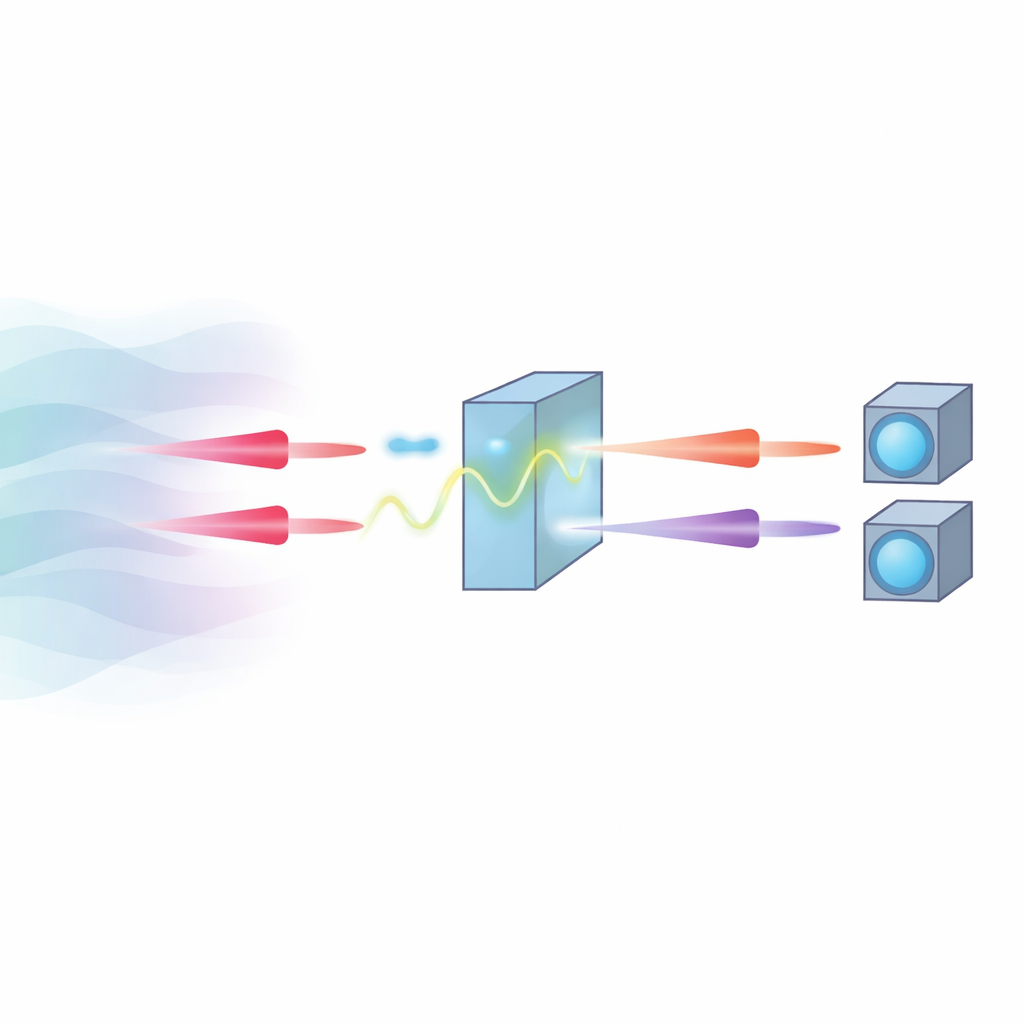
Nearly a century ago, physicist Enrico Fermi imagined two atoms suddenly allowed to interact with the electromagnetic field of empty space. As time passed, the atoms became correlated in two ways: by tapping into the ever‑present vacuum fluctuations, and by trading an actual photon of light between them, known as source radiation. Theory said both processes mattered, but separating them was considered impossible. The new work replaces Fermi’s atoms with two ultrashort laser pulses and lets them play the same game inside a special crystal that responds to electric fields. This all‑optical version allows the interaction to be switched on and off with exquisite timing as the pulses enter and leave the material.
Using light pulses as quantum probes
In the experiment, two near‑infrared laser pulses travel side by side through a zinc‑telluride crystal cooled to just a few degrees above absolute zero to remove ordinary thermal radiation. As each pulse passes, it briefly couples to electromagnetic field modes at much lower, terahertz frequencies through a nonlinear optical effect. This changes the polarization of the pulses—the direction in which their electric fields vibrate—by a tiny amount. Highly sensitive detectors then read out these polarization changes for each pulse, letting the researchers look for correlations between them that betray the influence of the vacuum and of source radiation.
Picking out two kinds of quantum noise
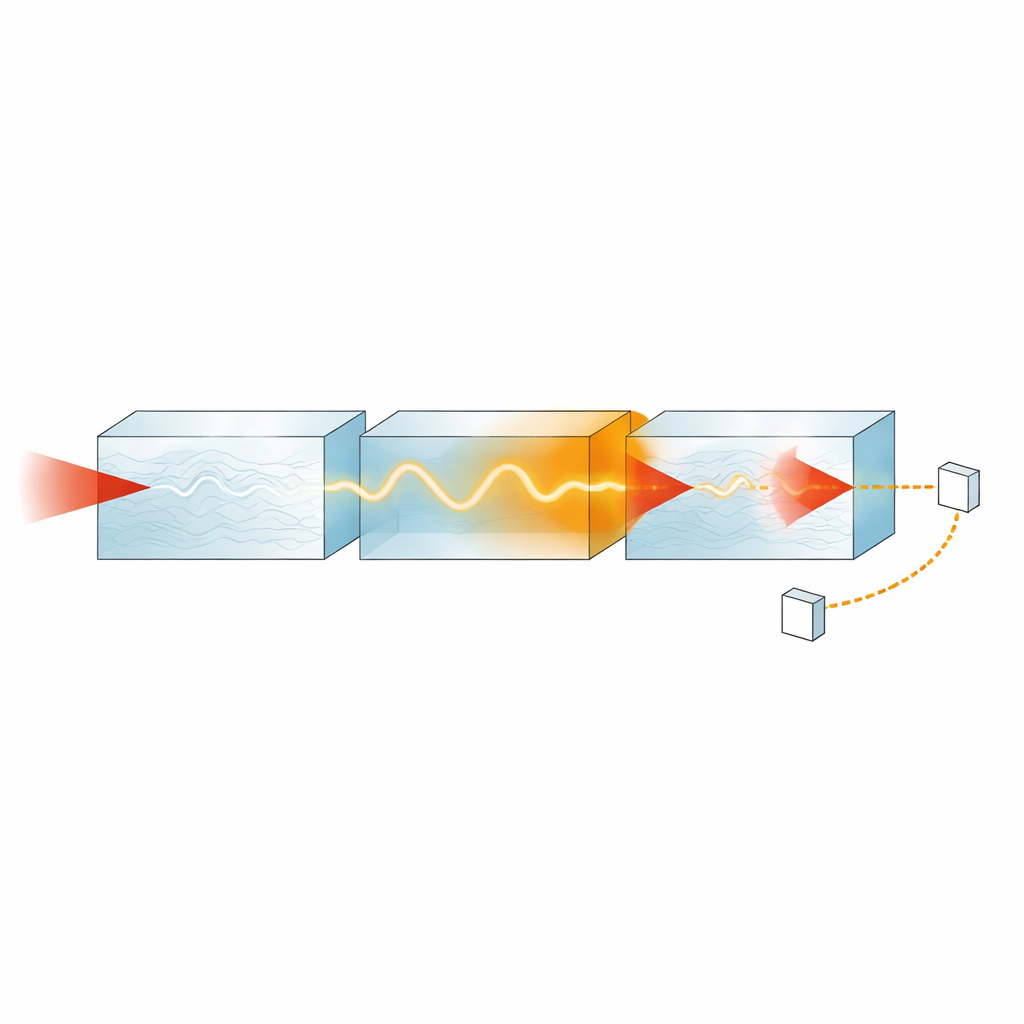
A key trick is that vacuum fluctuations and source radiation disturb different “quadratures” of the light field, roughly analogous to pushing on a swing at quarter‑period versus in‑phase. By inserting different wave plates in front of each detector, the team can choose which quadrature of each pulse to observe. When both detection arms are tuned to the same out‑of‑phase quadrature, they pick up correlations that appear instantly as the two pulses overlap in time, revealing the imprint of vacuum fluctuations shared by both. When one detector is tuned in‑phase and the other out‑of‑phase, a new, delayed correlation appears: one pulse first stirs up source radiation, which then propagates through the crystal and is picked up by the second pulse only after a light‑travel time. This asymmetric timing pattern encodes the causal, “after‑the‑fact” character of source radiation.
Checking a fundamental quantum rule
By studying these correlations not only in time but also as a function of frequency, the authors show that the two signals are linked exactly as predicted by the quantum version of the fluctuation–dissipation theorem, a deep principle that connects random noise to a system’s response. The vacuum‑induced signal and the source‑radiation signal line up like the real and imaginary parts of a complex wave, shifted by a quarter of a cycle. Despite small shifts due to practical details such as the exact spacing between the beams in the crystal, the measurements closely match detailed theoretical calculations, confirming that the two contributions are physically meaningful and not just artifacts of mathematical bookkeeping.
Why this matters for future quantum technologies
Being able to measure vacuum fluctuations and source radiation separately does more than settle a conceptual debate. It opens a new window on quantum fields in time‑dependent and even curved “spacetimes” engineered in the lab. Because the method can, in principle, pick out correlations from a single terahertz photon even against a warm background, it could help probe exotic effects such as the dynamical Casimir effect, in which moving boundaries create light from the vacuum, or “entanglement harvesting,” where separated detectors draw quantum connections out of empty space. In everyday terms, the study shows that we can now not only sense the restless activity of the vacuum, but also watch how it turns into real radiation step by step.
Citation: Herter, A., Lindel, F., Gabriel, L. et al. Experimentally separating vacuum fluctuations from source radiation. Nat Commun 17, 2863 (2026). https://doi.org/10.1038/s41467-026-69142-4
Keywords: quantum vacuum, electro-optic sampling, terahertz radiation, vacuum fluctuations, quantum correlations