Clear Sky Science · en
Reversible H2 storage at moderate temperature by a trilayered lithium borohydride nanocomposite
Cleaner fuel for everyday life
Hydrogen is often hailed as a clean fuel that could power cars, trucks, and even entire neighborhoods while emitting only water. But to make this vision practical, we need safe, compact ways to store hydrogen on board vehicles at moderate temperatures. This study introduces a clever “layer-cake” nanomaterial that can hold and release large amounts of hydrogen far more easily than before, bringing hydrogen-powered transportation a step closer to reality. 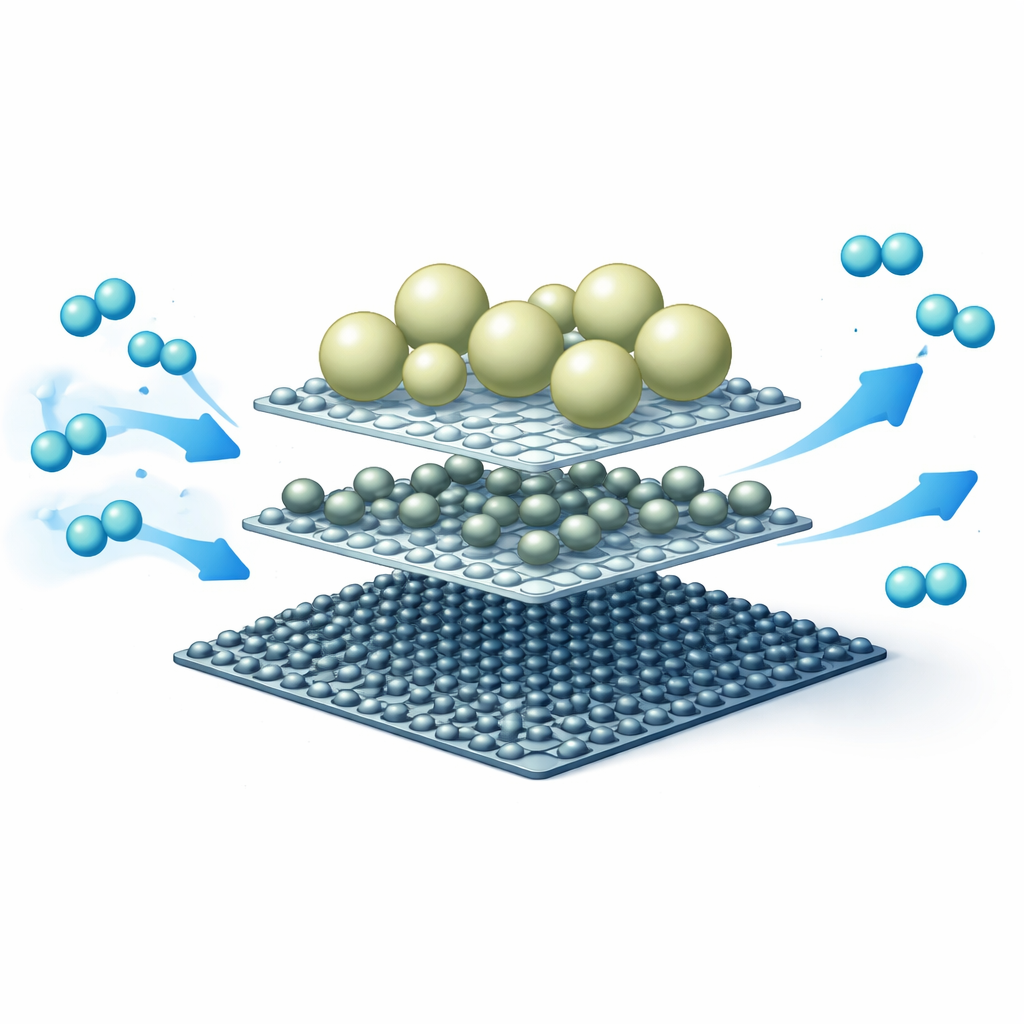
A promising but stubborn hydrogen sponge
At the heart of this work is lithium borohydride, a solid that can store an impressive amount of hydrogen by weight and volume, making it attractive for use in vehicles. The problem is that this material is too stable: it typically needs very high temperatures to give up its hydrogen and does not readily take the hydrogen back in, which hurts efficiency and durability. Over the past two decades, scientists have tried many tricks to tame it, such as mixing in other elements, shrinking it into nanoparticles, or trapping it inside porous structures. These steps helped, but the temperatures were still too high to be powered mainly by the waste heat of a fuel cell.
Building a three-layer nano sandwich
The researchers designed a new structure in which the ingredients are stacked in a precise order at the nanometer scale. The bottom layer is a sheet of graphene, an ultra-thin, strong form of carbon that acts like a support platform. On top of this they grew a middle layer of tiny nickel clusters, just a few nanometers across. Finally, lithium borohydride nanoparticles formed as the top layer, resting mostly on the nickel rather than directly on the graphene. Careful electron microscope imaging confirmed this trilayer, showing graphene at the base, a uniform sprinkling of nickel nanoclusters above it, and a layer of lithium borohydride particles on top. The nickel content and particle size were tuned so that the lithium borohydride remained finely divided and well distributed. 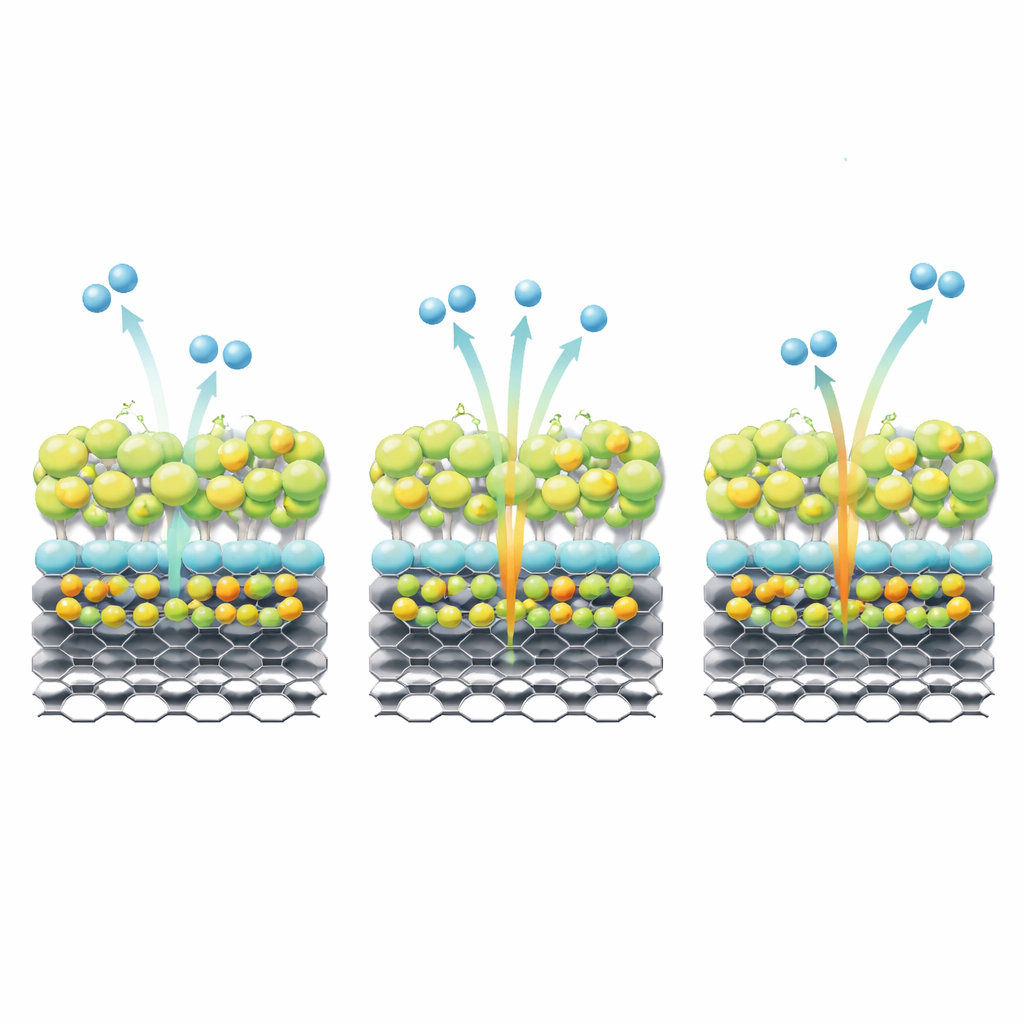
Storing more hydrogen at friendlier temperatures
When the team tested how this trilayered material handled hydrogen, the performance was striking. Compared with pure lithium borohydride, the temperature needed to start releasing hydrogen dropped by more than 100 degrees Celsius. The composite could release about 10.5 weight percent hydrogen (relative to the lithium borohydride portion) under moderate heating, and it did so much faster than the unmodified material. Even more importantly, the material could reabsorb hydrogen starting at only about 70 degrees Celsius—among the lowest reported for this family of materials—and could take back up to 12.3 weight percent hydrogen relative to its lithium borohydride content. It also withstood at least 30 charge–discharge cycles with little loss of capacity, and it avoided the foaming and breakup that usually plague this compound when it is repeatedly heated and cooled.
How nickel helps hydrogen move
To uncover why the trilayer performed so well, the scientists combined experiments with quantum-mechanical calculations. Their models showed that when boron-rich clusters from lithium borohydride sit directly on nickel, the nickel rearranges the boron network and donates electrons into it. This weakens certain boron–boron bonds and lowers the energy needed for hydrogen atoms to attach, move, and form new boron–hydrogen groups. Simulations of hydrogen molecules approaching the nickel–boron interface revealed that hydrogen splits more easily on nickel, and the resulting hydrogen atoms can quickly migrate across the surface and into the boron-rich region. In contrast, when the boron clusters sit on bare carbon, the electronic interaction tends to hinder hydrogen movement. By inserting nickel between graphene and lithium borohydride, the design encourages hydrogen to flow in and out efficiently while keeping the active particles well anchored.
Why this matters for future hydrogen vehicles
In everyday terms, this trilayered nanocomposite acts like a highly engineered sponge for hydrogen that soaks up and squeezes out fuel at temperatures closer to what real fuel-cell systems can provide. The graphene gives mechanical support and helps control the particle size; the nickel nanoclusters act as tiny reaction hubs that split and shuttle hydrogen; and the lithium borohydride holds large amounts of hydrogen in a compact form. Together, they overcome long-standing barriers of high temperature and poor reversibility. While more work is needed to scale up the material and integrate it into full storage tanks, this study offers a clear blueprint for designing next-generation solid hydrogen carriers that could make clean hydrogen vehicles far more practical.
Citation: Zhang, W., Zhang, X., Li, C. et al. Reversible H2 storage at moderate temperature by a trilayered lithium borohydride nanocomposite. Nat Commun 17, 3756 (2026). https://doi.org/10.1038/s41467-026-69059-y
Keywords: hydrogen storage, lithium borohydride, nanocomposite, nickel catalyst, graphene