Clear Sky Science · en
Electron confinement-enhanced green InP-based quantum dots for active-matrix LEDs displays
Brighter, Safer Screens for Everyday Devices
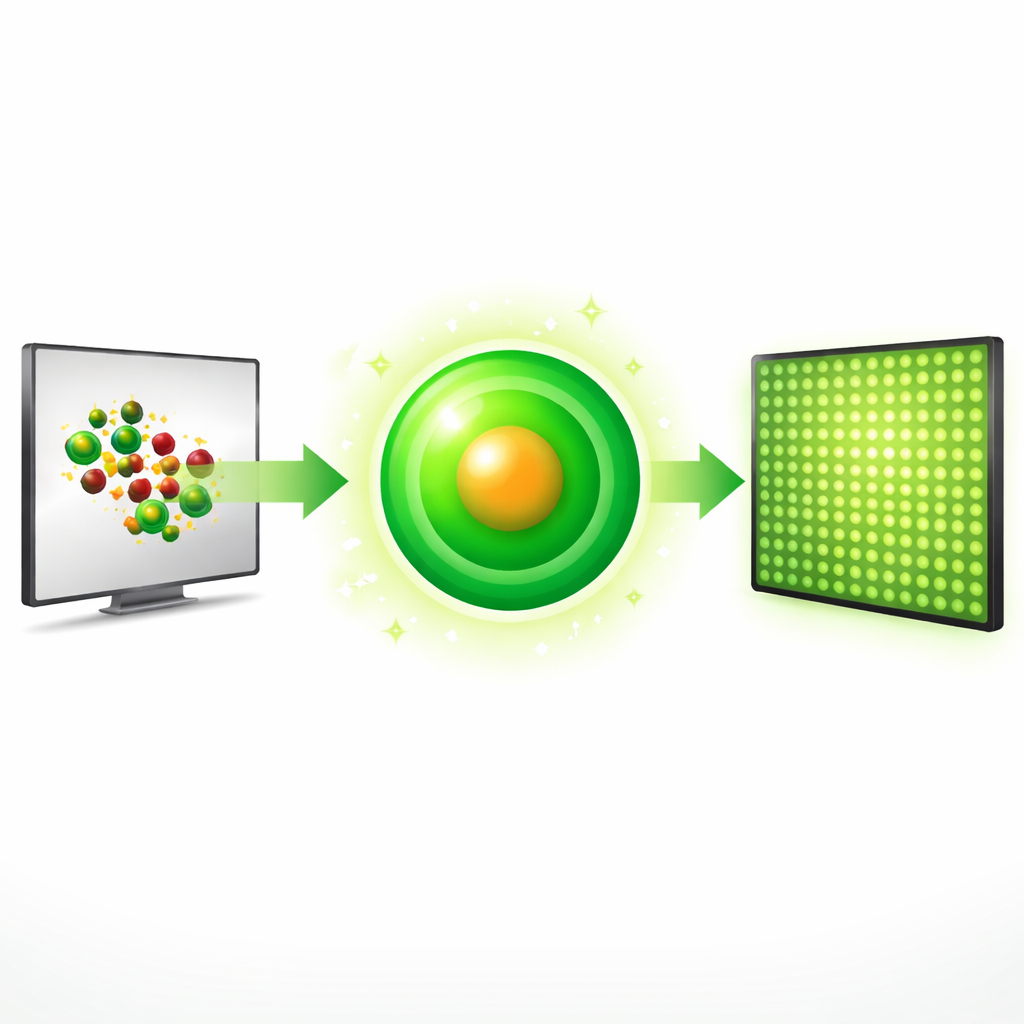
Televisions, smartphones, and virtual‑reality headsets increasingly rely on quantum dot LEDs to deliver vivid colors and low power use. Yet many of today’s highest‑performing quantum dots contain cadmium, a toxic heavy metal that regulators and manufacturers want to phase out. This study shows how to make bright green quantum dots from a safer material, indium phosphide, and how to shape them so that future displays can be both high‑performance and cadmium‑free.
Why Safer Quantum Dots Are Hard to Make
Quantum dots are tiny crystals that glow brightly when energized, and their color can be tuned simply by changing their size. Cadmium‑based dots have long set the performance standard, but their toxicity is a major roadblock for mass‑market use. Indium phosphide is a more environmentally friendly alternative, yet green‑emitting indium phosphide dots have lagged behind in brightness, color purity, and lifetime. The core problem is how electrons behave inside these particles. In many indium phosphide dots, the protective shell that surrounds the core grows unevenly, forming lopsided, tetrapod‑like shapes. Electrons then spread out toward the surface instead of staying near the center, where they should meet holes and emit light efficiently. This electron “leakage” not only wastes energy but also damages neighboring layers in the device, shortening its operating life.
Making the Quantum Dot Surface More Even
The researchers attacked this challenge by controlling how the shell grows on different faces of the indium phosphide core. Computer simulations showed that one particular crystal face, called the (111) facet, is especially reactive and tends to attract shell material faster than the others, causing the shell to grow unevenly. To smooth things out, the team coated the core with a tailored mix of two small molecules: n‑octylamine and a selenium‑containing compound. These molecules latch especially strongly onto the reactive facet, calming it down so that all faces of the core have nearly the same surface energy. Under these conditions, the zinc selenide shell grows evenly in all directions, followed by an outer zinc sulfide shell, yielding nearly spherical “strongly electron‑confined” quantum dots in which electrons remain tightly bound near the core.
From Better Particles to Better Light
Careful measurements showed how much this reshaping of the dots improved their optical behavior. Compared with dots made using conventional ligands, the new particles emitted green light with a very narrow color spread, meaning higher color purity that suits demanding display standards. Their light output efficiency—how many photons come out for every photon absorbed—rose above 92 percent, far higher than that of the uneven, weakly confined dots. Time‑resolved studies revealed that excited states in the improved dots live longer and are less likely to die out silently at surface defects. The strong confinement keeps electrons away from dangling bonds and trap sites on the shell, reduces non‑radiative loss pathways, and lets electrons and holes overlap more fully, boosting the chance that each excitation produces a photon.
Turning Safer Quantum Dots into Working Displays
When the team built full quantum‑dot LED devices using these improved particles as the light‑emitting layer, the impact was dramatic. The new devices reached an external quantum efficiency of 23.5 percent and an extremely high peak brightness, while maintaining a sharp green color. Just as important, they showed almost no unwanted emission from neighboring transport layers, a sign that charge carriers were recombining where they should instead of leaking away. This better behavior translated into vastly longer lifetimes: when adjusted to typical display brightness levels, devices with strongly confined dots were projected to last over 59,000 hours—more than a hundred times longer than those made with weakly confined dots. Using a specialized assembly method based on guiding liquid films with patterned surfaces, the researchers further arranged the dots into tiny pixel arrays as small as 1.5 micrometers across, achieving an ultrahigh resolution of 8,460 pixels per inch with little loss of efficiency.

What This Means for Future Screens
By carefully tuning the chemistry at the surface of indium phosphide quantum dots, this work shows that safer, cadmium‑free materials can deliver the efficiency, brightness, color quality, and durability needed for cutting‑edge displays. The key is strong electron confinement through uniformly grown shells, which prevents charge leakage and protects delicate device layers. Combined with precise assembly into microscopic pixels and integration into active‑matrix driving circuits, these advances bring heavy‑metal‑free quantum dot displays much closer to practical use in everything from phones to immersive headsets.
Citation: Guo, N., He, K., Li, H. et al. Electron confinement-enhanced green InP-based quantum dots for active-matrix LEDs displays. Nat Commun 17, 3268 (2026). https://doi.org/10.1038/s41467-026-69050-7
Keywords: quantum dot displays, cadmium-free LEDs, indium phosphide, electron confinement, high-resolution screens