Clear Sky Science · en
Probabilistic day-ahead forecasting of system-level renewable energy and electricity demand
Why tomorrow’s power matters today
Keeping the lights on is getting trickier as more homes, cars, and businesses run on electricity while power increasingly comes from the wind and sun. Unlike traditional power plants, renewable sources depend on the weather, which can change quickly. This study explores a smarter way to predict, a day in advance, how much electricity people will use and how much wind and solar energy the grid will produce. Better forecasts can cut costs, reduce pollution, and lower the risk of blackouts in places like California and beyond.
The challenge of guessing demand and sunshine
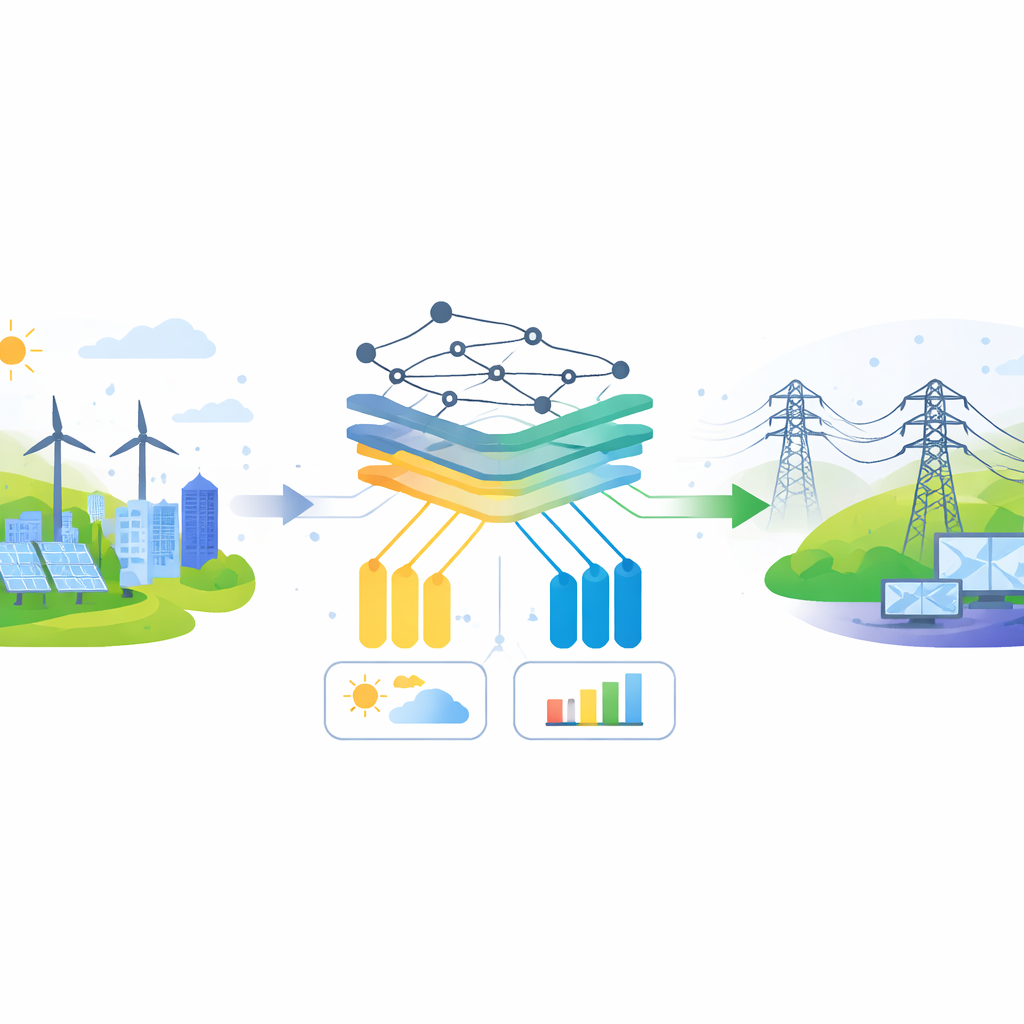
Electricity system operators must balance supply and demand every minute. A day ahead, they decide which power plants to run and how much backup to keep in reserve. As more solar panels and wind turbines feed the grid, and as demand grows from air conditioning, electric cars, and data centers, simple forecast methods struggle. Errors mean operators must scramble in real time, buying extra energy on short notice, curtailing renewables, or leaning on fast-start fossil fuel plants. In California’s system, these growing mismatches have led to higher operating costs, more imports from neighboring regions, and more frequent adjustments to keep the grid stable.
A new way to read the weather
The authors propose a forecasting framework that uses advanced statistical tools and machine learning to make full use of detailed weather forecasts. Instead of relying on a few coarse weather variables, they start from a rich, high‑resolution weather model that covers the entire western United States. A first step filters out the many weather data points that do not matter much for energy, pinpointing locations and conditions that strongly influence electricity demand and renewable generation. This includes factors like temperature, humidity, and solar radiation near major population centers and around wind and solar farms, distilled into a compact set of the most relevant signals.
Seeing the whole system at once
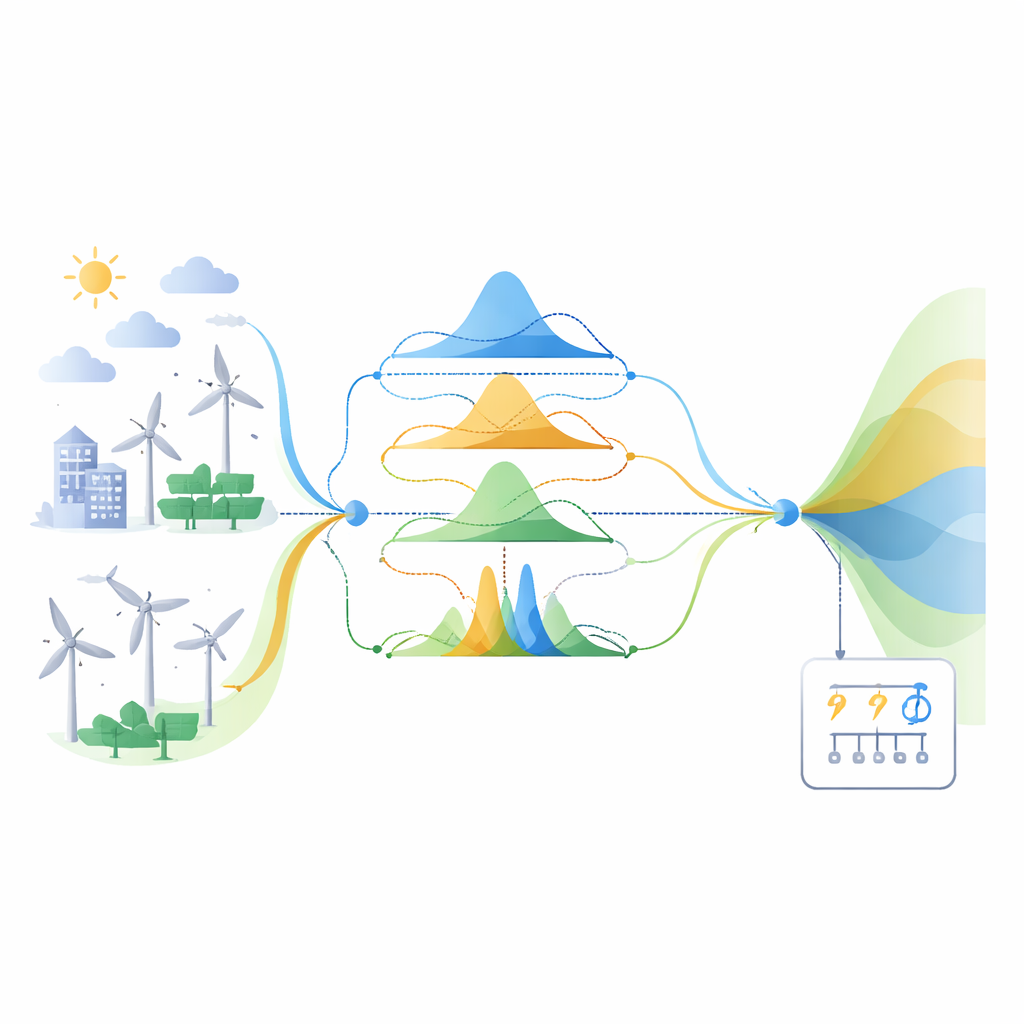
Most previous methods forecast each piece of the system separately: one model for demand, another for wind, and another for solar. In contrast, this work builds joint probabilistic forecasts, which means it predicts not just single best guesses but full ranges of possible outcomes for demand, wind, and solar together, hour by hour. By modeling how these quantities move in tandem across California’s three main grid zones, the approach captures relationships such as hot days that increase air‑conditioning use while also boosting solar output, or stormy conditions that lower solar production but may raise wind power. The method produces many plausible future scenarios that preserve realistic day‑long patterns, rather than isolated hourly points.
From better forecasts to smarter backup
To test their approach, the researchers focused on the California Independent System Operator, which manages most of the state’s high‑voltage grid. They compared their probabilistic models against standard benchmarks, including the operator’s own day‑ahead forecasts. Across electricity demand, solar, wind, and the combined “net demand” seen by conventional generators, their best models improved forecast skill by up to about a quarter. Crucially, the probabilistic forecasts also provided well‑calibrated uncertainty bands, especially during stressful periods such as record heat waves or unusual storms. Using these bands, the team experimented with a new way to allocate operating reserves over the day: instead of spreading backup evenly or relying on fixed historical error patterns, they shifted reserves toward hours when uncertainty was actually higher, such as midday when solar output is largest and more variable.
What this means for a cleaner, steadier grid
When the researchers simulated grid operations using their reserve‑allocation method, they found that total imbalances between supply and demand—measured as the need for imports or renewable curtailment—were reduced compared with current deterministic practices. Joint probabilistic forecasting made it possible to cut these imbalances while still meeting reliability needs, and ensemble combinations of models performed best overall. In practical terms, this means operators could rely less on expensive, emission‑intensive backup plants, integrate more wind and solar without sacrificing stability, and respond more flexibly to extreme weather. The study suggests that treating forecasts as probability distributions, rather than single numbers, is a key step toward a more efficient, sustainable, and resilient electricity system.
Citation: Terrén-Serrano, G., Deshmukh, R. & Martínez-Ramón, M. Probabilistic day-ahead forecasting of system-level renewable energy and electricity demand. Nat Commun 17, 3307 (2026). https://doi.org/10.1038/s41467-026-69015-w
Keywords: renewable energy forecasting, electricity demand, power grid reliability, probabilistic modeling, operating reserves