Clear Sky Science · en
Scaling laws in confined media applied for biomarker detection
Watching Molecules Squeeze Through Tiny Gates
Our bodies and the world around us are crowded with large molecules jostling in tight spaces, from the inside of cells to water filters and diagnostic chips. This study explores how molecules behave when they are pushed into ultra-small holes called nanopores. By learning the simple rules that govern this motion, the researchers show how to turn crowding into an advantage: they use it to push scarce biomarkers such as sugars and tiny peptides into nanopores so they can be detected one by one, potentially improving medical tests and other sensing technologies. 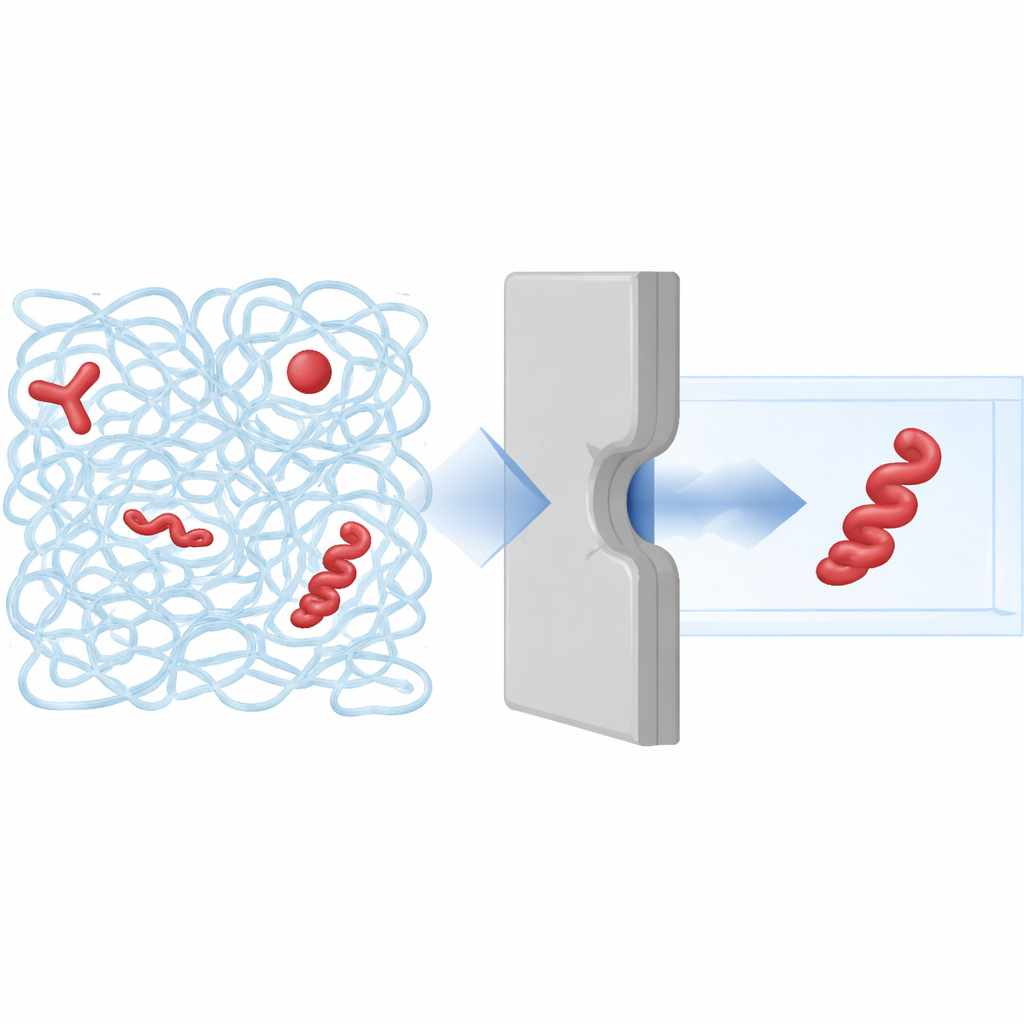
How Crowding Creates a Gentle Push
In an ordinary liquid, molecules move freely and rarely bump into each other. But when many long-chain molecules called polymers are present, they overlap and form a loose mesh, like cooked spaghetti in a pot. The spaces in this mesh have a typical size, called the mesh size, which shrinks as more polymer is added. The team worked with solid-state nanopores drilled in ultrathin silicon nitride membranes, only a few nanometers wide. They discovered that when the mesh size in the surrounding solution becomes smaller than the nanopore opening, the crowded polymers create an osmotic push that helps drive chains into the pore. This push can overcome the natural energy penalty of squeezing a flexible chain into such a narrow channel.
Simple Scaling Rules for Tiny Spaces
To put numbers on this picture, the authors turned to classic ideas from polymer physics developed by Pierre-Gilles de Gennes. These theories predict that the critical polymer concentration needed for chains to start entering a pore follows a simple power law that depends on the ratio of pore diameter to the size of a single monomer unit. The researchers tested this by changing both polymer concentration and nanopore size. They recorded brief drops in ionic current every time a chain passed through the pore, and from these events extracted how often entries occurred and how long each one lasted. The measured threshold concentration followed the predicted power law with impressive accuracy, providing direct experimental proof of the theory at the single-molecule level.
Inside the Pore: Hidden Gaps and Slow Crawling
Once a polymer chain is inside, it does not zip straight through. Instead, it moves in a slow, snake-like motion known as reptation, sliding along its own length while surrounded by the polymer mesh outside the pore. By analyzing how the duration of current blockades changed with polymer length and concentration, the team showed that these dwell times follow the scaling expected for reptation and are largely independent of the pore size itself. They also confirmed another long-standing prediction: because the chain is repelled from the pore wall, a thin depletion layer forms where few polymers are present. Depending on the balance between pore diameter and mesh size, the system switches between three regimes: chains excluded entirely, chains squeezed through a narrowed central tube, or chains that keep their bulk shape inside the pore. 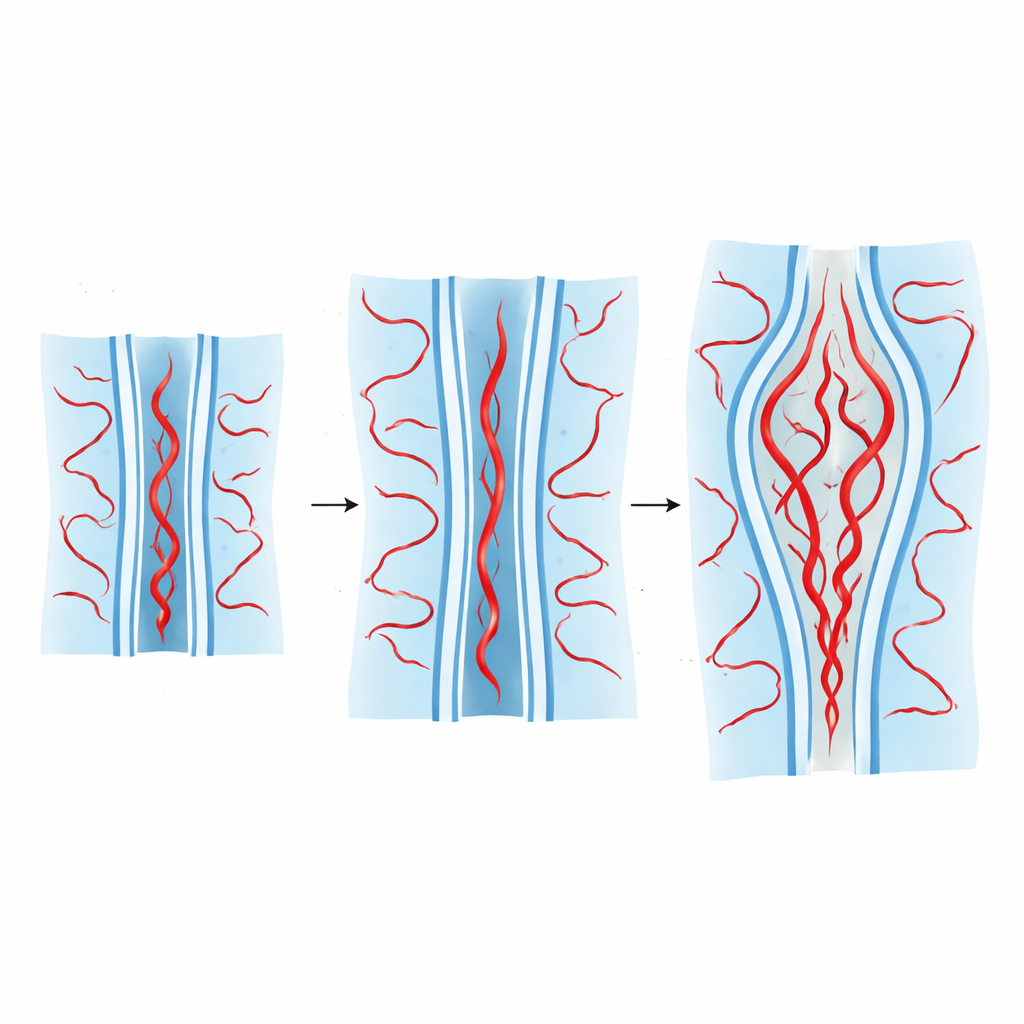
Helping Sugars and Peptides Stand Out
Armed with this understanding, the researchers turned crowding into a practical sensing tool. They added another class of molecules—charged polysaccharides called dextran sulfate—into the crowded polymer solution. On their own, these sugar chains were often too large to enter the nanopore and produced few signals. In the presence of semi-dilute polymers, however, the osmotic push lowered the confinement barrier by roughly two units of thermal energy, greatly increasing how often these chains were detected, regardless of their length. The team then applied the same strategy to short peptide hormones, using vasopressin as a model. Under crowded conditions, the nanopore could clearly distinguish between two mirror-image versions of vasopressin that differ in the handedness of just one amino acid—an important capability because biological systems often respond very differently to such enantiomers.
From Basic Physics to Better Diagnostic Tools
Overall, the work shows that a few simple scaling laws can describe how large molecules move into and through nanoscopic pores, even in complex, crowded environments. When the mesh of surrounding polymers is fine enough, osmotic forces dominate over other effects, pulling chains and biomolecules into the pore and creating a measurable, molecule-by-molecule signature in the ionic current. By tuning polymer concentration and pore size, experimenters can boost the frequency and duration of detection events, improving both sensitivity and resolution. This universal, physics-based strategy could help turn solid-state nanopores into more powerful tools for detecting difficult biomarkers—such as long sugars, peptides, and proteins—in realistic biological and environmental samples.
Citation: Cai, Y., Cressiot, B., Winterhalter, M. et al. Scaling laws in confined media applied for biomarker detection. Nat Commun 17, 3322 (2026). https://doi.org/10.1038/s41467-026-68912-4
Keywords: nanopore sensing, macromolecular crowding, biomarker detection, polymer physics, osmotic pressure