Clear Sky Science · en
A magnetically soft yet mechanically strong and ductile Ta free CoFeNi high entropy alloy with Al and Ti additions
Why better motor metals matter
From electric cars to compact aircraft engines, modern life increasingly depends on high‑speed electric machines. Inside every motor are metal parts that must guide magnetic fields efficiently while withstanding enormous spinning forces and heat. Traditional soft magnetic alloys do the magnetics well but are relatively weak and prone to energy loss as heat. This paper explores a new family of "high‑entropy" metals that promise a rare combination: strong yet flexible, highly resistant to electrical losses, and still magnetically soft enough for next‑generation motors.
New metals built from many ingredients
The researchers start from a well‑known magnetic recipe based on cobalt, iron, and nickel. To this base they add small amounts of aluminum and titanium, creating so‑called high‑entropy alloys that mix several metallic elements in nearly equal amounts. Unlike conventional steels or specialty magnetic alloys, these mixtures form a simple underlying crystal framework in which tiny, ordered clusters of atoms appear. By carefully choosing the amounts of aluminum and titanium, the team designs two compositions that should form such nanoscale clusters while avoiding very expensive elements like tantalum. 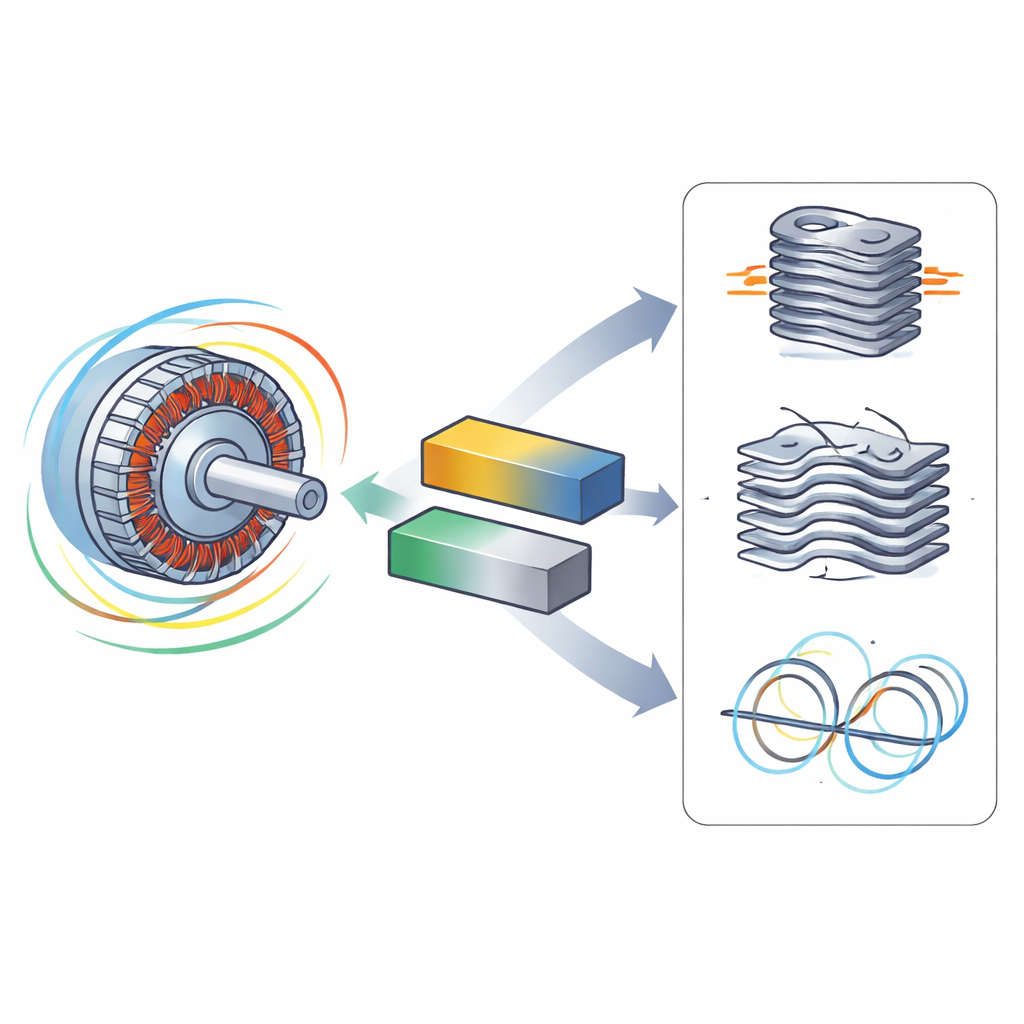
Tuning tiny building blocks inside the metal
Using computer thermodynamic modeling and a series of heat treatments, the authors steer how the internal structure of these alloys develops as they are heated and cooled. At high temperatures the material is a single, uniform phase. On cooling, extremely small, ordered particles just a few billionths of a meter across appear inside the matrix. In one alloy they remain ultra‑fine and numerous; in the other they can be grown or reshaped by additional rolling and annealing steps. Advanced microscopes and atom‑by‑atom mapping confirm that these particles are rich in nickel and titanium and remain coherently embedded in the surrounding metal, acting like evenly dispersed nanoscale reinforcements.
Strength without losing magnetic softness
Mechanical tests reveal that both alloys are far stronger than the original cobalt‑iron‑nickel metal while still stretching considerably before breaking. Depending on processing, they reach yield strengths from about 780 to 1200 megapascals—roughly two to three times that of many commercial soft magnetic alloys—yet retain elongations between 18% and 35%. At the same time, magnetic measurements show low coercivity, meaning the material’s magnetization flips easily as a motor turns, and reasonably high saturation magnetization, which determines how much torque a motor can deliver. By keeping the strengthening particles very small, the authors minimize their tendency to pin magnetic domain walls, so the material stays magnetically soft even as it becomes mechanically robust. 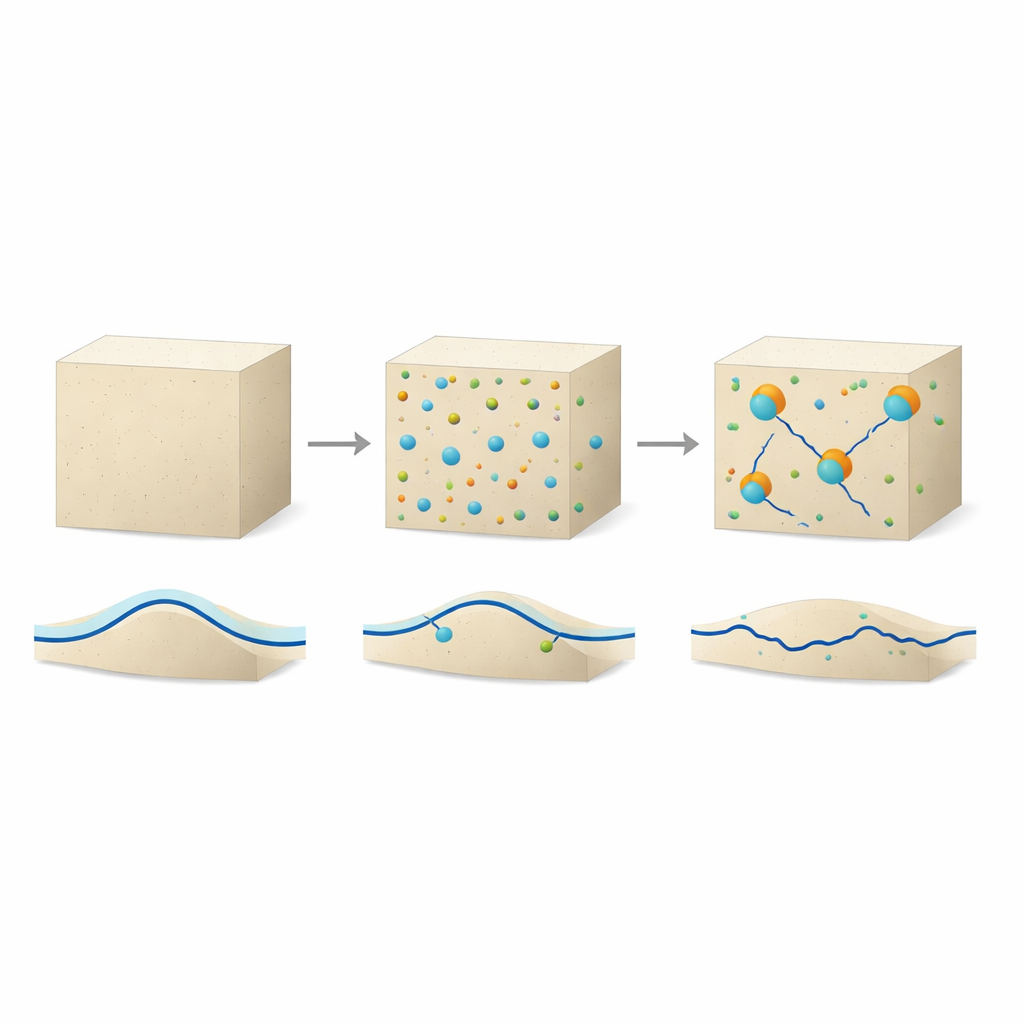
Beating energy losses with electrical resistance
A crucial advantage of these high‑entropy alloys is their very high electrical resistivity, several times that of standard motor alloys. When metal parts in a motor experience rapidly changing magnetic fields, circulating currents form and waste energy as heat. The complex mix of elements and the presence of nanoscale particles cause strong scattering of electrons, sharply cutting these eddy currents. One of the new alloys, in its simplest heat‑treated state, combines low coercivity, high magnetization, excellent strength, and exceptional resistivity, placing it in a favorable corner of performance charts that compare many commercial and experimental soft magnetic materials.
Toward better, cheaper, and lighter machines
In everyday terms, this work shows how tweaking the ingredient list and heat‑treating schedule of a metal can tune the size and spacing of invisible atomic clusters to achieve an otherwise elusive combination of properties. The titanium‑rich alloy in particular offers strong, ductile, magnetically soft behavior with very high resistance to electrical losses, all without relying on scarce tantalum. These Ta‑free high‑entropy alloys could enable lighter, more efficient, and more durable electric motors and energy‑storage rotors, helping future vehicles and power systems waste less energy and run more reliably.
Citation: Sarkar, S.K., Keskar, N., Tan, L.P. et al. A magnetically soft yet mechanically strong and ductile Ta free CoFeNi high entropy alloy with Al and Ti additions. Nat Commun 17, 2890 (2026). https://doi.org/10.1038/s41467-026-68891-6
Keywords: soft magnetic alloys, high entropy alloys, electric motors, nanoprecipitates, electrical resistivity