Clear Sky Science · en
Carbon sequestration for geological negative emissions of the shale gas value chain in China
Turning a Problem into a Hidden Climate Helper
Burning fossil fuels is a major driver of climate change, yet the world still depends heavily on them for energy. This study explores an intriguing question: can a fossil-fuel industry not only cut its pollution, but actually pull more carbon dioxide out of the atmosphere than it emits? Focusing on China’s rapidly growing shale gas sector, the researchers show how carefully designed operations could transform shale gas from a climate liability into a powerful underground carbon sponge.
Why Shale Gas Matters for China and the World
China’s shale gas production has skyrocketed over the past decade, helping the country reduce its reliance on imported gas and replace some coal in power plants and factories. That switch can lower air pollution and carbon emissions, but shale gas still releases large amounts of greenhouse gases during drilling, processing, transport, and final use. Leaky equipment, flaring of gas, and the sheer amount of fuel burned all add up. Because China’s geology and regulations differ from those in the United States—the most studied shale producer—understanding China’s own shale gas footprint is crucial for assessing global climate progress.
Using Carbon Itself as a Tool
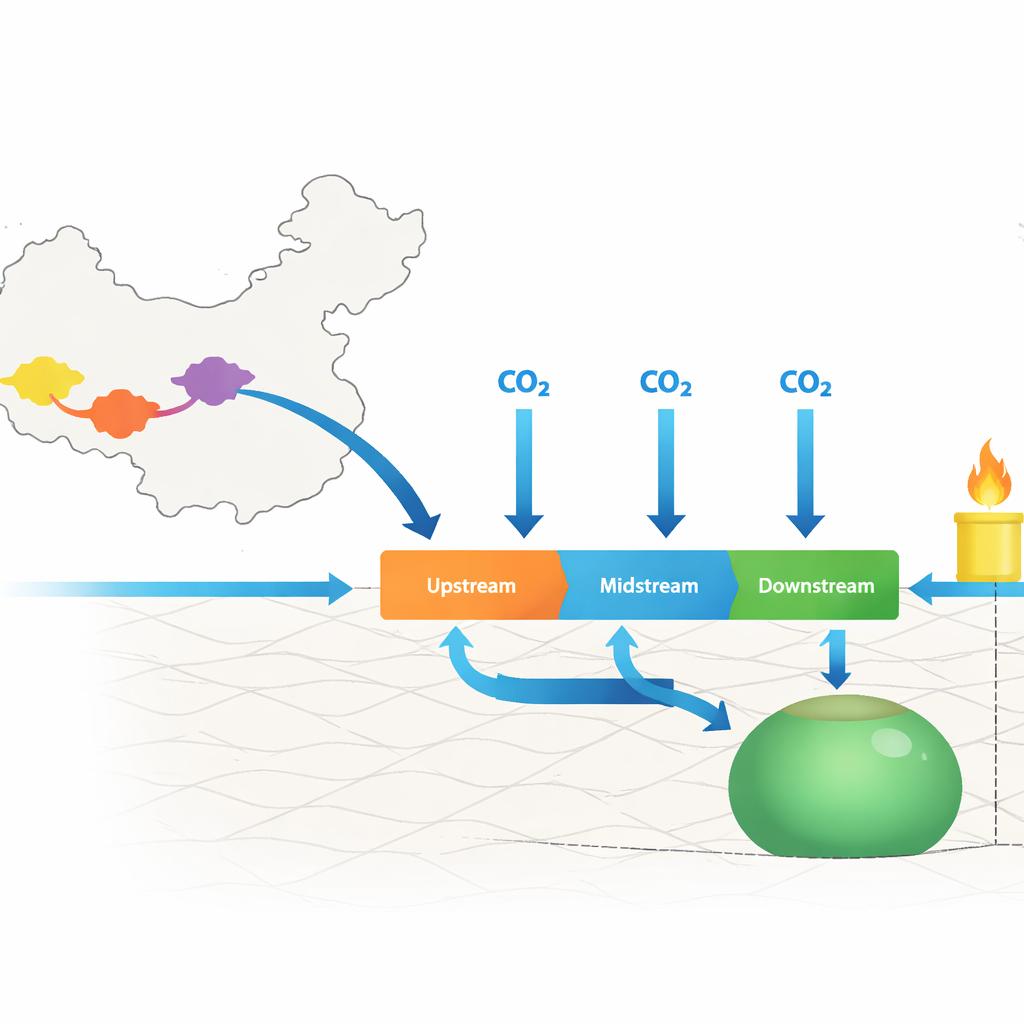
The heart of this work is a family of approaches that use carbon dioxide not just as waste, but as a working fluid and long-term guest underground. The team looks at three main techniques. In the first, high-pressure carbon dioxide is used instead of water to crack the rock and open pathways for gas. In the second, carbon dioxide is injected in cycles into an aging well to push out more gas. In the third, once the gas is mostly gone, the depleted well is turned into a storage site, with carbon dioxide occupying the freed pore space. Together, these methods both boost gas recovery and lock carbon underground in several ways: trapped in rock structures, stuck to mineral surfaces, and slowly transformed into stable compounds.
From Carbon Source to Carbon Sink
To test what is possible, the researchers build a full “life story” of shale gas in China—from well pad construction through drilling, production, pipelines, and final use—then overlay different future strategies. Under business-as-usual, the shale gas value chain remains a large emitter of carbon dioxide and methane. But when better leak detection, smarter production methods, and systematic use of depleted wells for storage are combined, the picture flips. Across China’s main shale basins, the study finds that the industry could, in theory, bury more carbon than it emits, turning it into a net “geological negative emissions” system. The potential sink is huge: tens of billions of tonnes of carbon dioxide equivalents, comparable to several years of China’s current national emissions, while also raising total gas production.
Money, Rocks, and Regional Differences
Climate benefits alone are not enough—companies also need to make money. The team therefore couples environmental analysis with financial modeling, tracking costs and revenues over the entire life of a typical project. They find that results vary sharply by region. In the Sichuan Basin, where the rock is especially well-suited and infrastructure is advanced, many negative-emission setups already look profitable or close to it. In other basins with more challenging geology, the extra costs of capturing, transporting, and injecting carbon dioxide outweigh the earnings from additional gas, unless carbon prices are high or subsidies are provided. International-style carbon prices greatly expand the number of profitable projects, suggesting that stronger market signals could unlock much of this potential.

What This Means for a Net-Zero Future
Overall, the study shows that with the right mix of engineering, policy, and finance, shale gas operations in China could move from being a stubborn source of climate pollution to part of the solution—storing significant amounts of carbon underground while supplying energy. This will not be easy: it demands careful monitoring to avoid leaks, rigorous management of earthquake risks, and robust carbon pricing or targeted support in less favorable regions. But if these hurdles are addressed, the approach offers a practical pathway for countries rich in shale resources to help stabilize the climate while they transition to cleaner energy systems.
Citation: Hong, P., Guo, M., Liang, S. et al. Carbon sequestration for geological negative emissions of the shale gas value chain in China. Nat Commun 17, 3504 (2026). https://doi.org/10.1038/s41467-026-68829-y
Keywords: shale gas, carbon storage, negative emissions, carbon pricing, energy transition