Clear Sky Science · en
The endomicrobiome and weed invasiveness in Mediterranean ecosystems worldwide
Hidden helpers inside a common weed
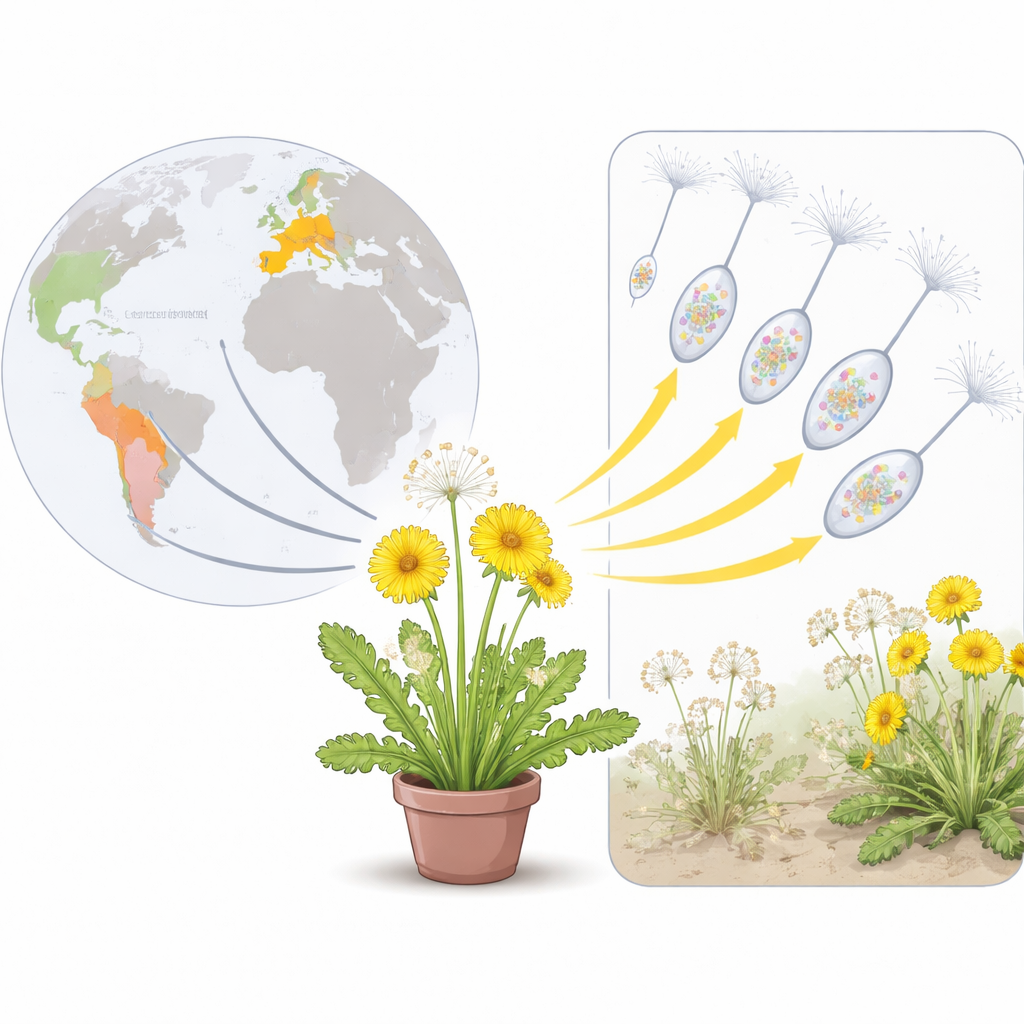
Across the world’s Mediterranean-climate regions, from California to Chile and South Africa, a familiar plant quietly reshapes landscapes: the common dandelion. This study asks a deceptively simple question with big consequences for conservation and agriculture: do the microscopic organisms living inside dandelion seeds help turn this ordinary weed into a global invader? By following dandelions over several generations in controlled experiments, the researchers show that these hidden partners can strongly boost the weed’s growth, reproduction, and ability to push aside native plants.
Why some weeds take over
Mediterranean ecosystems cover only about five percent of Earth’s land but host roughly one-fifth of all plant species. They are also home to hundreds of millions of people who depend on these landscapes for water, food, and recreation. Invasive plants threaten this richness by consuming resources, altering fire regimes, and costing economies billions of dollars. Scientists know that invaders often adapt quickly to new climates and conditions. But beyond genes and seeds, plants also carry an “inner world” of bacteria and fungi inside their tissues. These endomicrobiomes are known to enhance nutrient uptake and stress tolerance, yet their role in helping weeds become invasive has remained largely unexplored.
Following dandelions through time
The team focused on Taraxacum officinale, the common dandelion, collected from Mediterranean-type ecosystems on five continents. They grew plants for five generations under identical greenhouse conditions, but split them into two lines: one kept its natural seed-borne microbes intact, while the other had these microbes greatly reduced using targeted antibiotic and fungicide treatments that did not otherwise harm the plants. In each generation, only the best-performing individuals—those with the greatest photosynthesis, most flower heads, and highest viable seed output—were chosen to produce the next generation. In parallel, the researchers compared how early (first-generation) and later (fifth-generation) dandelions holding their microbes competed against closely related native daisy family species from each region.
Microbes that sharpen a weed’s competitive edge
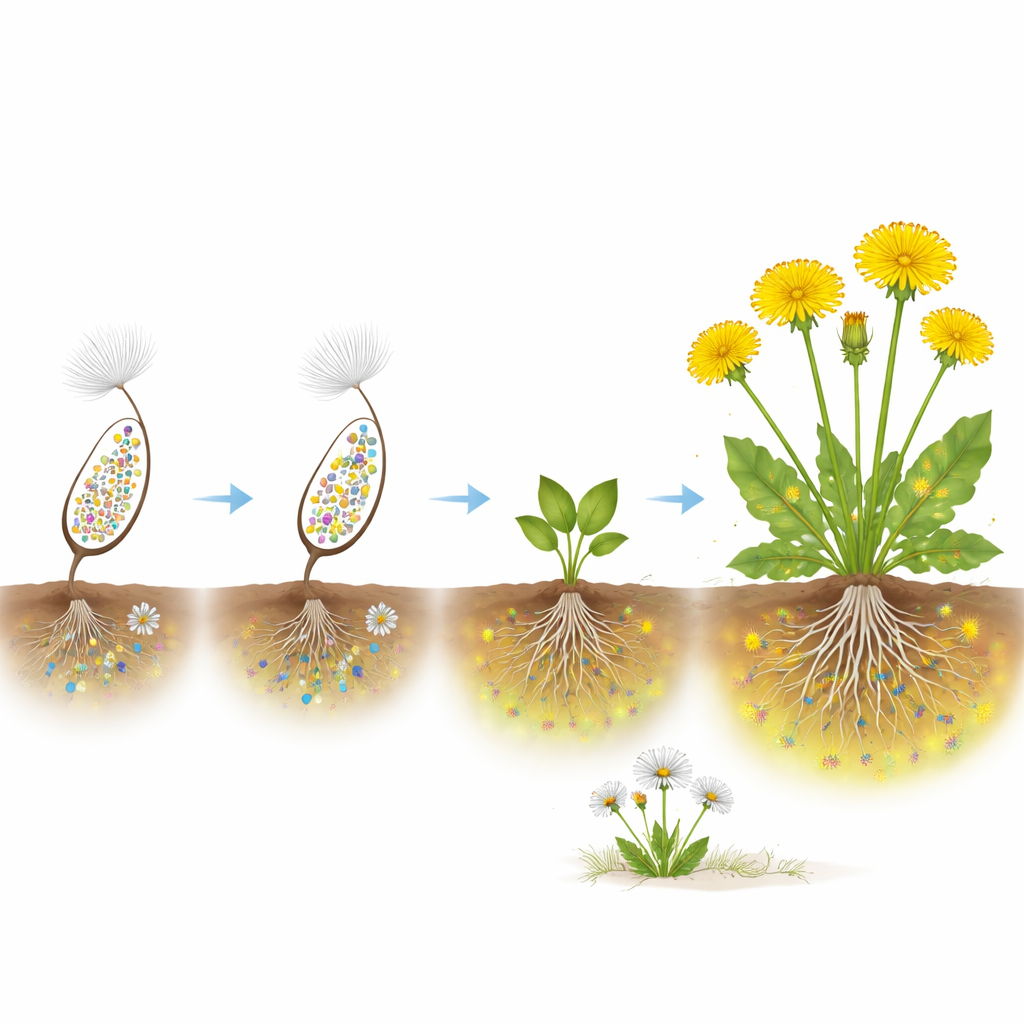
Over five generations, dandelions that retained their inner microbes consistently improved faster than those with reduced microbial partners. Microbe-rich plants captured more energy through photosynthesis, produced more flowers, and set more viable seeds. In contrast, plants with depleted endomicrobiomes showed slower or even negative changes in these traits, depending on their continent of origin. When pitted against native daisies, later-generation dandelions with intact microbes gained biomass and inflicted increasingly strong losses on their neighbors. At the same time, soils and plant tissues around these invasive dandelions accumulated higher levels of phenolic compounds—chemicals known to defend plants and to inhibit the growth of competitors—particularly when dandelions grew in direct competition rather than alone. Native species did not show a similar rise in these compounds across generations.
Signals from the plant’s control room
To understand how microscopic partners might drive such changes, the researchers examined activity levels of several genes linked to stress tolerance, chemical defenses, and seed production. Across continents, dandelions with intact endomicrobiomes generally turned up the activity of genes connected to drought and heat tolerance and to the synthesis of phenolic compounds. Another gene associated with maintaining DNA methylation—a mechanism that can stably adjust gene activity without altering the genetic code—was also more active, hinting that the microbes may help establish longer-lasting shifts in how the plant responds to its environment. A gene that normally slows growth-related signals was less active in microbe-rich plants, consistent with their greater flower production. Although responses varied somewhat among regions, the overall pattern suggests that inner microbes help re-tune the dandelion’s molecular control systems in ways that favor invasiveness.
Rethinking weed control from the inside out
For non-specialists, the central message is that the dandelion’s success is not just about the weed itself, but also about the microscopic passengers it carries from place to place inside its seeds. These inner communities can, over only a few generations, make dandelions grow faster, produce more seeds, and release more chemical “weapons” into the surrounding soil, giving them a strong edge over native plants. Understanding and perhaps disrupting these partnerships could open new avenues for managing invasive weeds that rely less on broad-spectrum herbicides and more on carefully steering plant–microbe relationships. In short, the study reveals that to curb some of our most troublesome weeds, we may need to start thinking from the inside out.
Citation: Molina-Montenegro, M.A., Acuña-Rodríguez, I.S., Atala, C. et al. The endomicrobiome and weed invasiveness in Mediterranean ecosystems worldwide. Nat Commun 17, 3063 (2026). https://doi.org/10.1038/s41467-026-68826-1
Keywords: invasive plants, plant microbiome, dandelion, Mediterranean ecosystems, weed management