Clear Sky Science · en
Carbonated mantle peridotites represent a hidden sink for subducted CO2
Why Earth’s Hidden Carbon Matters
Carbon dioxide does not just move between air, oceans, and life at the surface. Huge amounts are dragged deep into Earth where they can be locked away for millions of years, helping to keep the planet’s climate in balance. This study looks at an unusual set of rocks in Oman that appear to have trapped a vast quantity of carbon deep underground. By working out how, when, and from where that carbon arrived, the authors shed new light on a “missing” part of Earth’s long‑term carbon cycle.
Where Ocean Floor Meets the Deep Earth
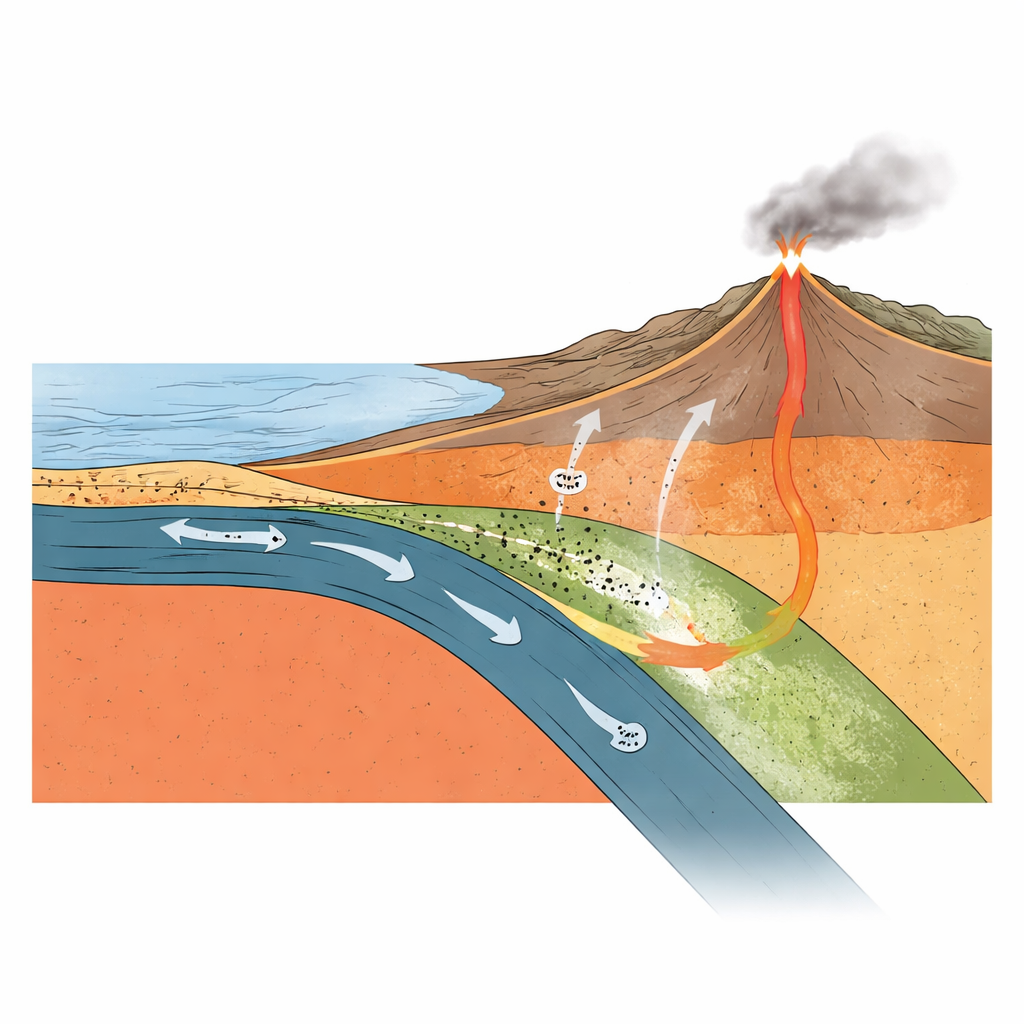
At some plate boundaries, an oceanic plate bends and sinks beneath another plate in a process called subduction. Sediments and altered oceanic crust on this plate are rich in carbon‑bearing minerals and watery fluids. As they descend, they heat up and release fluids that can rise into the overlying mantle wedge. In Oman, a large slice of ancient ocean floor and upper mantle, called the Semail Ophiolite, has been thrust up onto land, preserving a cross‑section through a former subduction zone. Within this slice, the researchers examined a drill core (Hole BT1b) that passes from relatively little‑changed mantle rocks into bright, fully carbonated rocks known as listvenites, which together may have naturally stored around one billion tons of CO2.
Rocks That Tell Fluid Stories
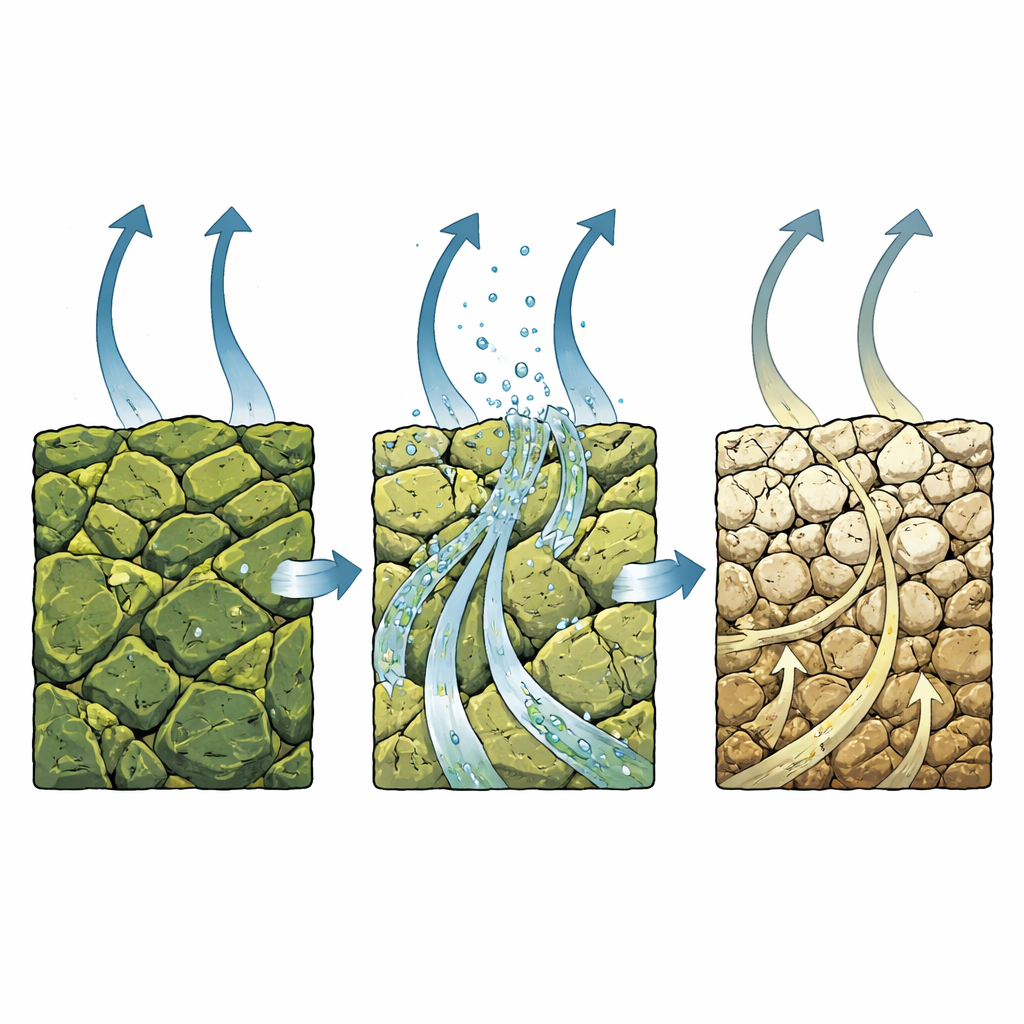
As carbon‑rich fluids move through hot rock, they leave chemical fingerprints behind. The team focused on halogens—fluorine, chlorine, bromine, and iodine—which prefer to travel in fluids rather than in solid minerals. By using high‑precision micro‑analysis to measure these elements in tiny patches of serpentine, carbonate, and other minerals across the transition from partly altered to fully carbonated rock, they tracked how fluids moved and changed. They found that as serpentinite gradually turned into carbonate‑rich listvenite, chlorine was expelled far more strongly than bromine or iodine. This created evolving fluids with distinctive halogen ratios that could be matched to likely sources deeper in the subduction zone.
Following the Path of Hidden Carbon
The halogen patterns show that the fluids that did most of the carbonating were not just shallow seawater squeezed from sediments. Instead, they were mixtures of sedimentary pore waters with an extra dose of CO2‑rich fluid rising from deeper in the subducting slab, where heating causes carbonates to dissolve or break down. Modeling of how the fluid chemistry had to evolve to match the rock data indicates that these fluids must have carried unusually high amounts of carbon compared with salt. As these fluids entered the forearc mantle—the region above the slab but in front of the volcanic arc—they reacted with peridotite and serpentinized rocks, turning them stepwise into listvenite and locking dissolved CO2 into solid, stable carbonate minerals that can persist for geological time.
Untangling Conflicting Clocks
Previous age measurements on carbonate veins in similar rocks suggested that some listvenites in Oman formed long after subduction in this region had ended, implying a more local and recent origin for the fluids. This new work shows that the main phase of carbonation in the studied drill core is chemically tied to subduction‑related fluids, not to later events. The authors distinguish two stages: an early, magnesite‑rich stage linked to subduction fluids with one halogen signature, and a later, more calcium‑rich stage involving dolomite that has a different halogen pattern and likely reflects younger tectonic or magmatic activity. The younger ages, they argue, mostly date this second, overprinting episode rather than the original large‑scale trapping of carbon.
What This Means for Earth’s Climate Engine
By combining the fluid chemistry with independent estimates of how much pore water escapes from sediments worldwide, the researchers estimate that CO2‑rich fluids moving from deeper slab levels into the forearc mantle could carry roughly 1.7–3.4 × 10¹³ grams of carbon per year. That could account for a large fraction—possibly up to 90 percent—of the carbon entering subduction zones. In other words, rocks like these carbonated mantle peridotites may represent a major, previously underappreciated sink that keeps much of the subducted carbon from either returning quickly to the atmosphere via volcanoes or plunging into the deep mantle. Because the conditions that create such rocks depend on factors like temperature, sediment type, and tectonic setting, this hidden carbon trap may have varied in strength through Earth’s history, subtly steering the planet’s long‑term climate.
Citation: Carter, E.J., O’Driscoll, B., Burgess, R. et al. Carbonated mantle peridotites represent a hidden sink for subducted CO2. Nat Commun 17, 3297 (2026). https://doi.org/10.1038/s41467-026-68646-3
Keywords: subduction zone carbon, mantle carbonation, listvenite, forearc mantle, global carbon cycle