Clear Sky Science · en
Global remapping of the sensory homunculus emerges early in childhood development
How the Brain Adapts When a Hand Is Missing from Birth
What happens in the brain when a child is born with only one hand? Our sense of touch and movement is organised in a kind of internal "body map" on the surface of the brain. This study asks whether that map slowly reshapes over childhood as children learn clever new ways to use their bodies, or whether most of the change happens very early in life and then stays largely fixed. The answer matters for how we think about brain plasticity and for the timing of therapies and technologies for children born with limb differences.
Everyday Ingenuity: Many Ways to Do a Two-Handed Task
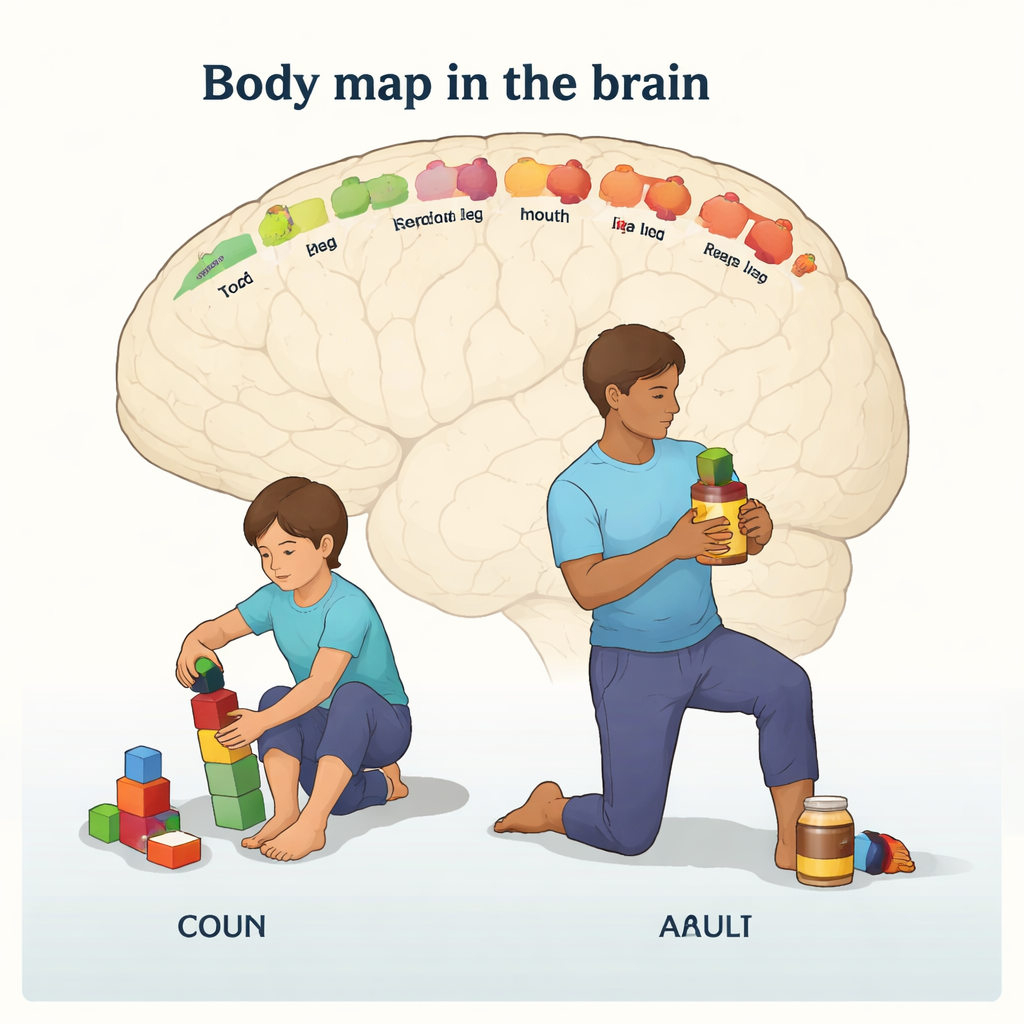
The researchers first looked at how people with a congenital upper-limb difference actually live and move. Children aged 5–7 and adults born with one missing hand were filmed while doing 15 everyday tasks that most people normally do with two hands, such as opening containers, separating Lego bricks or undoing a bolt. The team measured which body parts were used, and for how long, during each task. They found that children with limb differences used a richer mix of body parts than either adults with limb differences or two-handed children. Feet, legs, torso, residual arm and even the mouth were often recruited to help the intact hand. Adults with limb differences still used these alternative strategies more than two-handed adults, but their movements were less varied than those of the children.
Probing the Hidden Body Map in the Brain
Next, the scientists asked how this inventive behaviour relates to the brain’s internal body map. Using functional MRI, they gently vibrated different body parts—chin, residual arm or wrist, torso, leg, foot and thumb—while participants watched cartoons in the scanner. Safe soft "air cushions" delivered the vibrations to avoid metal in the MRI. In people with two hands, each body part produced a distinct stripe of activity along the brain’s sensory strip, in the classic order from foot (near the top of the brain) down to face (near the side). This confirmed that the method could cleanly separate responses from different body regions, even in young children, and that overall data quality was similar across age groups and limb conditions.
The Missing-Hand Area Is Reused Early and Broadly
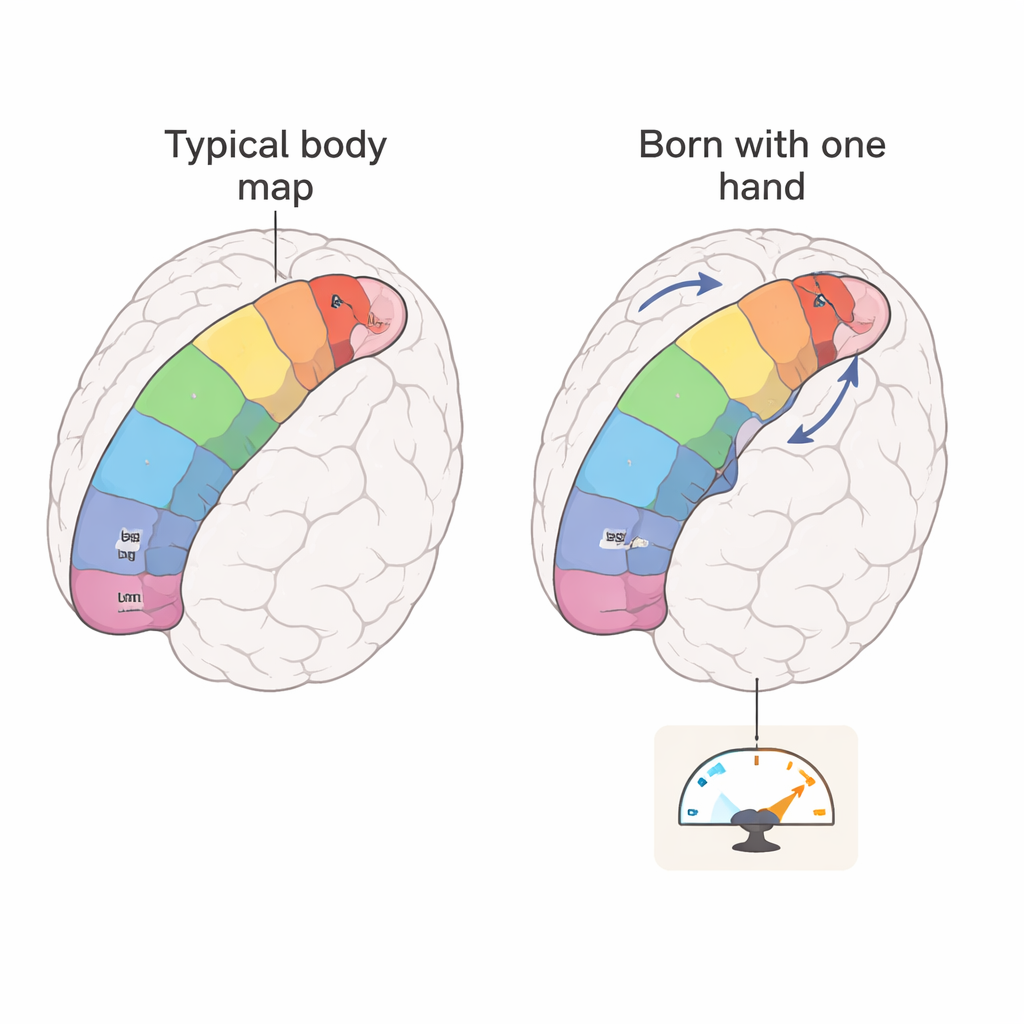
When the team zoomed in on the brain region that would normally respond to the missing hand, they found it was far from silent. In both children and adults with limb differences, this patch lit up strongly when other body parts were stimulated, especially the residual arm and lower face, which neighbour the hand area on the brain’s surface. Even the foot, which is usually represented far away, showed signs of encroaching into the hand zone. A more detailed pattern analysis showed that the deprived hand region carried distinct information about several different body parts, not just one. Crucially, these changes were already present in children as young as five, suggesting that large-scale remapping of this area happens very early in development and is then largely maintained into adulthood.
A Whole-Body Shift in the Brain’s Touch Map
The reorganisation did not stop at the edges of the missing-hand zone. Along the full length of the somatosensory strip, the preferred locations for feet, legs, torso, arm and face were all shifted towards the missing-hand region in people with limb differences. Despite these shifts, the overall order of body parts along the strip remained intact: feet were still more medial than legs, which were still above the torso, arm and face. This pattern was already clear in children and changed only subtly with age, indicating that the global layout of the body map adapts early to the absence of a hand and then stays fairly stable. The researchers built a simple computational model in which the brain automatically boosts weak inputs to keep overall activity levels in balance, a process called homeostatic plasticity. This model could reproduce the broad, global shifts seen in the imaging data without needing to assume complex learning rules.
Behaviour Still Leaves Its Fingerprints
Although early deprivation and automatic balancing processes seemed to do most of the work, behaviour still mattered. When the researchers compared individual children and adults with limb differences to their two-handed peers, those who relied more heavily on a particular compensating body part—such as the feet or torso—tended to have that body part’s representation shifted further towards the missing-hand area. This brain–behaviour link was stronger in children than in adults, hinting that early years may be a particularly sensitive time when everyday habits can fine-tune an already reconfigured map.
What This Means for Children Born with Limb Differences
For a non-specialist audience, the key message is that the brain’s body map is both impressively adaptable and surprisingly stable. In children born without a hand, the brain quickly reallocates the unused hand territory to other body parts, and this remapped layout spans the entire touch strip in the brain by early childhood. Later experiences and compensatory tricks fine-tune this organisation but do not overhaul it. This suggests that therapies or neurotechnology aiming to change basic sensory maps may be most effective if introduced very early in life, and that supporting the creative ways children already use their bodies could help the brain settle into the most useful long-term patterns.
Citation: Tucciarelli, R., Bird, L., Straka, Z. et al. Global remapping of the sensory homunculus emerges early in childhood development. Nat Commun 17, 1591 (2026). https://doi.org/10.1038/s41467-025-66539-5
Keywords: brain plasticity, sensory homunculus, congenital limb difference, somatosensory cortex, child development