Clear Sky Science · en
Impact of stent materials and hemodynamic changes after endovascular aneurysm repair for abdominal aortic aneurysm
Why this matters for people with weak artery walls
As more people live into their seventies and eighties, bulging weak spots in the body’s main artery—abdominal aortic aneurysms—are being found and treated more often. A common minimally invasive fix places a fabric-covered metal tube, called a stent-graft, inside the swollen vessel to prevent deadly rupture. This study asks a deceptively simple question with big implications: does the specific metal and fabric used in these stent-grafts change how stiff the arteries become afterward, and could that stiffness quietly shape who lives longer?
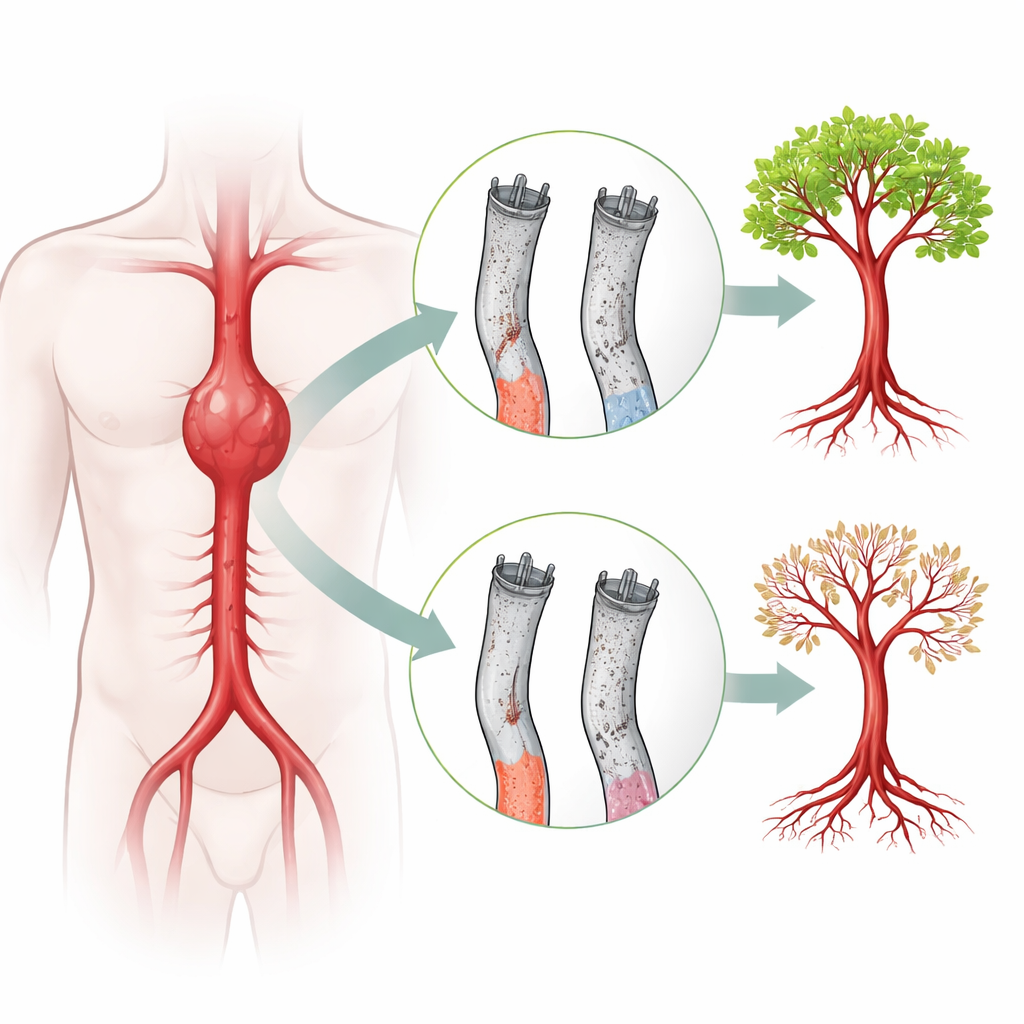
Bulging arteries and the modern plumbing fix
An abdominal aortic aneurysm is a dangerous ballooning of the large artery that runs through the belly. If it bursts, the chance of death is extremely high. To prevent this, many patients now undergo endovascular aneurysm repair (EVAR), in which doctors thread a stent-graft up from the leg and line the inside of the damaged segment, creating a new internal channel for blood. Unlike open surgery, EVAR avoids a big incision and usually has a smoother early recovery. But replacing a stretch of living, elastic artery with a relatively rigid tube can change how each heartbeat’s pressure wave travels through the body, potentially stressing the heart and other vessels in subtle ways.
How the study followed artery “bounce” and patient survival
The researchers tracked 265 older adults with abdominal aortic aneurysms who underwent EVAR at a single center. About half received stents made from nitinol, a flexible nickel-titanium alloy, and half from stainless steel; the graft fabric was either Dacron (a type of polyester) or PTFE (a Teflon-like material). Before the procedure and again one month later, the team measured how fast pressure waves moved from the neck to the groin—carotid-femoral pulse wave velocity, a standard yardstick of arterial stiffness. They also analyzed how much the pressure waves bounced back from the lower body toward the heart. Then they linked these measurements to deaths from any cause over the following two years using national registry data.
What happened to artery stiffness after the repair
One month after EVAR, the repaired arteries behaved noticeably differently. Overall, pulse wave velocity increased, meaning the central arteries had become stiffer, while certain reflection measures fell, suggesting the bulging segment was no longer acting as a major “bounce point” for pressure waves. When the team compared stent types, an important pattern emerged: patients with nitinol stents showed a larger jump in pulse wave speed than those with stainless-steel stents, even after accounting for blood pressure. The two graft fabrics, Dacron and PTFE, produced broadly similar changes in stiffness and wave reflections once blood pressure was factored in, hinting that the metal framework may play a bigger role than the cloth in reshaping the vessel’s mechanical behavior.
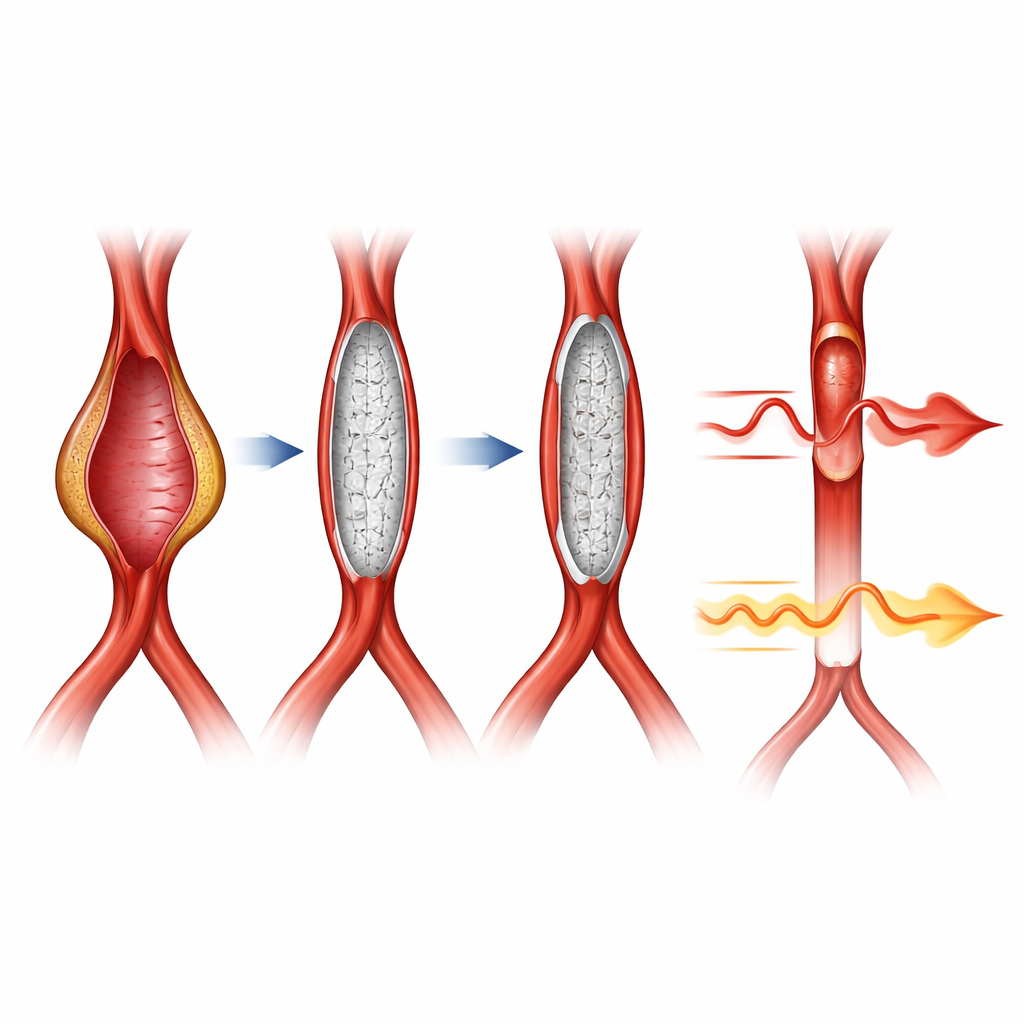
Materials, stiff arteries, and who did worse
Over the two years after their procedures, 25 participants died. Survival curves showed that patients with nitinol stents died more often than those with stainless-steel stents, and those with PTFE grafts fared worse than those with Dacron. When the researchers dug deeper using statistical models that adjusted for age, aneurysm size, kidney function, and other health factors, one signal stood out: people whose pulse wave velocity rose more after EVAR were more likely to die, regardless of which specific device they had received. Both the absolute stiffness after the procedure and the change from baseline were tied to mortality, but the change itself remained the strongest independent predictor once device type and other risks were taken into account.
What this means for patients and future devices
For patients and clinicians, the study’s message is straightforward: the way an aortic repair changes the “springiness” of the central arteries matters for long-term survival. Certain combinations of metals and fabrics were linked to higher death rates, but the common thread was how much the procedure increased arterial stiffness, not simply which brand or model was used. In practical terms, this suggests that future stent-grafts should be designed not only to prevent rupture and fit complex anatomy, but also to preserve as much natural vessel flexibility as possible. Measuring pulse wave velocity before and after EVAR could help identify patients at higher risk, who might benefit from closer monitoring and aggressive control of blood pressure and other cardiovascular hazards.
Citation: Tseng, CH., Huang, WM., Lin, LY. et al. Impact of stent materials and hemodynamic changes after endovascular aneurysm repair for abdominal aortic aneurysm. Hypertens Res 49, 1673–1682 (2026). https://doi.org/10.1038/s41440-026-02595-8
Keywords: abdominal aortic aneurysm, endovascular aneurysm repair, arterial stiffness, stent-graft materials, pulse wave velocity