Clear Sky Science · en
Signatures of repeated genomic selection associated with human-modified landscapes in genetically independent populations of Rhinella horribilis
Why this matters for life in a human-shaped world
As farms, towns, and roads spread, wild animals must cope with hotter conditions, polluted ponds, and fragmented habitats. This study asks how one surprisingly resilient species, the Giant Toad, manages to survive in such altered landscapes. By peering into the toad’s DNA, the researchers show that populations living in separate, human-modified regions appear to be evolving similar genetic solutions to the same stressful conditions.
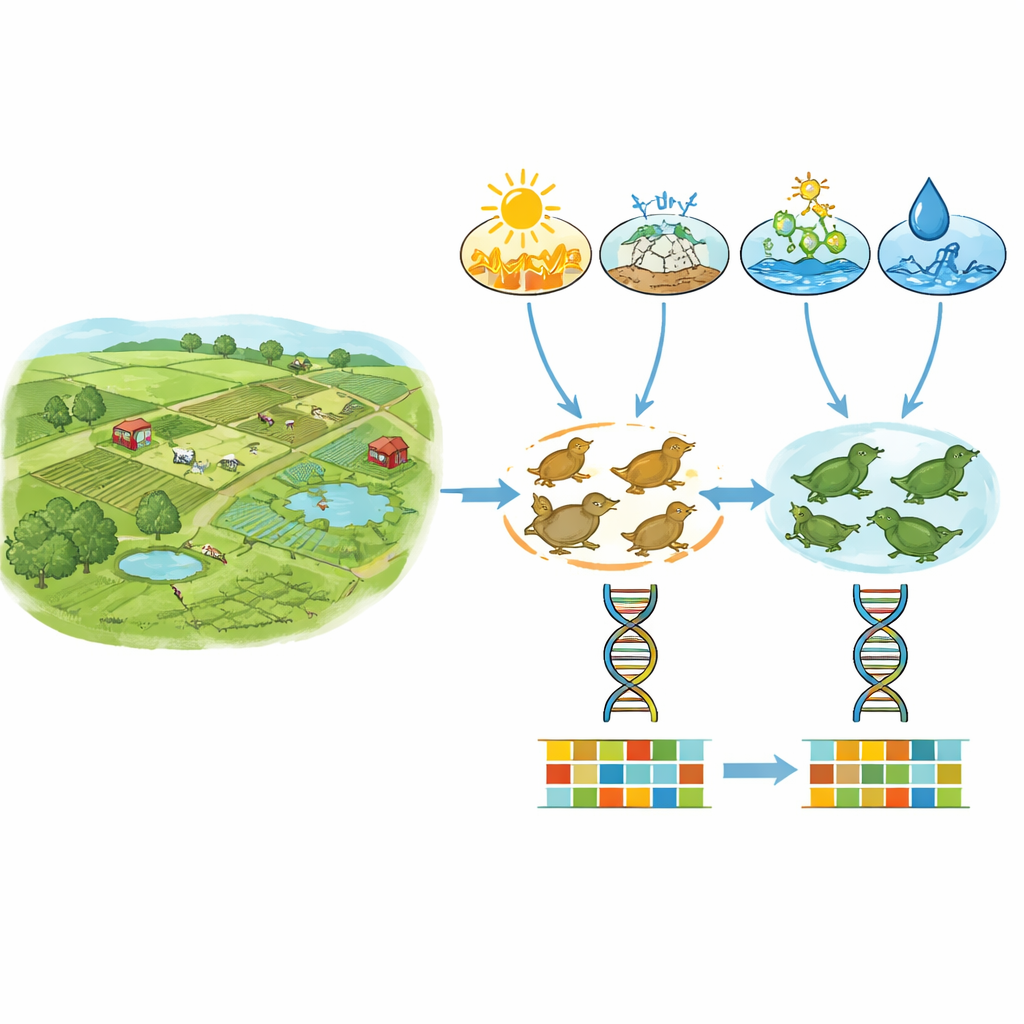
Toads living in tough neighborhoods
The Giant Toad, Rhinella horribilis, breeds in shallow, often temporary pools scattered through agricultural and livestock areas in southern Mexico. These ponds can be far from ideal: they tend to be hot, sun‑baked, low in oxygen, and loaded with dissolved salts and other runoff from nearby fields and settlements. Yet the species is abundant there, hinting that it may be adjusting to these conditions rather than simply enduring them. The authors focused on two such landscapes in the Sierra Madre del Sur mountains. Although separated enough that their toad populations are genetically distinct, both regions share a long history of traditional farming, recently intensified with monocultures, fertilizers, and pesticides, creating a natural experiment in rapid adaptation.
Reading the genetic footprints of the environment
From 190 adult toads across both landscapes, the team extracted DNA and scanned hundreds of thousands of positions in the genome for tiny changes called single‑nucleotide polymorphisms. They then asked whether certain genetic variants were consistently more common in places with particular environmental conditions, such as warmer water, stronger solar radiation, or higher potassium levels. Using three complementary statistical methods, and keeping only DNA sites flagged by at least two of them, they narrowed the search to several hundred promising variants in each landscape. These “candidate” sites, unlike the rest of the genome, strongly tracked differences in climate and water quality, suggesting that natural selection is favoring them.
Same pressures, similar genetic answers
Next, the researchers tested whether the same sets of variants could explain environmental differences in both landscapes, and compared them to large collections of apparently neutral sites. The candidate variants did a far better job of predicting local conditions than random parts of the genome, and this pattern held even when each landscape’s candidates were applied to the other region. This indicates that the associations are not just statistical noise or side‑effects of population history. When the team mapped these variants to known genes, they found hundreds of affected genes in each landscape, with 34 genes shared between them. A statistical test showed that having this many shared genes, and especially the smaller subset involved in specific biological functions, is highly unlikely by chance, pointing to repeated genetic responses to similar human‑driven pressures.
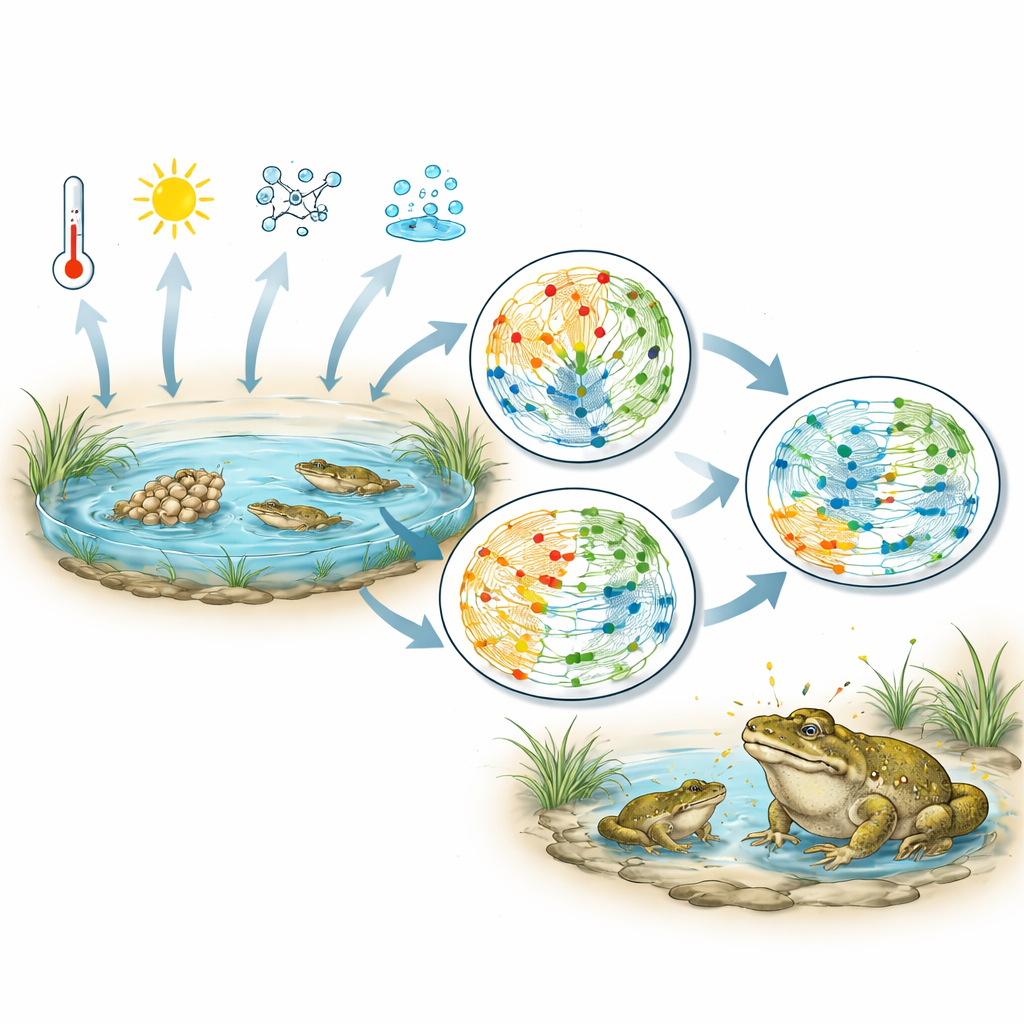
Development, stress, and immunity under pressure
The shared genes are not random: they cluster in processes crucial for embryonic growth, sexual development, and immune defense. Several are tied to the Notch signaling system, which steers how cells specialize during early development and also influences skin structure and pigmentation. Others sit in pathways that help cells respond to stress and control organ formation, as well as in signaling routes that help the immune system recognize and fight microbes and viruses. Importantly, the genetic variants in these genes were linked to harsh pond conditions—high water temperatures, strong solar radiation, low oxygen, and elevated potassium. These same conditions are known from other studies to alter tadpole growth, survival, and susceptibility to disease, suggesting that shifts in these pathways may help toads develop quickly, maintain tissue health, and ward off infections in degraded habitats.
What this means for wildlife in changing landscapes
Altogether, the study shows that Giant Toad populations in two genetically independent regions appear to be evolving in parallel as they face similar combinations of heat, light, poor water quality, and pathogens in human‑modified environments. Rather than relying on a single “super gene,” they tap into sets of existing genes that shape development and immunity, adjusting how these genes are used in stressful settings. For non‑specialists, the key message is that some species can rapidly tailor their biology to survive in human‑dominated landscapes—but this resilience depends on underlying genetic diversity and may not be shared by more sensitive amphibians. Understanding which genes and pathways enable such adaptation can help scientists predict which species are likely to cope with ongoing environmental change, and which will need the most urgent conservation help.
Citation: Soria-Ortiz, G.J., Vázquez-Domínguez, E. Signatures of repeated genomic selection associated with human-modified landscapes in genetically independent populations of Rhinella horribilis. Heredity 135, 289–298 (2026). https://doi.org/10.1038/s41437-026-00831-y
Keywords: amphibian adaptation, human-modified landscapes, giant toad genetics, environmental stress, rapid evolution