Clear Sky Science · en
Quantitative genetics of trauma induced mortality in Drosophila melanogaster
Why tiny flies can teach us about head injuries
Traumatic brain injury from falls, crashes, or explosions can leave lasting disabilities, yet people with seemingly similar injuries often recover very differently. This study uses an unlikely helper—the fruit fly—to explore why. By giving thousands of flies controlled head-like injuries, the researchers show how hidden genetic differences and early-life conditions combine to influence who survives and who does not, offering clues that may one day help explain varied outcomes in human patients. 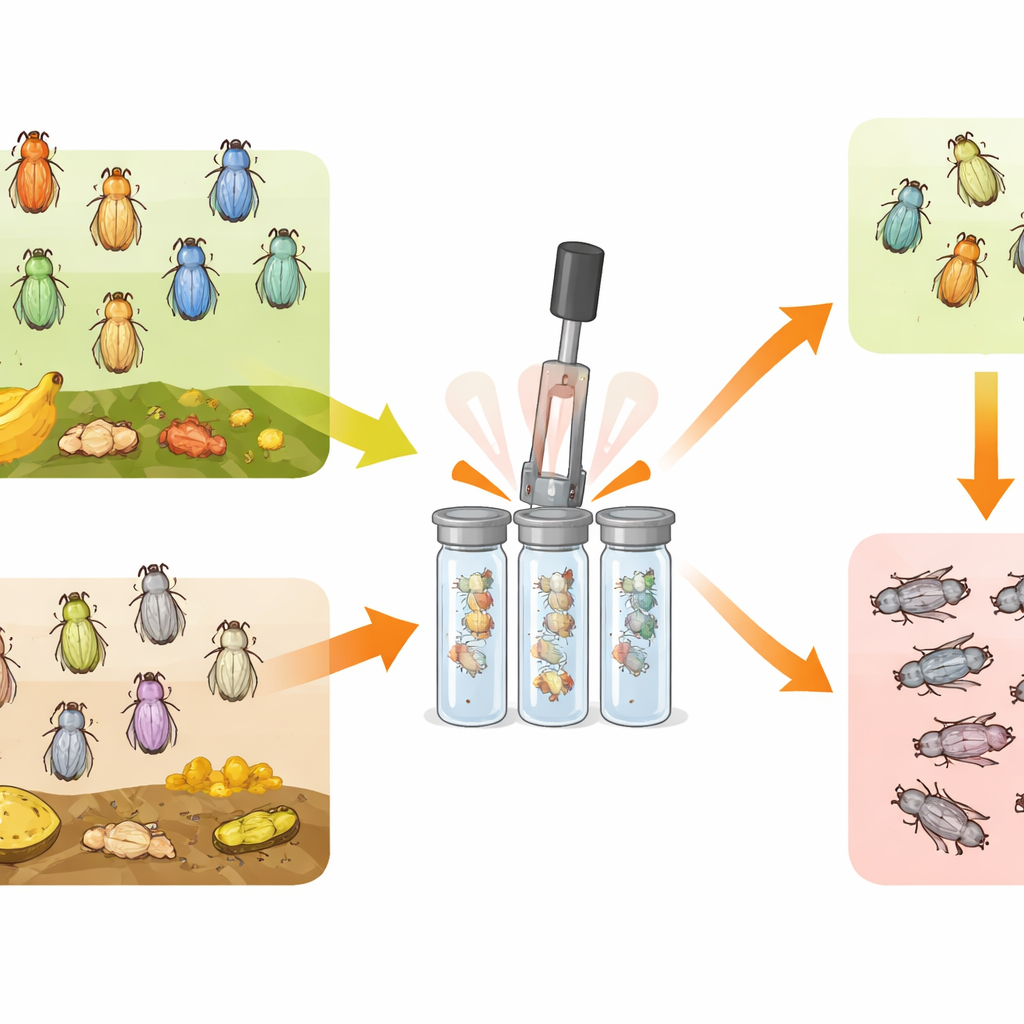
Using flies to mimic a hard knock to the head
To study brain trauma in a precise, repeatable way, the team used a setup that slams vials of flies against a padded surface at a set speed. This “high-impact trauma” injures multiple organs, but earlier work shows that brain damage is a major cause of death in this model. After each round of impact, flies recover for a short time and are then moved to fresh food. A day later, the scientists count how many are alive and compare those numbers with uninjured “sham” groups, creating a simple index of trauma-induced deaths. This system lets them test how family background, new DNA changes, and diet during development all shape survival after injury.
Hidden genetic differences in survival
First, the researchers asked how much of the survival difference after injury is due to genetics. They set up a controlled breeding design in which each father fly was mated to several mothers, then measured trauma-induced deaths among their offspring. This allowed them to estimate how strongly related families resemble each other in their response to injury. The analysis revealed a surprisingly high amount of inherited variation: families differed widely in their risk of dying after trauma, and most of that difference behaved additively, meaning that many small genetic effects stack together. In contrast, comparing closely related inbred flies with more mixed outbred flies showed no strong impact of inbreeding, suggesting that rare harmful variants that only act when doubled up are not the main drivers of this trait.
When new mutations and poor diets tip the balance
The team then asked why so much genetic variation in trauma survival can persist. One idea is that the trait reflects an individual’s overall “condition”—how many biological resources they can draw on to cope with damage. To probe this, they weakened genetic quality by exposing male flies to a chemical that sprinkles new random mutations across their DNA. Their offspring, carrying these fresh mutations, were more likely to die after trauma than offspring of untreated males, even though most mutations were present in only one of the two chromosome copies. Next, the researchers reduced condition by cutting food during the larval stage in half. This diet made adults 16–20% lighter. Smaller flies should experience slightly less force during impact, yet flies raised on poor diets were far more likely to die from the same trauma, showing that lack of resources during growth severely undermines resilience. 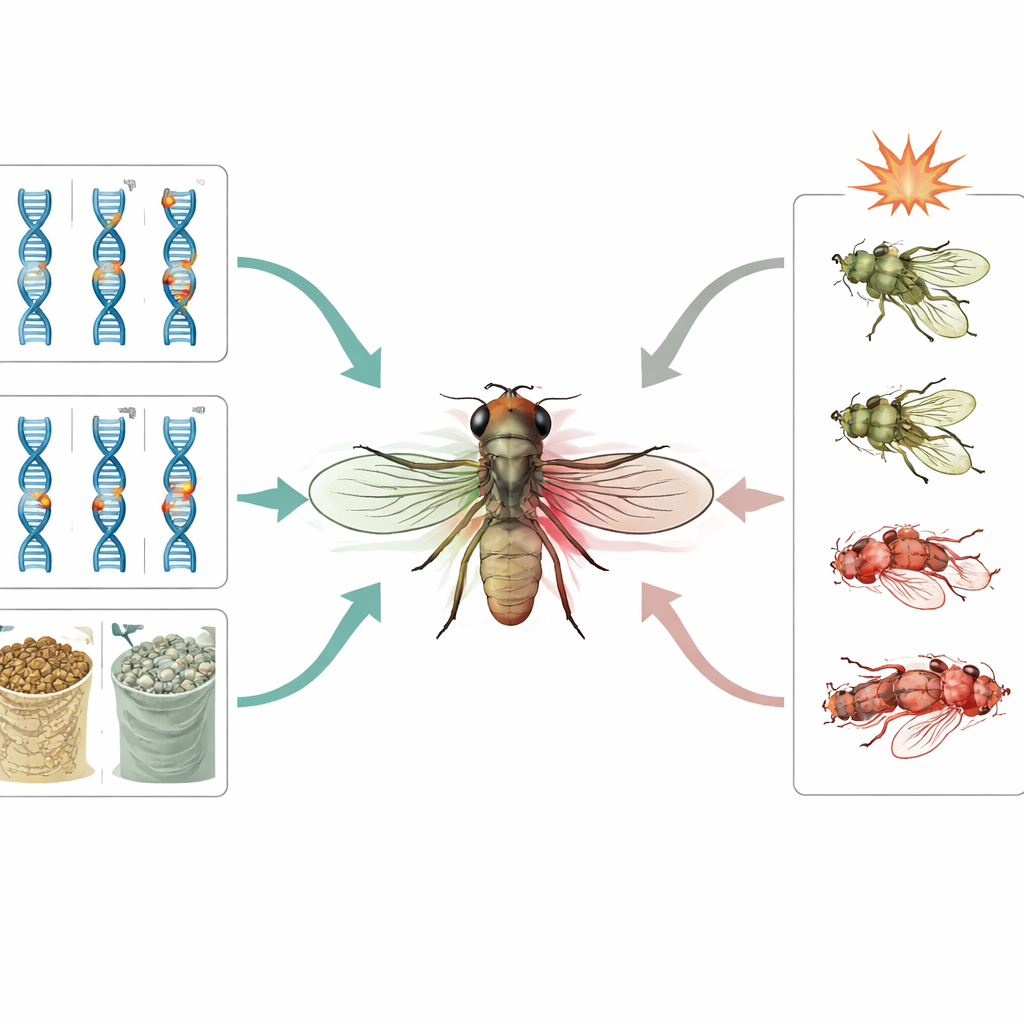
How overall quality connects trauma survival to other life traits
Because both new DNA changes and poor early nutrition increased deaths after trauma, the authors reasoned that survival might mirror an animal’s general biological quality. To test this, they turned to a large panel of inbred fly strains for which many traits have been measured by other labs. For lines where both trauma survival and fitness-related traits were known, they found clear patterns: strains that suffered higher death rates after trauma also tended to have lower survival from egg to adult, produce fewer offspring over their lifetimes, and die younger even without injury. These negative correlations remained even after removing lines carrying a previously identified high-risk variant, implying that many genes across the genome contribute to this shared pattern of vulnerability.
What this means for understanding head injuries
Taken together, the results paint a simple picture: flies that are in poorer overall shape—because of their genetic makeup or because they grew up hungry—are more likely to die after a hard knock. The study shows that trauma outcomes are strongly condition-dependent and influenced by many genes of small effect, rather than a few rare, extreme variants. While fruit flies are far from humans, the work supports the idea that a person’s broader health and life history may be just as important as the immediate injury itself in shaping recovery from a traumatic brain injury.
Citation: Yun, G., Liu, R. & Sharp, N.P. Quantitative genetics of trauma induced mortality in Drosophila melanogaster. Heredity 135, 271–277 (2026). https://doi.org/10.1038/s41437-026-00828-7
Keywords: traumatic brain injury, fruit fly genetics, brain trauma recovery, mutation and resilience, early-life nutrition