Clear Sky Science · en
Trocar sleeve adapter accelerates silicone oil injection in real-world vitreoretinal surgery
Why speeding up eye surgery matters
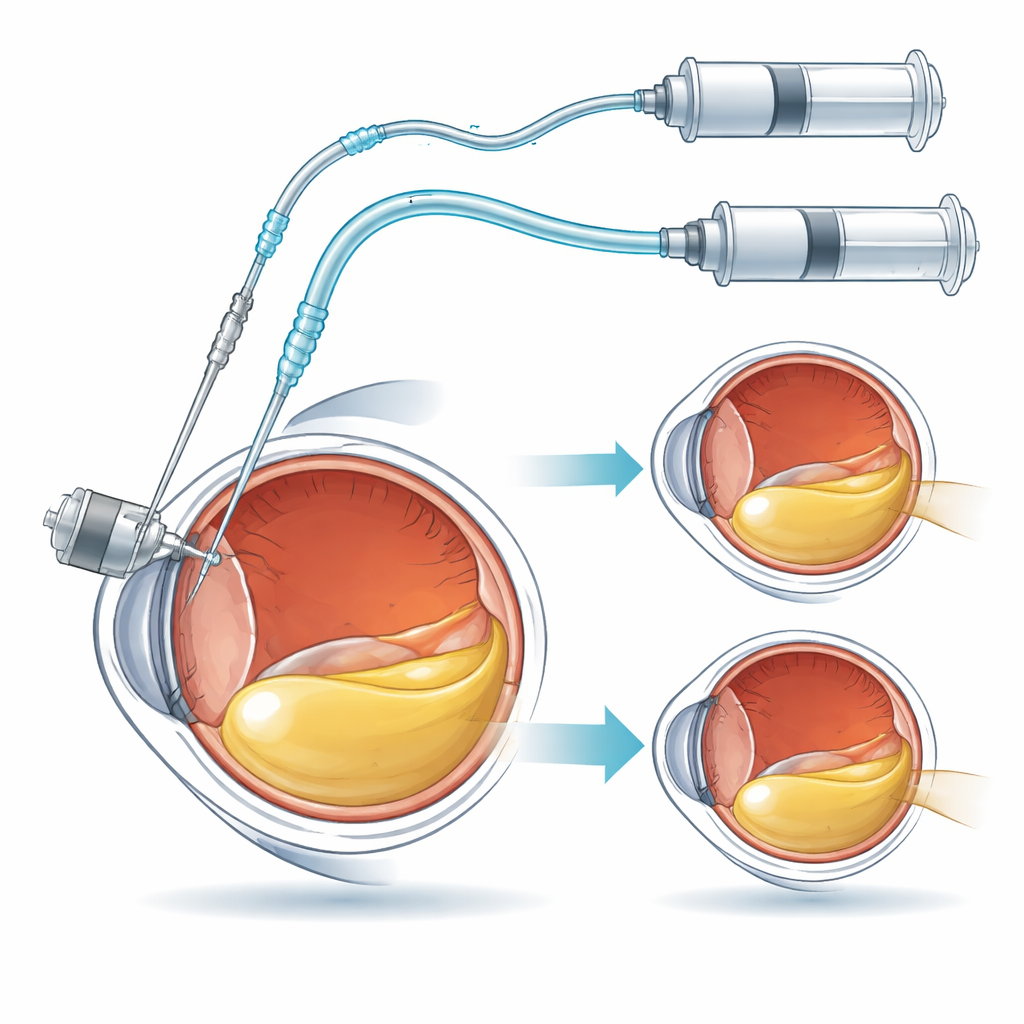
When a person suffers a serious problem at the back of the eye, such as a complicated retinal detachment, surgeons may use a clear, medical-grade silicone oil to hold the fragile retina in place while it heals. These operations are delicate and time‑consuming, and every extra minute in the operating room means more cost, more time under bright light for the retina, and a longer period during which infection could, in theory, take hold. This study explores a simple hardware change in the surgical setup that makes injecting this silicone oil much faster, without adding new risks for patients.
A bottleneck in modern retina repair
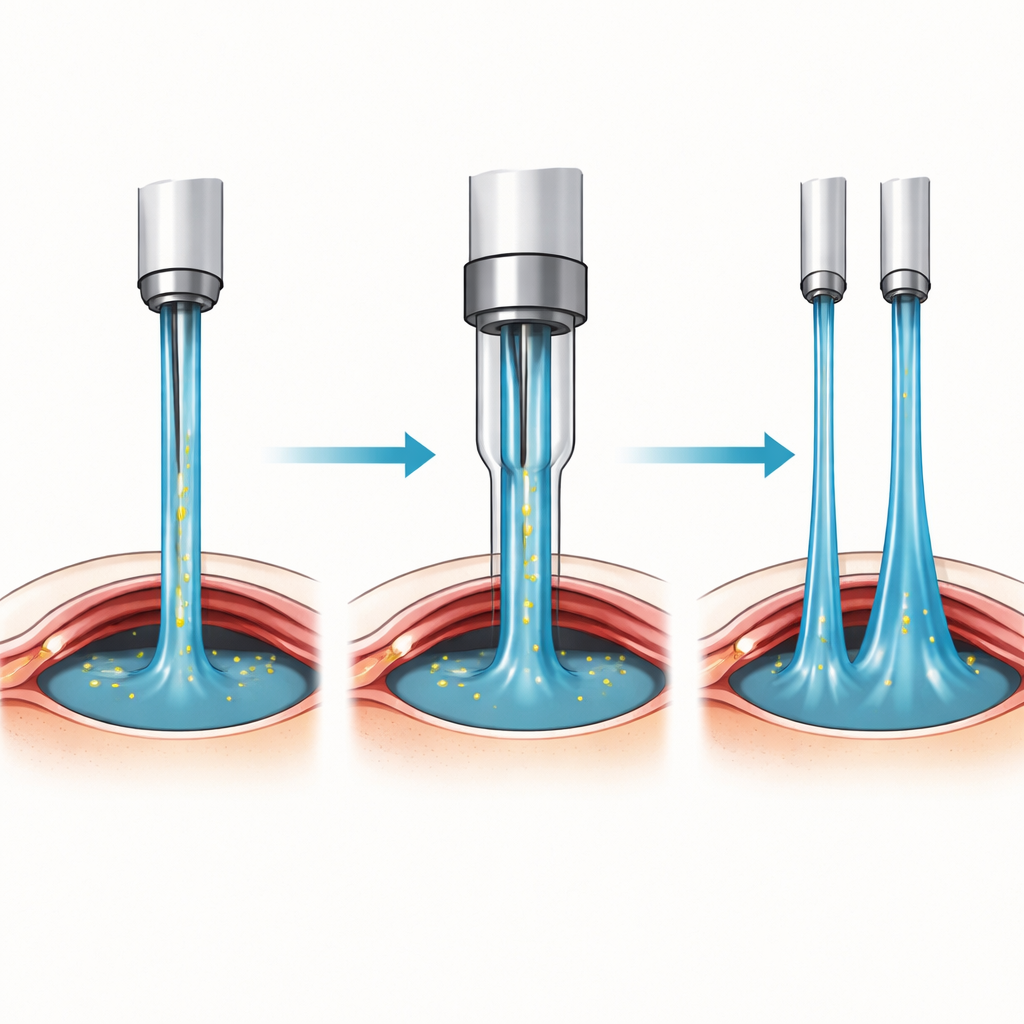
Silicone oils come in different thicknesses. Thinner oils are easier and quicker to inject, but they tend to break up into tiny droplets inside the eye, which can cloud vision. Thicker oils are more stable but notoriously slow to inject: delivering just a few millilitres can take around ten minutes. At the same time, modern eye surgery has moved toward ever‑thinner instruments to reduce trauma, but this slimming of tubes and ports makes the flow of thick oil even slower. Some surgeons have begun choosing thinner, less ideal oils simply to avoid long injection times, highlighting a need for smarter ways to deliver the oil.
A simple change in the oil’s pathway
The key idea in this work is to widen the tightest point in the oil’s path into the eye. Normally, the silicone oil passes through a thin infusion tube that runs inside a tiny metal port, called a trocar, already anchored in the eye wall. In the new approach, the team uses a so‑called trocar sleeve adapter that slips over the outside of this port instead of inserting another tube inside it. This simple rearrangement effectively enlarges the narrowest section of the pathway, allowing oil to flow more freely. The adapter was originally designed to suck oil out of the eye; here, the authors tested whether it could also speed oil going in during real‑world operations.
How the study was carried out
The researchers reviewed 105 eye surgeries performed with the same size ports and platform, carried out by five experienced retina surgeons. All surgeries required silicone oil to stabilize the retina, either for a first detachment, a repeat detachment, or an oil exchange in an unstable eye. Half of the eyes received oil through the standard thin infusion tube, while the other half used the wider trocar sleeve adapter. Two commercially available oils were compared: a relatively thin blend (Densiron 68) and a very thick oil (DORC Silicone 5000). The team timed only the active filling phase—from the first press of the foot pedal until the last air bubble left the eye—and also tracked vision measures, eye pressure, and any device problems.
How much faster the new route was
The difference in speed was striking. For the thinner oil, average injection time dropped from about 4 minutes and 20 seconds to roughly 1 minute and 30 seconds when the adapter was used. For the thicker oil, filling time plunged from nearly 13 minutes to about 2 and a half minutes. Even after adjusting these numbers for different eye sizes, the time savings remained threefold for the thinner oil and fivefold for the thicker one. Statistical analyses confirmed that both the type of oil and the type of device strongly influenced how long injections took, while the patient’s age did not. Only three brief disconnections between the adapter and the port occurred, all easily corrected, and no serious complications or harmful pressure spikes were seen in either group.
What this could mean for patients and surgeons
For patients, shorter silicone oil injections can translate into shorter overall operations, less exposure to bright surgical lights, and a potentially lower window of risk for infection. For surgeons, the adapter makes using thick, more stable oils more practical in everyday practice, without giving up the benefits of small, minimally invasive ports. Although this study was not randomized and cannot on its own prove cause and effect, it shows that a widely available adapter can cut injection times dramatically while appearing safe in routine use. Future, more rigorous trials will need to confirm these findings, but the message is clear to a lay reader: a small tweak to the plumbing of eye surgery may substantially ease a big challenge in repairing fragile retinas.
Citation: Wakili, P., Englisch, C.N., Rudolph, C.N. et al. Trocar sleeve adapter accelerates silicone oil injection in real-world vitreoretinal surgery. Eye 40, 783–788 (2026). https://doi.org/10.1038/s41433-026-04279-6
Keywords: vitreoretinal surgery, silicone oil injection, retinal detachment, trocar sleeve adapter, ophthalmic devices