Why kidney gene reports may not tell the whole story
Genetic tests are often treated as final answers for people with inherited kidney problems. This study shows that, for a group of conditions called Alport spectrum disorders, many older test reports are less clear-cut than they first appeared, and that careful re-checking can turn once “certain” answers into maybes.
What is Alport spectrum disorder
Alport spectrum disorder is a family of inherited kidney conditions that often start with blood in the urine and can lead to kidney failure, hearing loss, and eye changes. These problems arise from changes in three genes that help build a key support layer in the kidney filter. Some people have a severe form that often causes kidney failure in early adult life, while others have milder disease with only blood in the urine and a smaller chance of kidney failure much later on.
Why old genetic answers needed a second look
Until about a decade ago, many labs called almost any rare change in these three genes a “mutation,” treating it as clearly harmful. In 2015, new international rules set stricter standards for judging whether a gene change is truly disease-causing, probably harmless, or somewhere in between. Because knowledge and databases have expanded quickly, the authors suspected that some earlier reports in people with suspected Alport spectrum disorder might now be judged differently and could give a misleading impression of certainty.
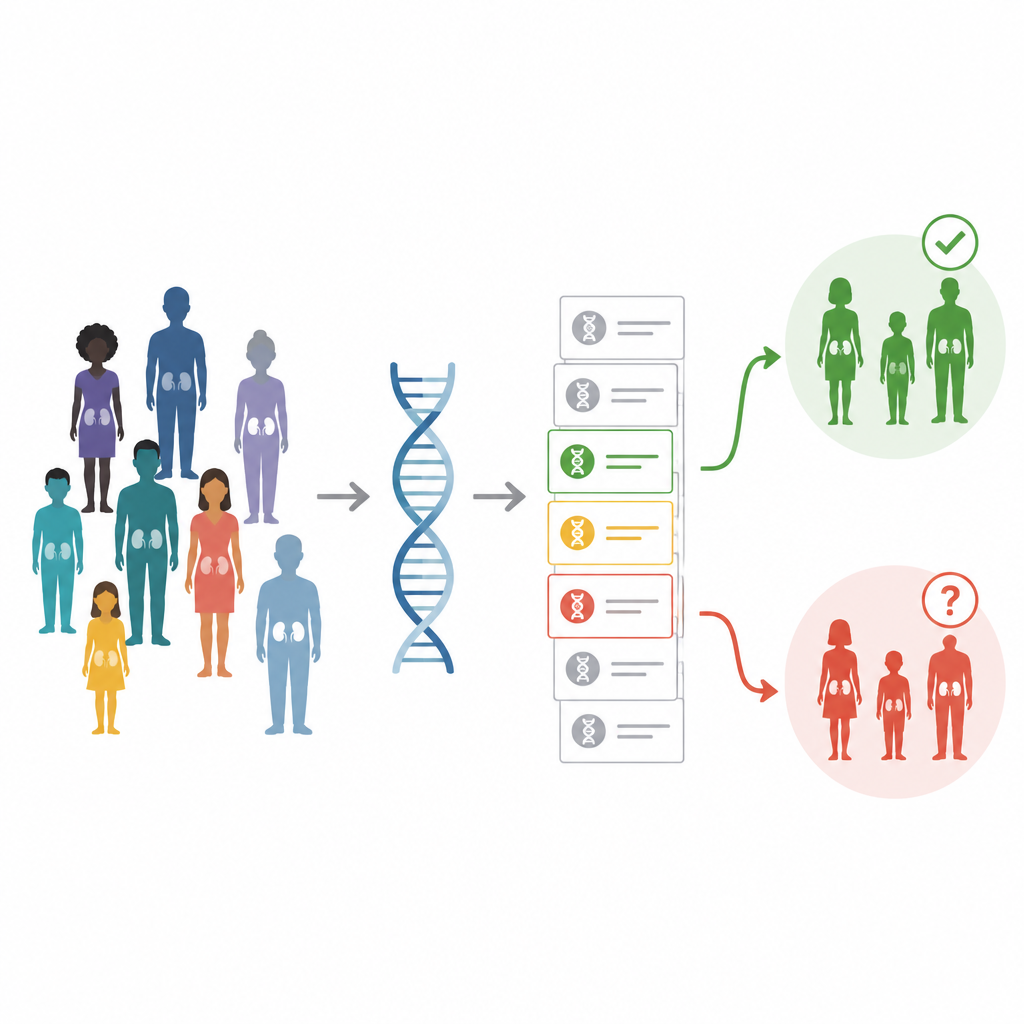
How the researchers rechecked the gene changes Figure 1. From kidney patients through DNA testing to clear or uncertain genetic answers.
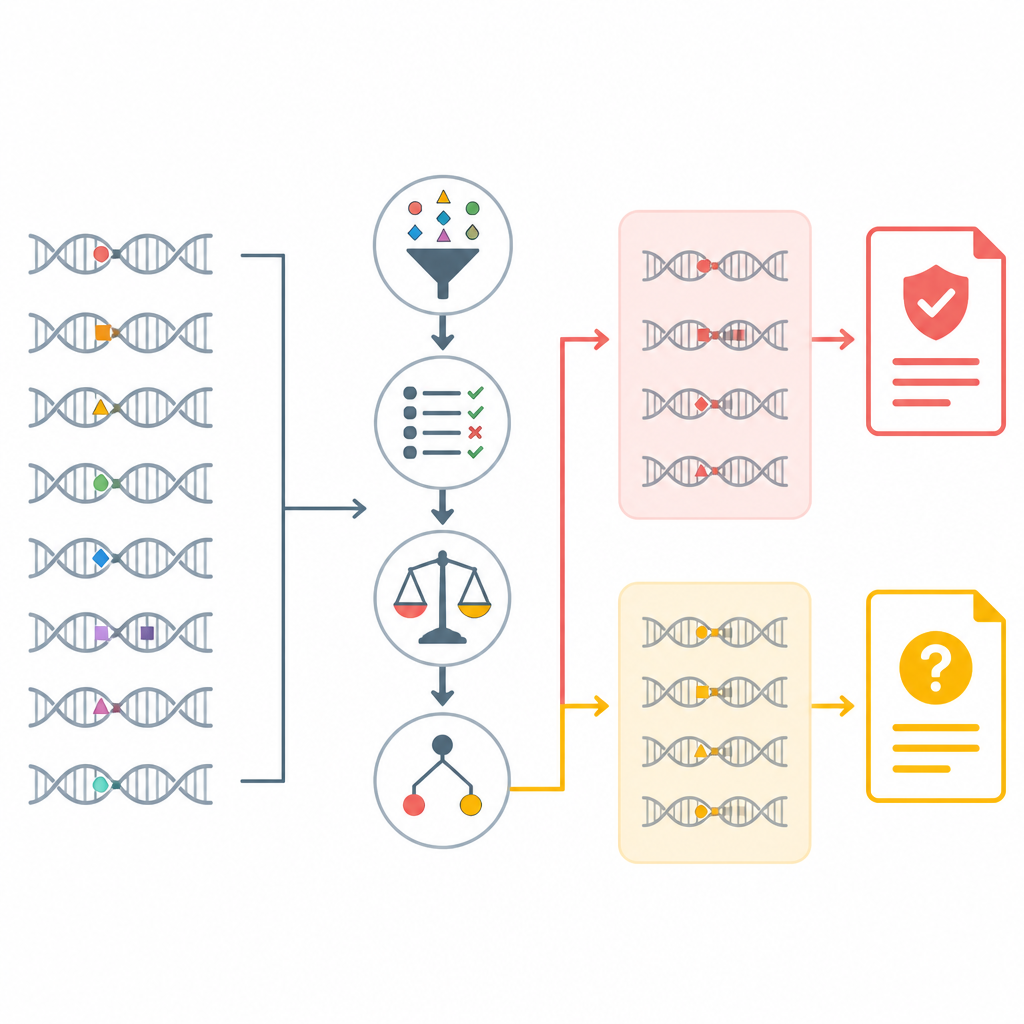
The team revisited 80 different gene changes previously reported as disease-causing in 91 patients tested between 2009 and 2014. They applied the newer rule set, which weighs many pieces of evidence, including how common a change is in large population databases, computer models of its effect, and what is known about similar changes. They also looked not only at single gene changes, but at the full pattern of changes in each person, to see whether the overall genetic picture really matched the reported clinical diagnosis.
What changed after the reassessment
After this detailed review, 10 of the 80 gene changes were downgraded from clearly harmful to “variant of uncertain significance,” meaning their role in disease is unclear. As a result, only 69 of the 91 people still had a solid genetic explanation for their kidney problems, while 22 had ambiguous results. The changes that lost their “harmful” label were mainly subtle ones, such as single-letter swaps in the DNA code or changes close to, but not directly within, key splice sites. Strongly damaging changes that clearly disrupt the gene’s function remained classified as disease-causing.
How patient features and age shaped the findings Figure 2. Stepwise filtering of DNA changes to separate clearly harmful variants from uncertain ones.
People whose results became uncertain tended to be younger and to show only mild signs, such as microscopic blood in the urine without kidney failure, hearing loss, or eye problems. In contrast, individuals with severe kidney disease or symptoms outside the kidney were more likely to carry gene changes that stayed firmly in the disease-causing category. The study also highlighted a specific gene change that once looked suspicious but is now known to be common and harmless, thanks to modern population databases, yet it had been reported in four separate patients as if it were disease-causing.
What this means for patients and doctors
This work shows that genetic answers for Alport spectrum disorder are not fixed for all time. As rules and data improve, some previously “solved” cases become uncertain, especially in people with very mild symptoms. The authors argue that older reports need critical review and that gene findings should always be interpreted together with a person’s full medical picture and family history. For patients and families, the key lesson is that a genetic result may need updating, and that a careful, repeated look can prevent both overdiagnosis and false reassurance.
Citation: Riedhammer, K.M., Richthammer, P., Westphal, D.S. et al. Systematic reassessment of reported variants in individuals with suspicion of Alport spectrum disorder reveals a high rate of ambiguous results.
Eur J Hum Genet34, 630–638 (2026). https://doi.org/10.1038/s41431-026-02066-1