Clear Sky Science · en
Tuning optical properties of densified silica glass via high pressure and ultrafast laser excitation
Glass That Does More Than Just Stay Clear
Silica glass is the quiet workhorse behind the internet, lasers, and high‑end optics. We usually think of it as a passive, transparent material, but this study shows that its inner structure—and thus how it bends and emits light—can be deliberately reshaped in two very different ways: by squeezing it hard at high temperature, or by writing inside it with ultrafast laser pulses. Understanding these hidden transformations opens paths to faster communications, denser data storage, and new light‑based devices.
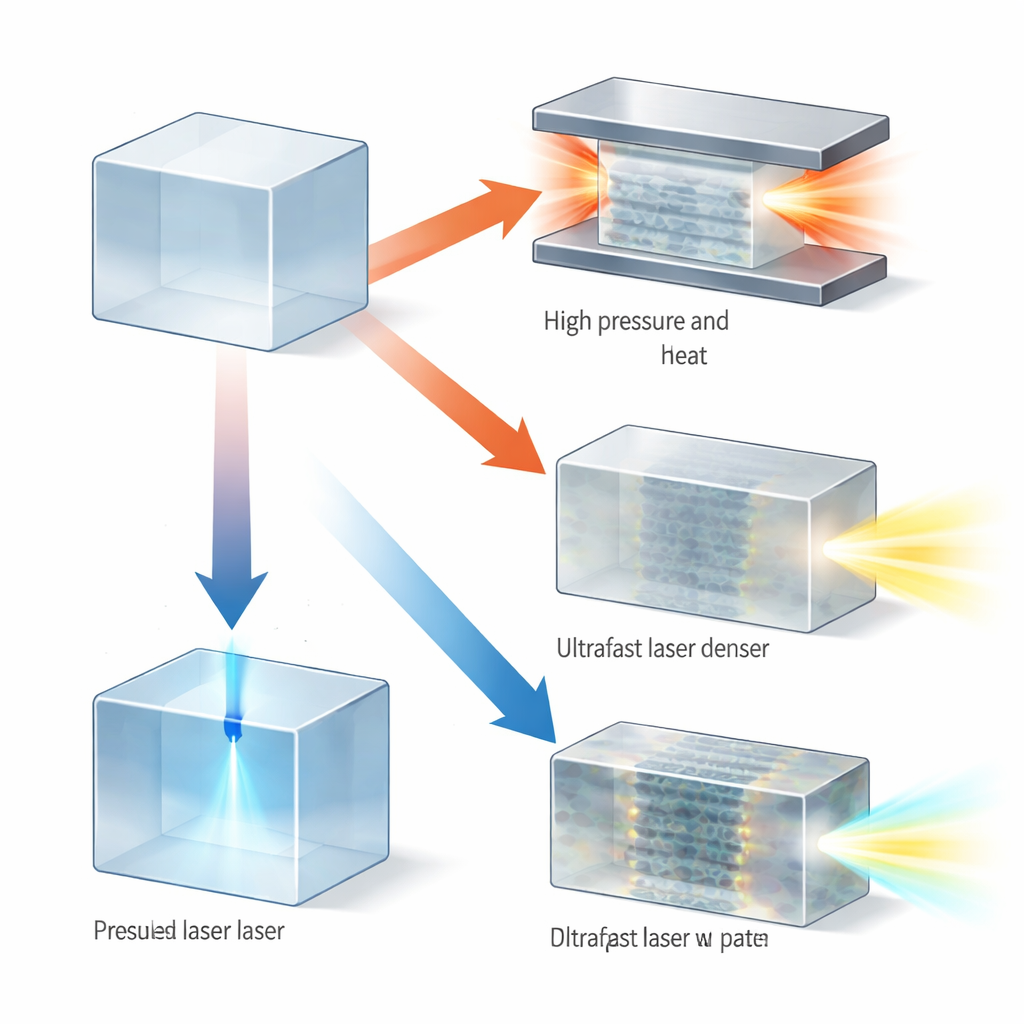
Two Ways to Squeeze Light Through Glass
The researchers compared how silica glass changes when it is densified by high pressure and heat, versus when it is modified by focused femtosecond (quadrillionth‑of‑a‑second) laser pulses. In both cases, atoms pack more tightly, which increases the glass’s refractive index—the measure of how strongly it bends light. Across many previous experiments, they found a simple linear rule: the more the density increases, the more the refractive index rises, regardless of whether the glass was compressed in a press or written by a laser. This shared trend is surprising because the microscopic paths taken by the glass structure are quite different for the two treatments.
Hidden Patterns and Their Breaking Points
When intense laser pulses are fired inside silica, they can create a fine internal pattern called a nanograting—alternating denser and more porous layers that strongly affect how polarized light passes through. Using microscopes that detect tiny changes in brightness and color, the team showed that these patterns persist up to moderate pressures, but above about 3.7 gigapascals at 673 K they effectively disappear: the high‑pressure treatment erases the density modulation and its associated optical effect. Even so, the process is reversible in a practical sense—after erasure, new nanogratings can be written again with the laser—hinting at rewritable three‑dimensional optical elements inside a single glass chip.
Defects That Make Glass Glow
Not all changes are alike, however. By measuring faint light emitted from defects inside the glass, the researchers discovered that high pressure and laser writing leave very different electronic fingerprints. Laser‑modified regions show strong red and green photoluminescence linked to “non‑bridging oxygens”—oxygen atoms that are no longer tied into the regular network. High‑pressure‑treated regions, in contrast, mainly produce green emission and essentially no red, more like a dense quartz crystal. This means the laser route produces and preserves isolated defect sites that can later interact with light, while the pressure route pushes the network toward a more relaxed, tightly linked form that suppresses those isolated emitters.
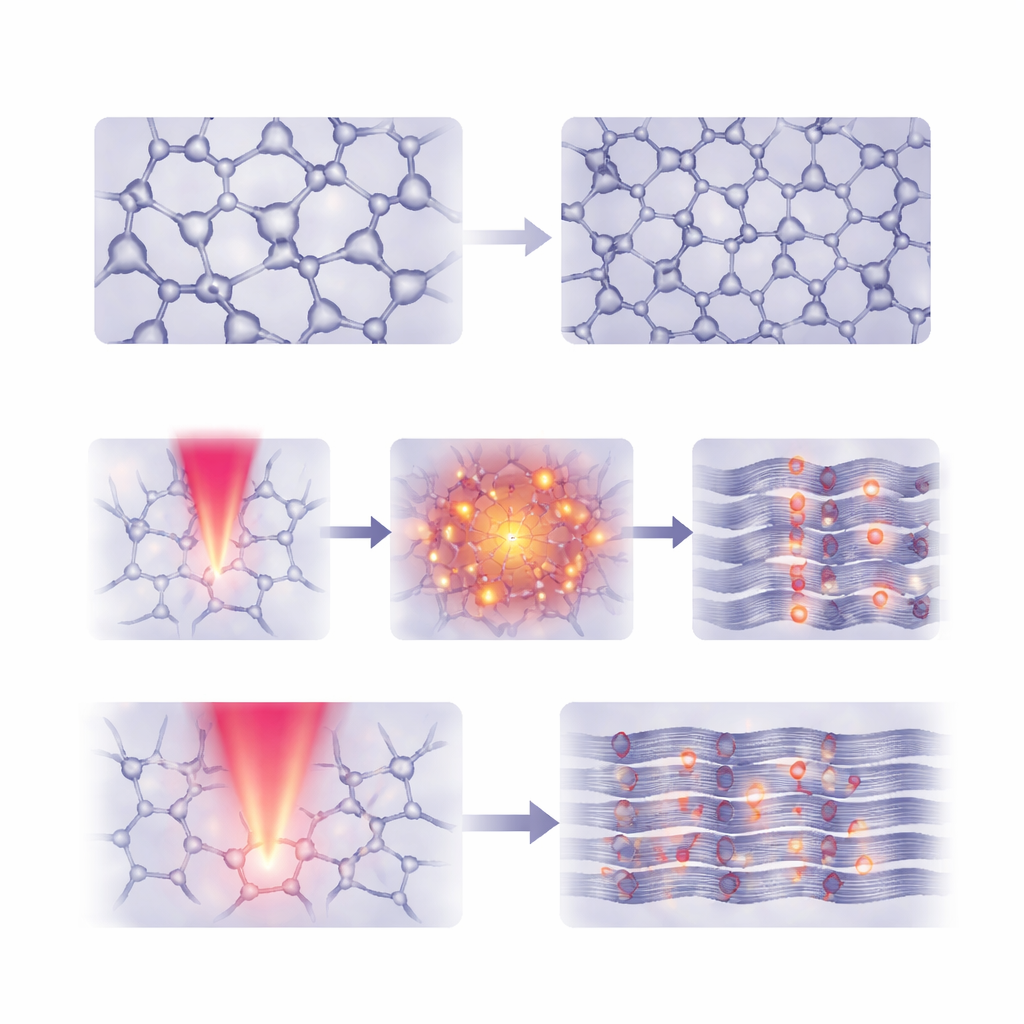
Peering Into the Glass Network
To connect these optical signals to actual structure, the team used Raman spectroscopy and high‑energy X‑ray diffraction to track how bond angles, ring sizes, and medium‑range order in the glass evolve. High pressure narrows the range of bond angles and shortens medium‑scale structural motifs, giving a more uniform, compact network. Laser exposure also shifts bond angles but tends to drive different local rearrangements, especially in regions that were already compressed. To understand this in more detail, the researchers ran machine‑learning‑powered molecular dynamics simulations that mimic local ultra‑high‑temperature heating and rapid cooling, similar to what a femtosecond laser does. These simulations showed the emergence of unusual features such as edge‑sharing tetrahedra and a broader spread of ring sizes, structures closely tied to the creation of non‑bridging oxygens and the observed glow.
Why These Differences Matter
Putting these pieces together, the study paints a picture of two complementary ways to “program” glass. High pressure and moderate heat globally densify the material and stabilize it into a robust, high‑density state with predictable bending of light but muted defect emission. Ultrafast lasers, by contrast, act locally and violently: they generate brief spikes of temperature and pressure that distort the network, create tiny dense‑and‑porous patterns, and lock in special defect sites as the glass refreezes. Because both routes can be combined and reversed in selected regions, engineers can, in principle, sculpt three‑dimensional patterns of refractive index and luminescence inside a single block of silica. For a layperson, the key message is that glass is not just a passive window: with the right tools, its internal architecture can be tuned like a circuit, enabling smarter optical fibers, long‑lived data storage, and future devices where light and electronics meet inside transparent materials.
Citation: Tsubone, M., Shimotsuma, Y., Kono, Y. et al. Tuning optical properties of densified silica glass via high pressure and ultrafast laser excitation. NPG Asia Mater 18, 15 (2026). https://doi.org/10.1038/s41427-026-00649-4
Keywords: silica glass, ultrafast laser writing, high-pressure densification, photonic devices, glass defects