Clear Sky Science · en
Injectable thixotropic hydrogel composed of elastin-like polypeptide and oxidized dextran for anastomotic support
Why surgeons need better leak stoppers
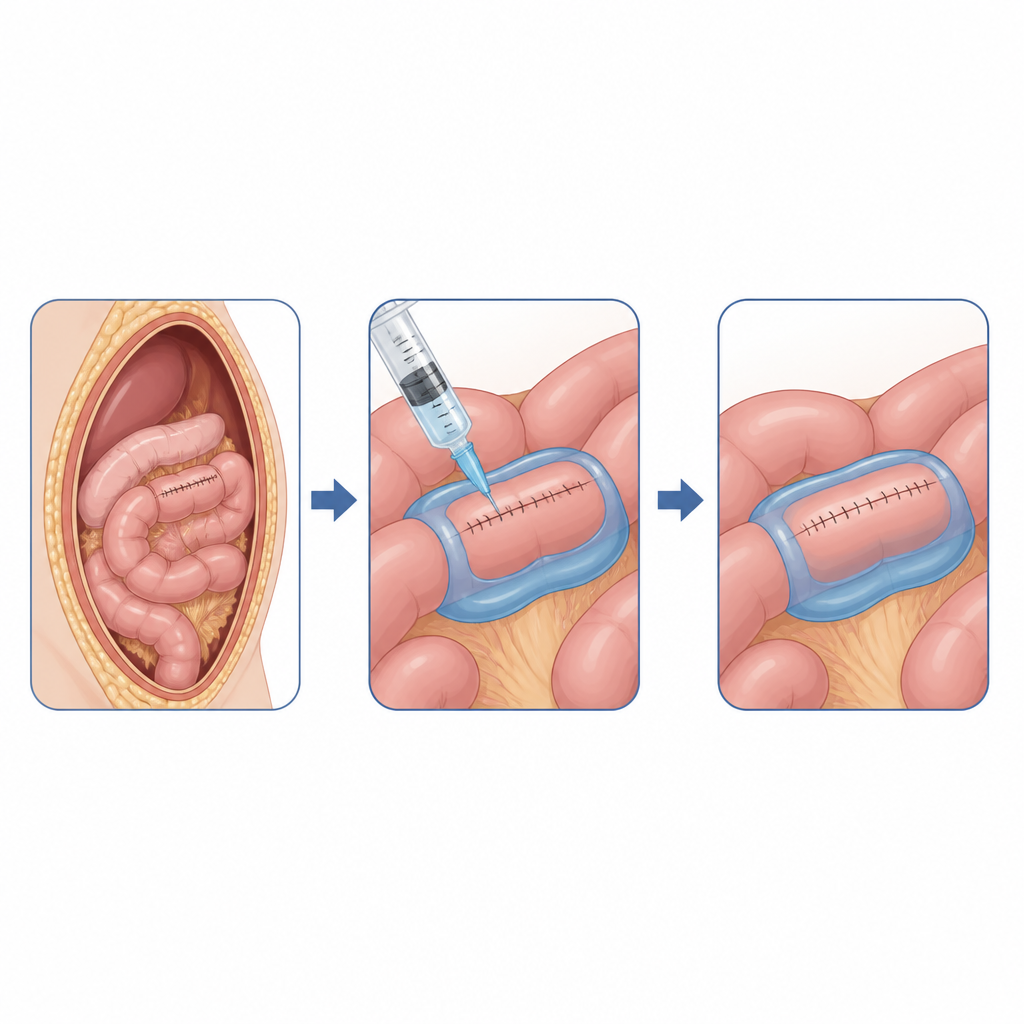
When part of the intestine is cut and sewn back together, even a tiny leak at the join can let gut contents spill into the abdomen, causing dangerous infections. Surgeons sometimes use glues or patches to reinforce these joins, but today’s products can be hard to handle and may not hold up well once the patient moves and the gut starts to squeeze again. This study introduces a new injectable soft gel designed to be easy to use in the operating room while forming a strong, gentle seal that supports healing from the inside.
A soft gel that flows, then firms up
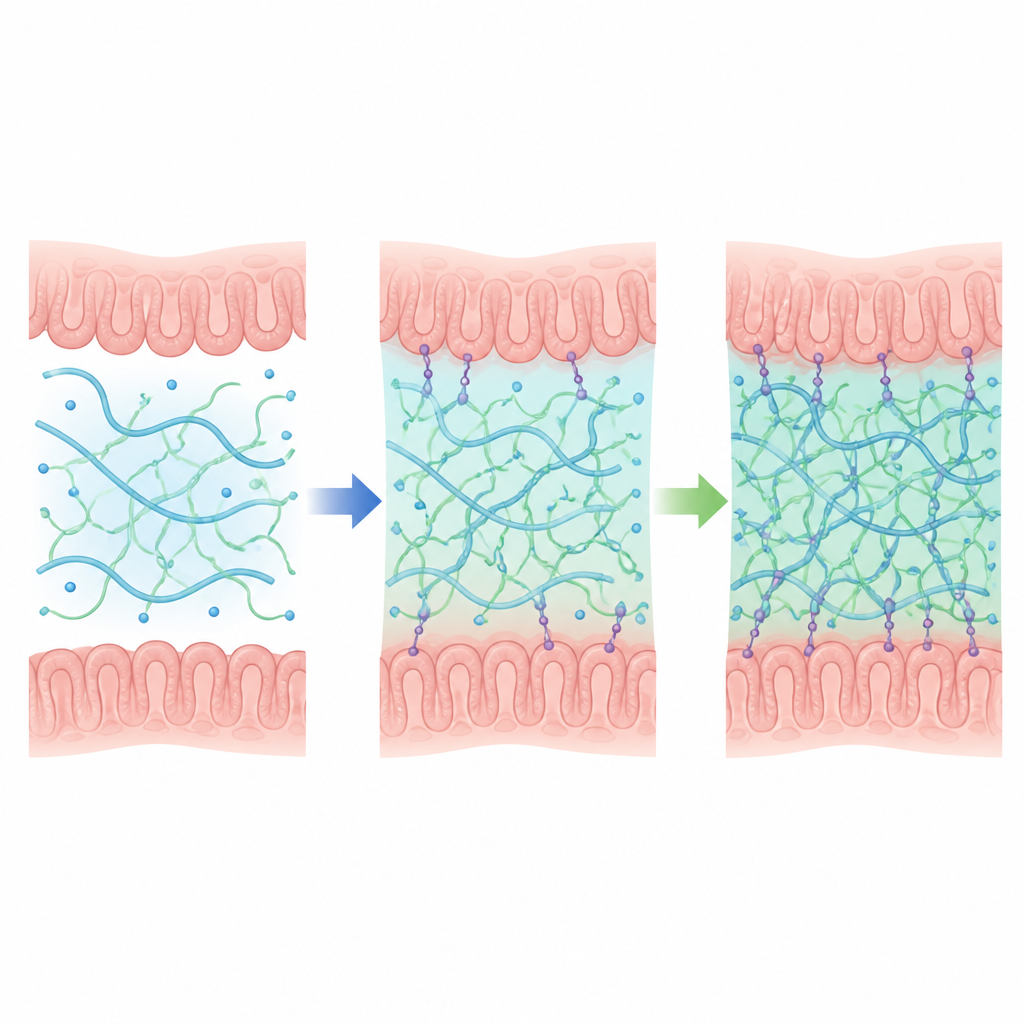
The researchers set out to build a material that behaves like a liquid while being injected, then quickly returns to a solid-like state once in place. They based the gel on a protein that mimics elastin, a natural springy component of our tissues. In warm water, these protein strands spontaneously form long, hair-thin fibers that tangle into a soft network, creating a gel that can be temporarily liquefied by shaking and then recover its structure when left still. To turn this into a practical surgical sealant, the team combined the protein fibers with oxidized dextran, a sugar-based polymer already known to be gentle to cells. This partner molecule can form chemical links both between fibers and with nearby tissues, giving the gel extra toughness and stickiness while preserving its injectable nature.
Tuning the recipe for strength and recovery
The team prepared several versions of the composite gel by adjusting how strongly the sugar component was oxidized, which controls how many reactive sites it carries. They confirmed that the sugar and protein chains truly bonded together, using standard lab methods that reveal changes in molecular weight, color, and chemical signals. Next, they probed how the different formulations behaved under mechanical stress using precise rheology tests. All versions could shift back and forth between more liquid and more solid states when the strain was turned on and off, a hallmark of so-called thixotropic materials. However, the gel made with the most highly oxidized sugar stood out: even after strong shaking, it recovered nearly half of its original stiffness and kept much of its network intact under large deformations similar to those produced by gut movements.
Gripping wet intestine and holding back pressure
To find out whether this optimized gel could really support stitched bowel, the researchers tested how well it stuck to pieces of pig intestine and how much pressure a sealed cut could withstand. In shear tests, where two tissue pieces bonded by the gel were pulled apart, the most reactive gel gripped significantly better than the protein-only version and approached the performance of a commonly used fibrin glue. In a separate setup mimicking a sutured intestinal cut, they applied the gel over the stitches and pumped in air until failure. Here too, the best-performing gel nearly doubled the burst pressure compared to sutures alone and matched the commercial fibrin product, suggesting it can meaningfully reinforce surgical joins under realistic conditions.
Behavior inside the abdomen
The scientists then injected the liquefied gel into the abdominal cavity of mice to see how it behaves in a living body. The protein-only gel disappeared within a day, likely washed away or broken down. In contrast, the composite gel remained where it was placed, still in solid form, even after the animals had moved freely. Over the course of a week, the material stayed localized and became more permanently elastic, hinting that it continued to form extra links with surrounding proteins. When the researchers examined tissue slices under the microscope, they saw only a thin layer of fibrous thickening on the outer intestinal surface and no signs of deep damage or strong inflammation, indicating that the gel’s presence was tolerated by the tissue.
What this could mean for future surgeries
Taken together, the results suggest that this injectable, self-healing hydrogel can be delivered easily during surgery, conform to the intestinal surface, and then quietly stiffen in place while adhering to tissue. Its ability to raise leak resistance to levels similar to fibrin glue, while existing as a single ready-to-use component rather than a two-part system, could simplify surgical workflows and offer surgeons a new tool to reduce the risk of dangerous leaks after gut surgery. Further work in more advanced animal models will be needed, but this protein-and-sugar gel shows how smart soft materials might one day help make intestinal repairs safer and more reliable.
Citation: Aoyama, Y., Nakano, Y., Shinozuka, T. et al. Injectable thixotropic hydrogel composed of elastin-like polypeptide and oxidized dextran for anastomotic support. NPG Asia Mater 18, 19 (2026). https://doi.org/10.1038/s41427-026-00646-7
Keywords: anastomotic leakage, injectable hydrogel, intestinal surgery, tissue sealant, oxidized dextran