Clear Sky Science · en
Superior capacity behaviour of mesoporous, edge-free carbon materials with ionogel electrolytes
Powering the gadgets of tomorrow
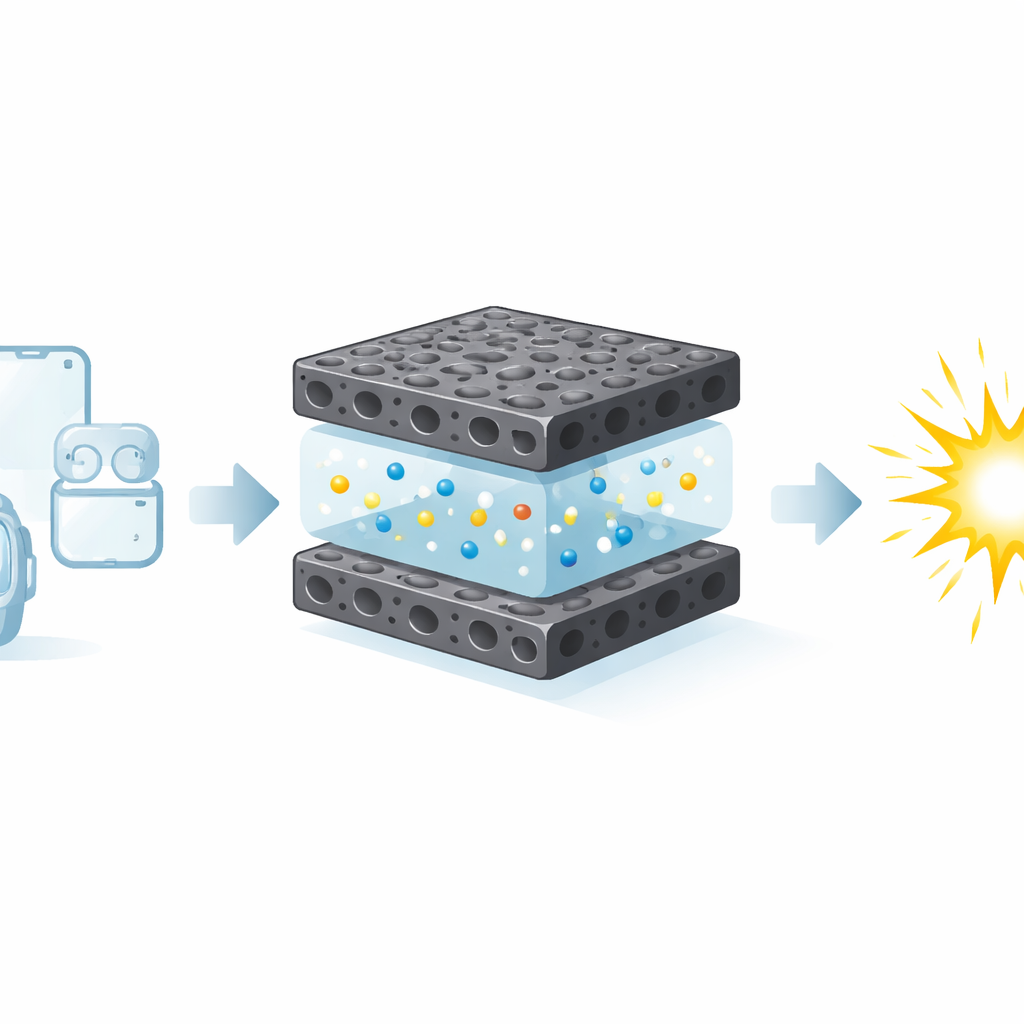
From wireless earbuds to bendable fitness bands and smart clothing, our devices are getting thinner, softer and more power hungry. Yet the batteries and capacitors that feed them were mostly designed for rigid boxes, not flexible wearables. This study explores a new way to store energy using a sponge-like carbon material paired with a jelly-like “ionogel” electrolyte, aiming to build slim, bendable power sources that charge quickly, work at higher voltages, and stay safe in everyday use.
A soft, solid energy jelly
Conventional supercapacitors often rely on liquid electrolytes, which can leak, corrode parts, and limit the usable voltage. Here, the researchers instead use an ionogel: a solid-looking but ion-rich gel made by trapping an ionic liquid inside a polyvinyl alcohol (PVA) polymer network. This gel behaves like a soft, flexible salt solution that conducts charge well, does not evaporate or burn easily, and can withstand a wide voltage window of about three volts. Thin ionogel films are placed between two identical carbon electrodes to form flat, sandwich-like devices suited to flexible electronics. The team carefully tuned the mixture so that most free water is removed, leaving just enough bound water to help ions move without triggering serious corrosion.
A sponge versus standard carbon
The heart of the work is a head-to-head comparison between a novel graphene-based carbon called Graphene MesoSponge (GMS) and a commercial activated carbon known as YP50F. GMS forms a three-dimensional, sponge-like network of single-layer graphene walls with large, interconnected pores several nanometres wide and very few exposed edges. YP50F, by contrast, is mostly microporous, with narrower channels and many edge sites. Using the same ionogel in both cases, the team assembled two symmetric cells: GMS | ionogel | GMS and YP50F | ionogel | YP50F. This allowed them to isolate how the internal architecture of the carbon—its pore size, curvature and edges—affects how well the gel wets the surface, how easily ions move, and how much charge can be stored.
Measuring performance in real devices
Electrochemical tests revealed that the GMS-based cell clearly outperforms its activated-carbon counterpart. Cyclic voltammetry showed smoother, more ideal charge–discharge shapes and lower corrosion currents at higher voltages for GMS, indicating better stability and fewer unwanted side reactions. Impedance measurements confirmed that the GMS cell has much lower bulk and internal resistance, along with higher real capacitance across useful frequencies. The mesoporous structure appears to let the ionogel seep fully into the carbon framework, giving ions more space and more direct pathways to move. Charge–discharge experiments further showed that the GMS device can operate stably up to about 1.8 volts with low internal resistance, while the YP50F cell struggles beyond roughly 1.4 volts and loses capacitance more quickly as current is increased.
Peeking between atoms
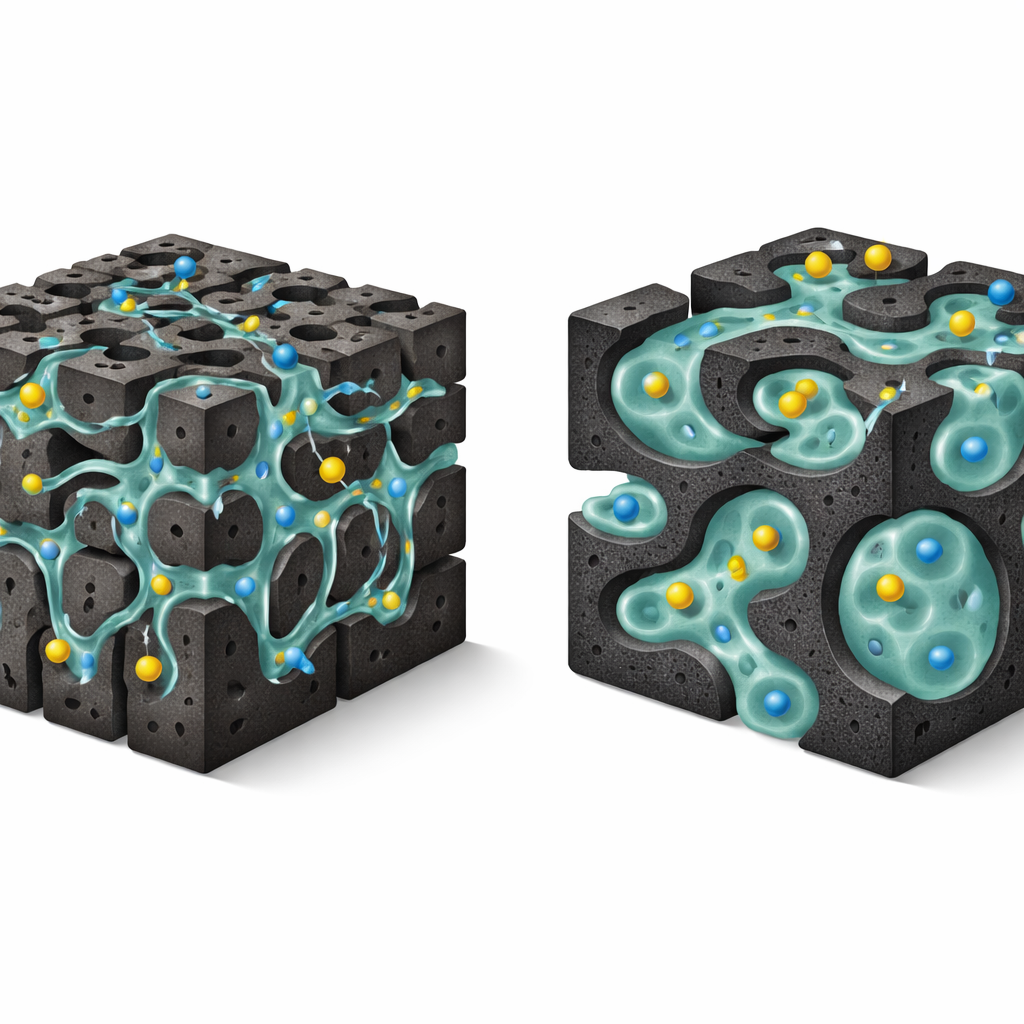
To understand why the sponge-like carbon behaves so well, the authors turned to computer modelling at the atomic scale. They built virtual graphene sheets—perfect, gently curved, and with specific kinds of defects—and surrounded them with the same ionic liquid and PVA fragments used in the real ionogel. Quantum-level calculations showed that the graphene sheets spontaneously bend and corrugate when in contact with the ion-rich gel, especially when a particular defect pattern known as a Stone–Wales defect is present. This curvature closely resembles the mesoporous GMS structure and creates a better geometric match to the ionic liquid molecules. A dense network of hydrogen bonds and subtle attractive forces emerges between ions, polymer and carbon, leading to strong but well-distributed interactions and high surface “wettability,” meaning the gel can spread and cling over the carbon’s internal surfaces without becoming trapped in only a few spots.
Design rules for better flexible power
The simulations also show that not all defects are equal. While some vacancy-type defects grip ions very tightly, they tend to localise them in small regions, reducing overall coverage and slowing ion motion. In contrast, the Stone–Wales-type defects and gentle curvature associated with GMS offer a balanced situation: ions are strongly attracted, yet can still move and rearrange quickly. This balance lines up with the experiments, where GMS electrodes show both higher capacitance and lower resistance than activated carbon under the same conditions. In practical terms, the work suggests that tuning pore size, curvature and defect patterns in carbon frameworks—together with well-chosen ionogels—can yield flexible, solid-state supercapacitors that charge and discharge rapidly, operate safely at higher voltages, and endure many cycles without significant loss.
What it means for everyday devices
For non-specialists, the takeaway is that not all “black powders” used in energy storage are created equal. By designing carbon at the level of its pores and atomic defects, and pairing it with a carefully engineered gel electrolyte, it is possible to build thin, bendable power units that bridge the gap between fast supercapacitors and robust batteries. The Graphene MesoSponge system studied here shows that a sponge-like, edge-free carbon combined with an ion-rich gel can store more energy, waste less as heat, and run at higher voltages than a standard activated carbon design. Such insights provide a roadmap for the next generation of flexible, safe, and efficient power sources for wearable electronics, soft robotics and other emerging technologies.
Citation: Jain, A., Moreno-Rodríguez, D., Iwamura, S. et al. Superior capacity behaviour of mesoporous, edge-free carbon materials with ionogel electrolytes. NPG Asia Mater 18, 16 (2026). https://doi.org/10.1038/s41427-026-00644-9
Keywords: flexible supercapacitors, graphene mesosponge, ionogel electrolyte, energy storage materials, wearable electronics