Clear Sky Science · en
Synergistic strategies for advancing single-atom catalysts in CO2 electroreduction
Turning a Climate Problem into a Useful Resource
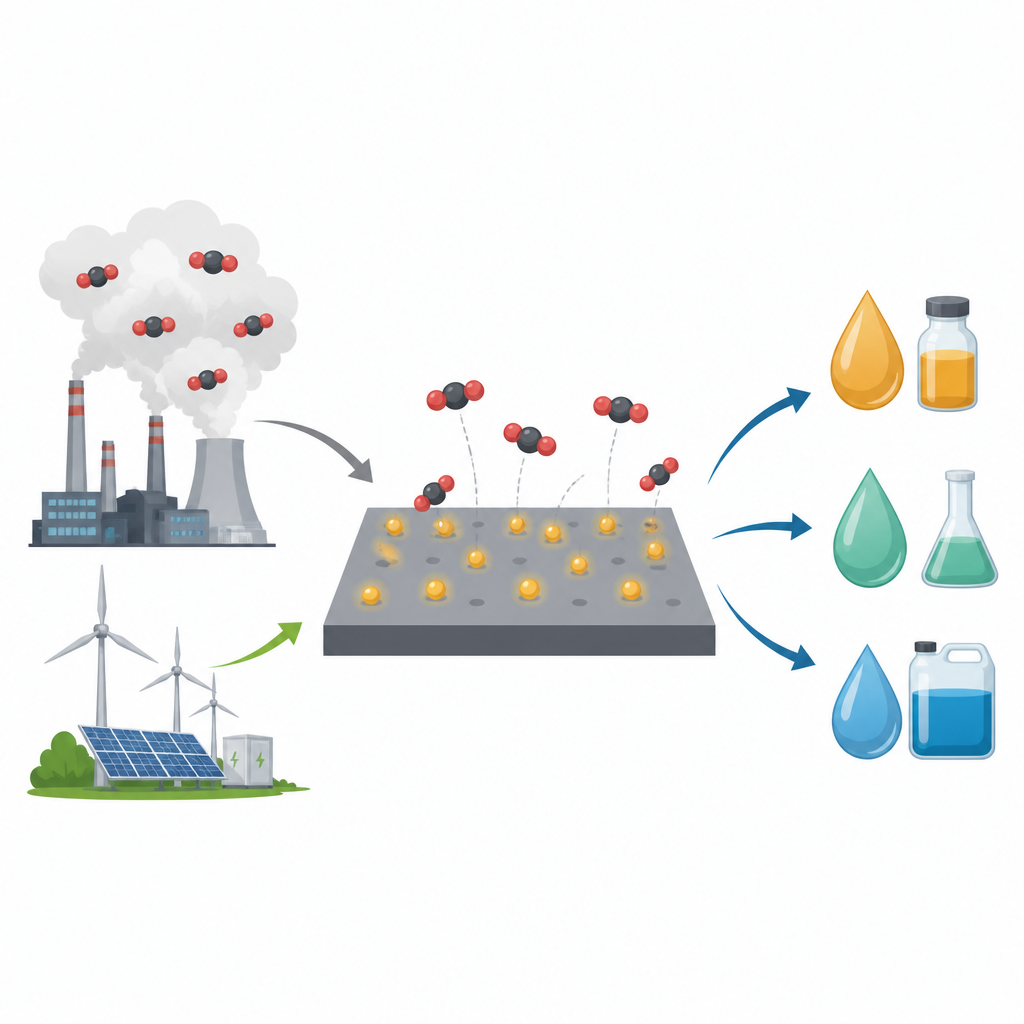
Burning coal, oil, and gas pours carbon dioxide into the air, heating the planet and driving extreme weather. This article explores how scientists are learning to turn that waste gas into useful fuels and chemicals using electricity from renewable sources. By designing catalysts made from single metal atoms, researchers hope to build compact devices that can store green electricity in chemical form while cutting carbon pollution at the same time.
How Electricity Can Reshape Carbon Dioxide
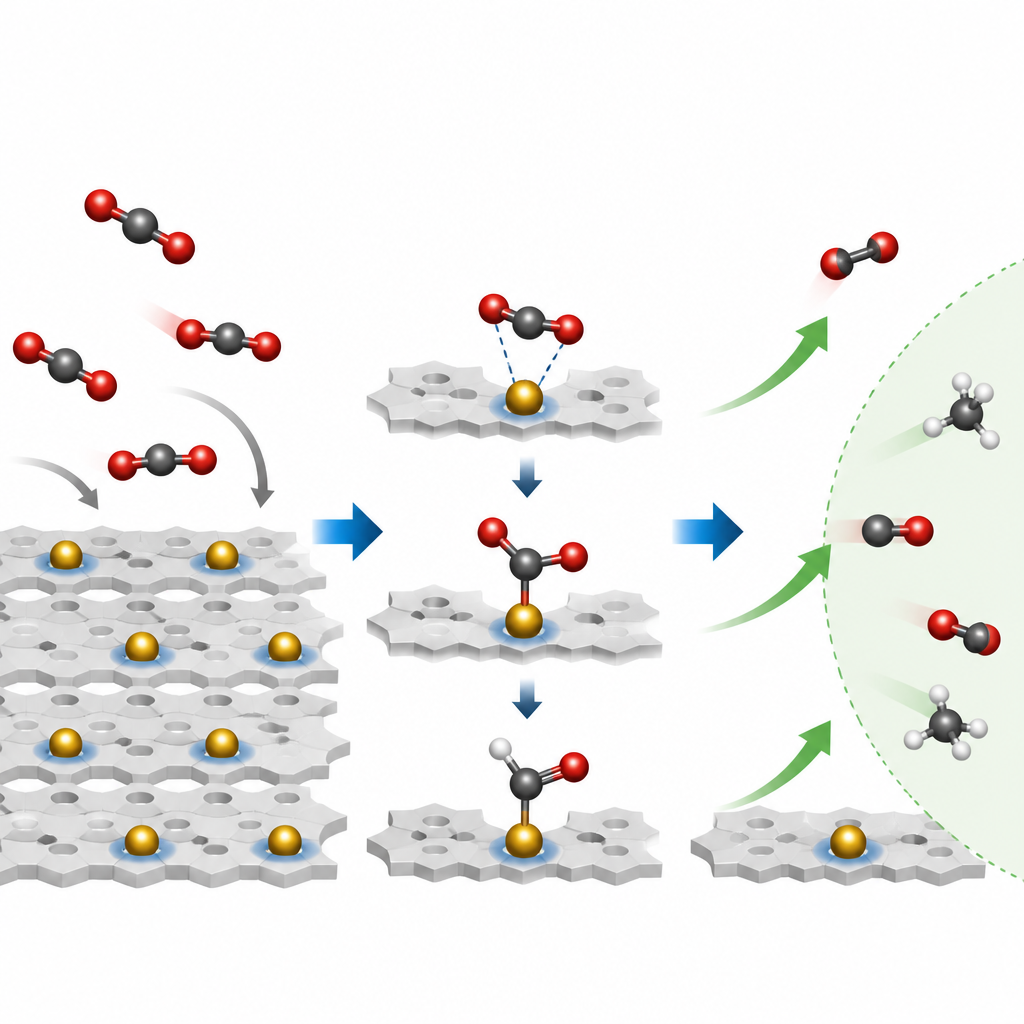
At the heart of this work is a process called electrochemical CO2 reduction, where electricity pushes CO2 molecules to rearrange into products such as carbon monoxide, formic acid, methane, and even more complex two-carbon fuels. The reaction is tricky, with many competing pathways and sluggish steps that waste energy or produce unwanted byproducts like hydrogen gas. Catalysts placed on the electrode surface help steer the reaction, lowering energy barriers and favoring certain products. But many traditional catalysts still fall short in speed, selectivity, and long-term durability, which limits their use in real devices.
Single Atoms as Tiny Workhorses
The review explains why catalysts built from isolated single metal atoms can perform far better than conventional nanoparticles. Each atom on these single-atom catalysts acts as an exposed active site, so virtually no metal is wasted. Anchored on supports such as carbon, metal oxides, metal–organic frameworks, or layered materials, these atoms sit in precisely tuned environments that shape how they interact with CO2 and reaction intermediates. The authors describe two big families of synthesis methods: “bottom-up” routes that grow the catalyst from small building blocks, and “top-down” routes that break larger structures into atomically dispersed sites. Techniques like atomic layer deposition, pyrolysis, wet chemistry, ball milling, vapor deposition, and electrodeposition are compared in terms of how well they prevent atoms from clumping together while keeping them firmly attached to the support.
Fine-Tuning the Atomic Neighborhood
Beyond simply making single-atom catalysts, scientists are learning to adjust their local surroundings to squeeze out better performance. One approach pairs two neighboring metal atoms, or even two different metals, so they can share tasks: one metal activates CO2, while the other helps release the desired product. Another strategy tweaks the atoms that directly bind the metal, such as nitrogen, sulfur, or boron, or introduces controlled defects and missing atoms in the nearby structure. These subtle changes shift how electrons are distributed, altering how strongly key intermediates stick to the surface. The result can be huge gains in how efficiently the catalyst makes a target product, whether that is a simple gas like carbon monoxide or richer carbon–carbon coupled products like ethylene and ethanol.
Building Better Homes for Single Atoms
The support material that holds the single atoms also matters greatly. Porous carbon networks, crystalline frameworks, metal oxides, and two-dimensional materials each provide different pathways for gas flow and electron transport. By carving out networks of micro-, meso-, and macropores, researchers improve how CO2 and products move to and from active sites, which boosts current and selectivity. Some designs use hollow spheres or foam-like structures to shorten transport distances, while others rely on strong bonding between metal atoms and supports to resist clumping during operation. Careful engineering of mass transport and electrical conductivity is crucial if these catalysts are to work in practical devices such as gas-fed flow cells that operate at industrially relevant current densities.
From Lab Concepts to Real-World Devices
In closing, the authors highlight both the promise and the hurdles of single-atom catalysts for CO2 conversion. The field has seen impressive advances in understanding how atomic structure, defects, and supports shape performance, and some systems now deliver high selectivity and large currents. Yet challenges remain, including limited options for making multi-carbon products, difficulty in precisely controlling defect types, the tendency of atoms to cluster at high loading, and the need for reactors that run efficiently and stably for thousands of hours. Future progress will depend on better in-situ probes of working catalysts and on machine learning tools that can quickly screen new designs. For a lay reader, the message is clear: by mastering chemistry at the single-atom level, scientists are laying the groundwork for devices that could transform waste CO2 and green electricity into useful fuels and chemicals.
Citation: Tian, J., Guo, M., Zhu, M. et al. Synergistic strategies for advancing single-atom catalysts in CO2 electroreduction. NPG Asia Mater 18, 18 (2026). https://doi.org/10.1038/s41427-026-00643-w
Keywords: single-atom catalysts, CO2 electroreduction, electrocatalysis, carbon utilization, renewable fuels