Clear Sky Science · en
Strategies for environmental polymer analysis: micro-/nanoplastics and water-soluble polymers
Why tiny plastics in our world matter
Plastics have quietly become part of every corner of our planet, from mountain air to deep sea mud and even inside our own bodies. Scientists now worry not only about visible litter, but also about much smaller fragments called microplastics and nanoplastics, along with plastic-like chemicals that dissolve in water. This article explains how researchers are learning to find and measure these elusive particles and polymers, a crucial step toward understanding what they may be doing to ecosystems and human health.
Small plastic pieces, big global reach
Since the 1950s, plastic production has risen to billions of tons and is expected to almost triple again by 2060. Once released, larger pieces of plastic break down into microplastics, which are about the size of grains of sand or smaller, and nanoplastics, which are far tinier than dust. These fragments have been detected from the tropics to the poles, in soil, rivers, oceans, and the air. Because they are light and small, they travel easily on wind and water. They also hold many chemical additives and can latch onto other toxic substances, turning them into mobile carriers of pollution that can enter food webs and accumulate in living tissues.
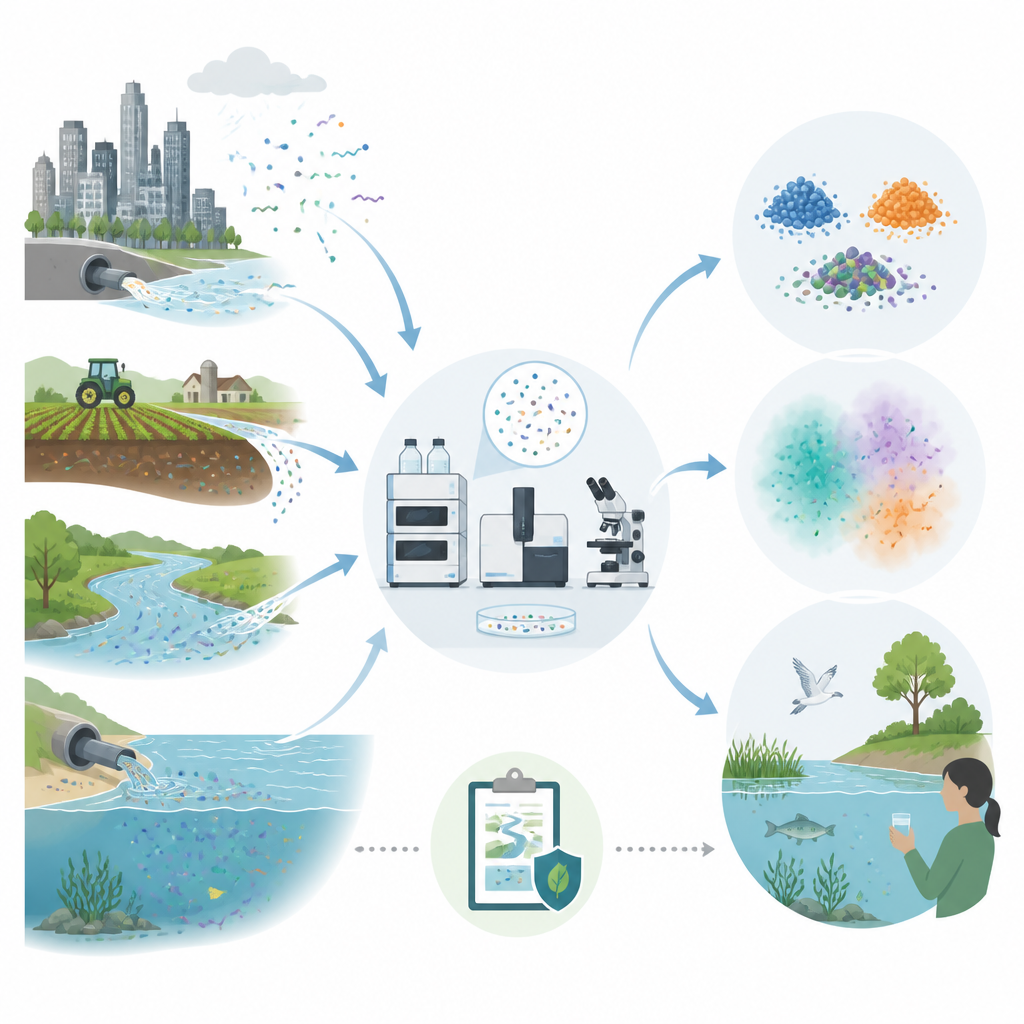
Hidden plastic in water and everyday products
Researchers have found microplastics and nanoplastics in drinking water, tap water, food, and even inside the human brain, lungs, heart, breast milk, placenta, and other organs. At the same time, huge volumes of water-soluble polymers are used in products such as detergents, cosmetics, water treatment aids, and farm chemicals. Many of these wash directly into the environment, where their long-term effects on soil and aquatic life are only beginning to be studied. Biodegradable plastics, often marketed as a safer alternative, can also break into micro- and nanoplastics rather than disappearing completely, which means they may contribute to the same problems they were meant to solve.
How scientists "see" invisible plastics
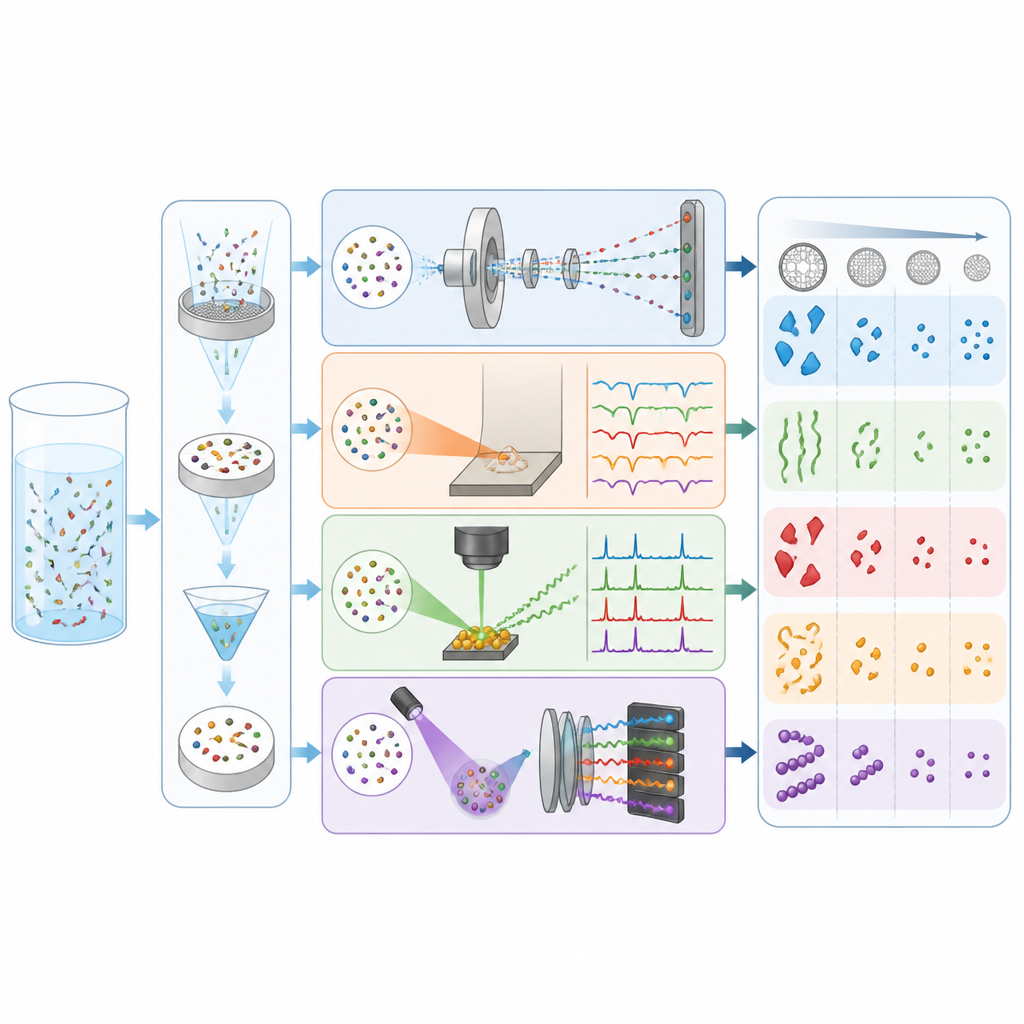
Because these environmental polymers come in many sizes, shapes, and chemistries, no single test can capture them all. The review describes four main families of tools. Mass spectrometry measures the masses of molecules released when plastics are heated, allowing scientists to identify and quantify tiny amounts of polymers in air, water, soil, and biological tissues. Infrared methods shine invisible light on particles and read their unique absorption patterns, and new variants can now examine plastics down to the nanometer scale. Raman and surface-enhanced Raman techniques use scattered laser light to obtain a kind of fingerprint for different plastics, especially very small ones, while fluorescence methods rely on dyes or built-in glow to reveal and count particles or dissolved polymers quickly and at relatively low cost.
Practical hurdles outside the lab
Turning these tools into routine monitoring systems is not straightforward. Real-world samples such as seawater, sludge, soil, and animal tissues contain many other substances that can block signals or mimic plastics. Removing these interfering materials often calls for digestion with oxidants, salts, or enzymes, but some of these steps can also damage or wash away the very plastics scientists are trying to study, especially newer biodegradable types. Each analytical method has its own sweet spot for particle size and concentration, as well as different costs and throughput. The authors argue that expectations for a single universal test are unrealistic; instead, the goal should be to combine methods in ways that cover each other's blind spots.
Joining forces for clearer answers
The review highlights that the most powerful approaches pair complementary techniques. For example, infrared and Raman measurements taken together can better distinguish aged or weathered plastics, while combining fluorescence imaging with mass spectrometry can link what scientists see under the microscope to precise chemical identities. Machine learning and artificial intelligence are starting to help by sorting complex spectra and merging data from different instruments. The authors call for shared reference materials, agreed size categories, common reporting rules, and large, curated libraries of spectra that include aged and biodegradable plastics, so that results from different laboratories and countries can be compared reliably.
What this means for people and the planet
For a lay reader, the message is that science is moving from simply sounding the alarm about tiny plastics and water-soluble polymers toward building a measurement toolkit that can support sound decisions. We still do not fully know how dangerous these materials are, but without trustworthy ways to find and quantify them in air, water, soil, and living organisms, it is impossible to judge risks or test solutions. By refining and combining analytical methods, standardizing procedures, and embracing data-driven tools, researchers are laying the groundwork for routine environmental checks that can track pollution, guide regulations, and help evaluate whether new materials truly lessen plastic burdens rather than quietly adding to them.
Citation: Hasegawa, S., Sawada, T. & Serizawa, T. Strategies for environmental polymer analysis: micro-/nanoplastics and water-soluble polymers. NPG Asia Mater 18, 17 (2026). https://doi.org/10.1038/s41427-026-00642-x
Keywords: microplastics, nanoplastics, water-soluble polymers, environmental monitoring, spectroscopic analysis