Clear Sky Science · en
Microwave synthesis of gram scale millimeter size layered transition metal oxide crystals
Turning Rock Powder into Future Memory Materials
Hidden inside certain gray mineral powders are ingredients for the next generation of low‑power computer memory. This study shows how a common ore containing molybdenum can be converted into long, shiny crystals using something surprisingly familiar: microwave radiation similar to that in a kitchen oven. The researchers not only grow these crystals quickly and with far less energy than traditional methods, but also build tiny electronic devices that remember electrical signals, pointing toward greener and more efficient data storage.
A Faster Way to Grow Useful Crystals
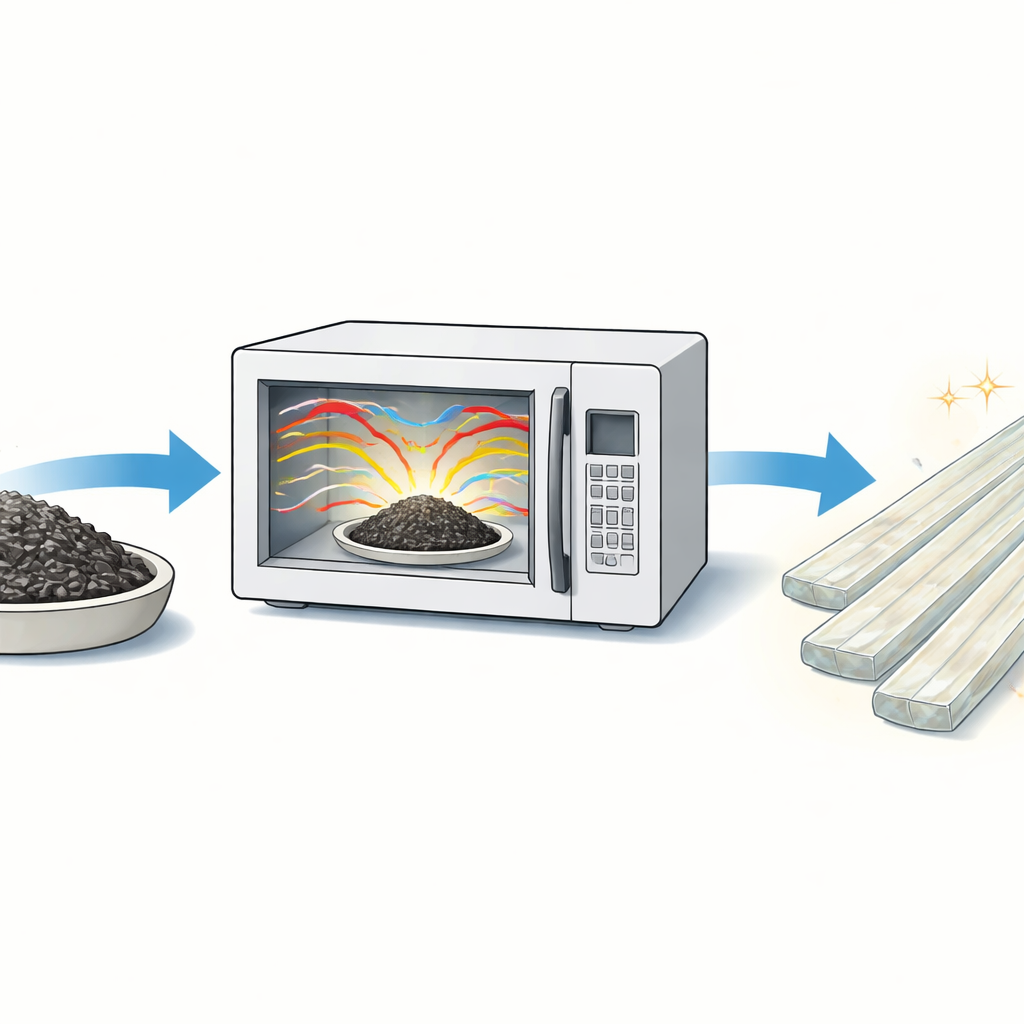
Many modern technologies rely on special metal‑oxide materials whose atoms stack in neat layers. One of the most versatile is molybdenum trioxide, a compound used in smart windows, batteries, sensors, and electronic components. Conventional ways of making this material often require many processing steps, harsh chemicals, and hours of heating in large furnaces. In contrast, the team devised a direct microwave method that starts from molybdenum disulfide, a naturally occurring ore, and transforms it into molybdenum trioxide crystals in minutes. By carefully tuning how microwaves heat the powder throughout its volume, rather than just at the surface, they trigger a controlled reaction with oxygen that rearranges the atoms into a new, ordered structure.
From Dark Ore to Bright Crystals
In the microwave field, oxygen from the air reacts with the sulfur‑bearing ore. Sulfur atoms are stripped away as gaseous compounds, while molybdenum atoms bond with oxygen to form the desired oxide. Because microwaves penetrate deeply, heating starts within the bulk of the powder, producing a uniform transformation instead of a scorched exterior. The result is striking: long, belt‑shaped crystals of molybdenum trioxide, some up to 7–8 millimeters in length—large enough to be seen and handled easily. Microscopes and spectroscopy tools show that these crystals are highly pure, have a well‑defined layered structure, and display clean, regular atomic patterns, all of which are crucial for reliable electronic behavior.
Cleaner, Cheaper Crystal Production
The researchers compared their process with eight widely used crystal‑growth techniques, such as hydrothermal growth, chemical vapor deposition, and laser‑based methods. After accounting for production speed, crystal size, equipment complexity, energy use, and carbon emissions, the microwave route came out ahead on most counts. It produces about a gram of high‑quality crystals per hour using only about half a kilowatt‑hour of electricity per gram—up to 140 times less energy than some other methods. Because it skips multiple purification and high‑temperature roasting steps that industry normally uses to turn ore into feedstock, it also cuts estimated climate‑warming emissions by roughly one to two orders of magnitude and avoids the need for expensive, specialized reactors.
Crystals that Remember Electrical Signals
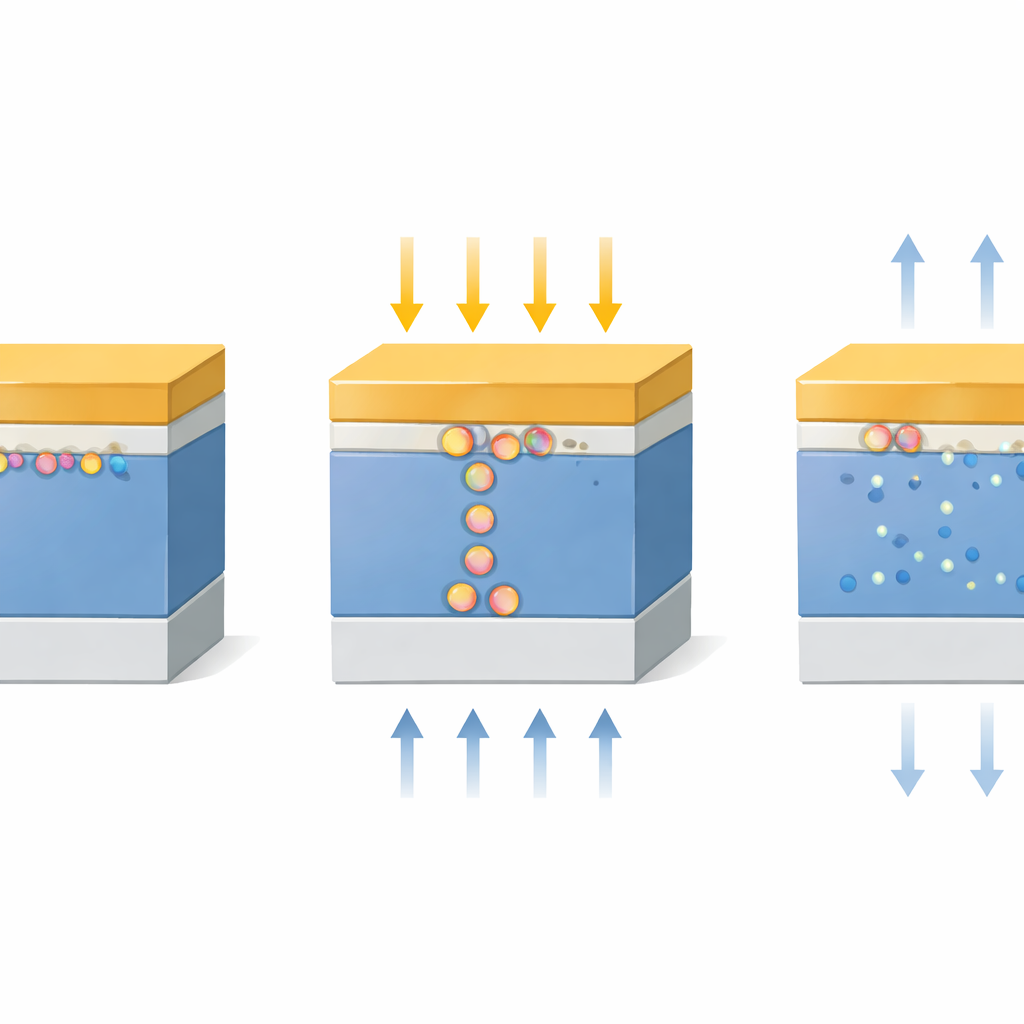
To show that the new crystals are not just efficient to make but also technologically useful, the team incorporated them into tiny memory elements called memristors. These devices consist of a silicon base, a thick slab of the grown molybdenum trioxide, an ultrathin aluminum‑oxide barrier, and a copper top contact. When a small voltage is applied in one direction, electrically active vacancies—tiny missing oxygen atoms—drift and cluster near the barrier, creating an easier path for current. Reversing the voltage drives these vacancies away, restoring a harder‑to‑conduct state. This reversible rearrangement lets the device switch between “on” and “off” resistance levels at voltages of only about two volts, even though the active crystal layer is hundreds of nanometers thick, which is unusually low for such robust structures. The devices endure many switching cycles with stable performance.
Why This Matters for Everyday Technology
Taken together, the work demonstrates that microwaves—better known for heating food—can be repurposed to rapidly grow large, clean crystals from abundant minerals while using far less energy and generating less pollution than current methods. The resulting molybdenum trioxide crystals are not just laboratory curiosities: they can be built into compact memory devices that switch reliably at low voltage, making them promising candidates for energy‑efficient data storage and brain‑inspired computing hardware. If scaled up, this approach could help supply the growing demand for advanced electronic materials in a way that is more compatible with both industrial needs and environmental constraints.
Citation: Elkaffas, R., Rezk, A., Shajahan, S. et al. Microwave synthesis of gram scale millimeter size layered transition metal oxide crystals. NPG Asia Mater 18, 11 (2026). https://doi.org/10.1038/s41427-026-00637-8
Keywords: microwave crystal growth, molybdenum trioxide, energy-efficient synthesis, memristor memory, transition metal oxides