Clear Sky Science · en
Social status impacts T-cell responses through synapse strength in the prefrontal cortex
How social standing can shape the body’s defenses
Why do some individuals ward off infection more effectively than others, even when they share similar genes and environments? This study explores an unexpected answer: differences in social status can tune the brain in ways that change how strongly the immune system reacts to vaccination. By tracing a chain from social rank in mice, to nerve cell activity in the brain’s decision-making center, to the behavior of T-cells in the blood, the researchers reveal a direct biological link between social life and disease-fighting power.
Social life in a tube
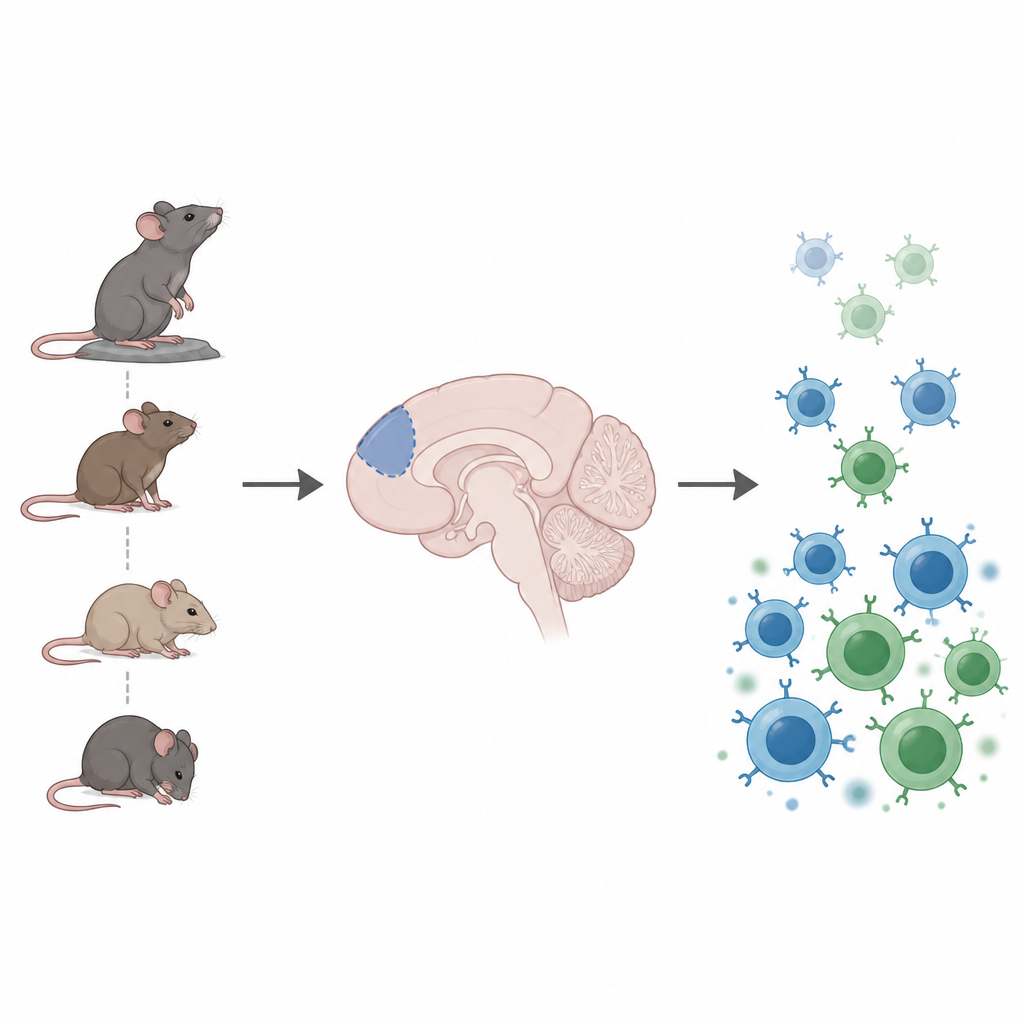
To study social rank without violence or injury, the researchers formed stable groups of four male mice and measured their hierarchy using a “tube test.” Two mice meet in a narrow tube, and the one that pushes the other out counts as the winner. Repeated encounters produced reliable rankings from first to fourth place, which also matched other signs of status such as the amount of courtship sounds males made to females. Hormone tests showed only modest differences in stress and sex hormones between ranks, suggesting that, under these calm laboratory conditions, social position affected health through mechanisms other than chronic stress alone.
Middle rank, strongest vaccine boost
The team next asked how well each mouse responded to a DNA vaccine designed to provoke a strong T-cell reaction against a viral or protein fragment. Surprisingly, the most robust response did not come from the top or the bottom of the hierarchy. Instead, mice holding the second position showed, on average, about 60 percent higher levels of vaccine-specific CD8 T-cells at the peak of the response than their cage mates. This advantage appeared with two different vaccine targets, indicating that it was a general feature of their adaptive immune system rather than a quirk of a single antigen.
A brain molecule that links rank and immunity
Social rank depends on flexible learning about group mates, which in turn relies on the ability of synapses to strengthen in response to experience. The researchers focused on a key receptor, called GluA1, that supports such synaptic strengthening in the dorsomedial prefrontal cortex, a brain region crucial for social competition. Mice lacking GluA1 throughout the brain could still form hierarchies, but the special immune advantage of second-ranked mice disappeared. When the team mixed normal, partial, and GluA1-deficient mice in the same group, animals with more GluA1 tended to achieve better ranks and mounted stronger T-cell responses, pointing to synapse flexibility as a bridge between social behavior and immune vigor.
Fine-tuning a small brain region boosts T-cells
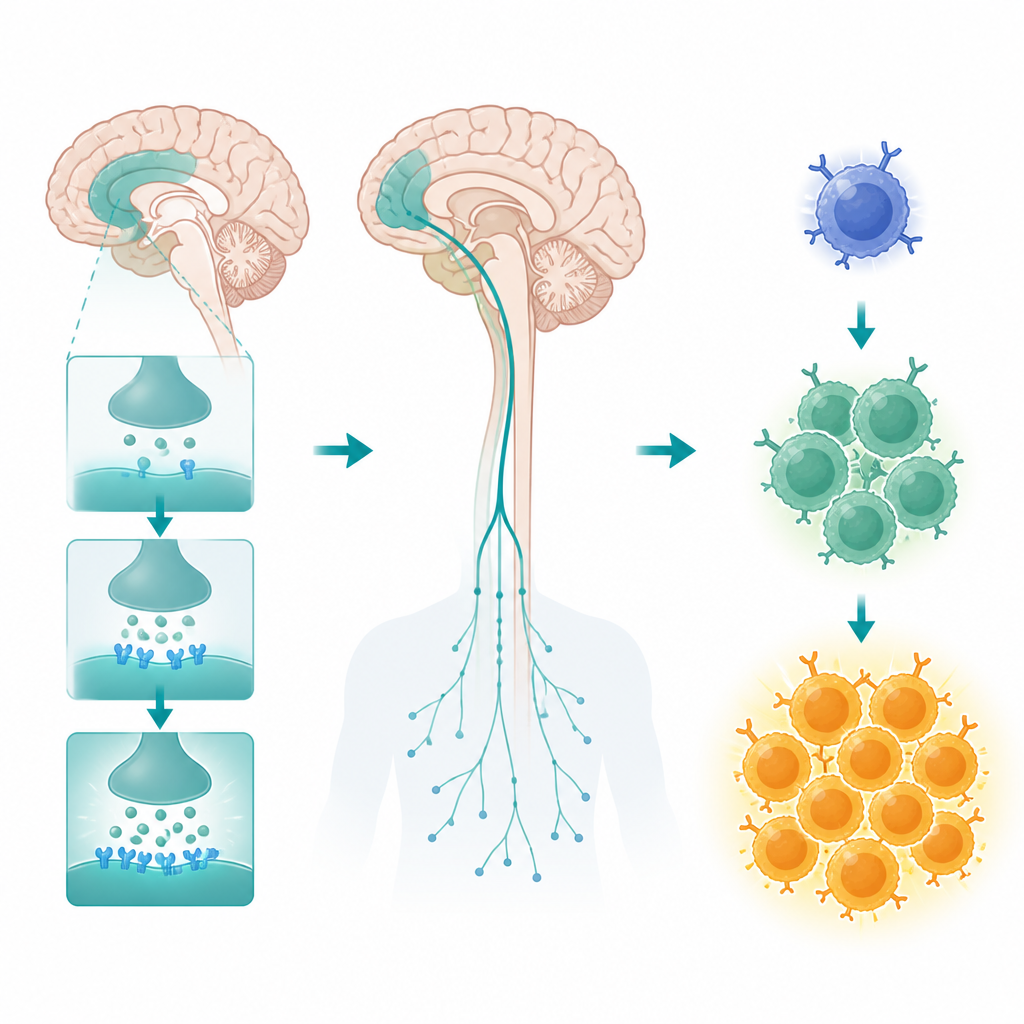
To pinpoint where in the brain this control arises, the researchers selectively restored or enhanced GluA1 in the prefrontal cortex of GluA1-deficient mice. Strengthening synapses in this limited area increased their T-cell expansion after vaccination, even when the animals were housed alone and not engaging in social contests. Further experiments used engineered receptors to temporarily raise or lower the activity of these prefrontal neurons in normal mice at the height of the vaccine response. Activating the cells boosted antigen-specific T-cells in the blood and spleen, while dampening their activity tended to reduce this expansion. Gene expression analysis of T-cells revealed changes consistent with improved survival and growth of these cells, including activation of pathways that support cell division and stress resilience.
What this means for health and inequality
Taken together, the findings show that a specific region of the prefrontal cortex can dial the strength of T-cell responses up or down, creating a direct physical link between the social world and the body’s adaptive immunity. In this mouse model, occupying a high-but-not-top social rank appears to combine favorable brain wiring with strong vaccine responses. While much work remains to see how these principles apply to humans, the study suggests that social environments may shape health not only through access to resources or stress, but also through brain circuits that talk directly to the immune system.
Citation: Xiong, H., Amado-Ruiz, D., Lodder, T.R. et al. Social status impacts T-cell responses through synapse strength in the prefrontal cortex. Cell Res 36, 395–410 (2026). https://doi.org/10.1038/s41422-026-01235-7
Keywords: social status, prefrontal cortex, T-cell immunity, synaptic plasticity, mouse social behavior