Clear Sky Science · en
High-throughput strategy for targeting MDM2 in uveal melanoma to reverse radiation therapy resistance
Why eye tumors can shrug off radiation
Radiation is a common way to treat tumors inside the eye, yet a type called uveal melanoma often keeps growing even after high doses. This study explores why some of these cancer cells are so hard to kill and shows how a targeted drug could make radiation work better, offering hope for patients whose sight and lives depend on more effective therapy.
A stubborn eye cancer
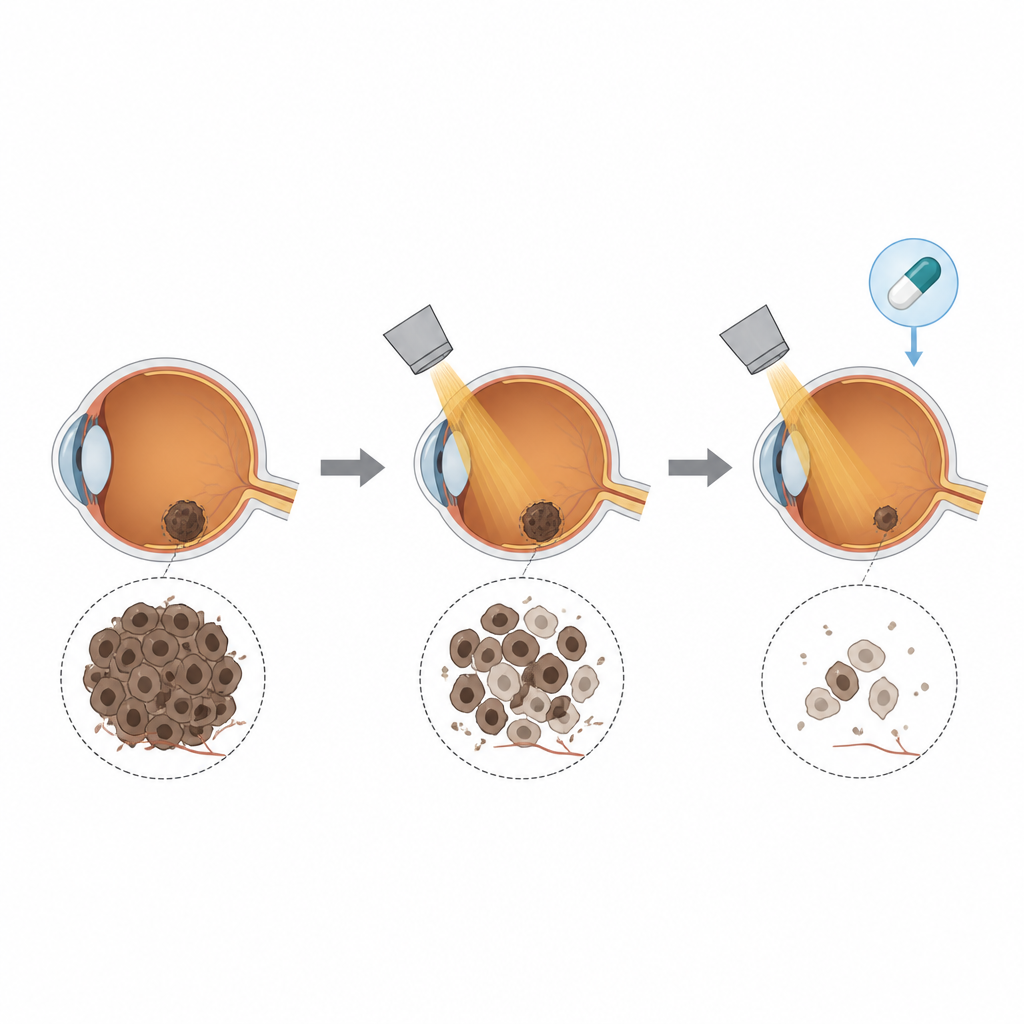
Uveal melanoma is the most common malignant tumor that arises inside the adult eye. It can progress quickly and is difficult to treat while preserving vision. Many patients receive forms of radiotherapy, such as focused beams or implanted radiation sources, but the cancer cells often adapt and survive. Because uveal melanoma usually affects people of working age, its resistance to treatment has serious consequences for long-term health and quality of life.
Hunting for the switch that protects tumor cells
The researchers set out to find which genes and cell types help uveal melanoma withstand radiation. They compared gene activity in radiation-sensitive and radiation-resistant tumor cells using transcriptome sequencing, a technique that measures thousands of genes at once. Computer models, including machine learning methods called LASSO and SVM–RFE, narrowed a list of 22 altered genes down to a handful of key suspects. Among them, one gene, MDM2, stood out because its activity was strongly higher in resistant cells and it is known to control p53, a major guardian of the genome that can trigger cell repair or self-destruction after DNA damage.
Zooming in on the most dangerous cells
To understand where resistance originates inside the tumor, the team turned to single-cell RNA sequencing, which profiles individual cells instead of blending them together. They found many distinct cell types in uveal melanoma tissue, including cancer stem cell like populations, immune cells, and support cells. Cancer stem cell like clusters showed strong links to DNA damage repair genes and shared space with cells rich in MDM2. This pattern suggests that a small, resilient group of tumor cells may use MDM2 to dampen p53 activity, quickly fix radiation damage, and survive treatment, seeding regrowth later on.
A targeted drug that reawakens cell self-destruct
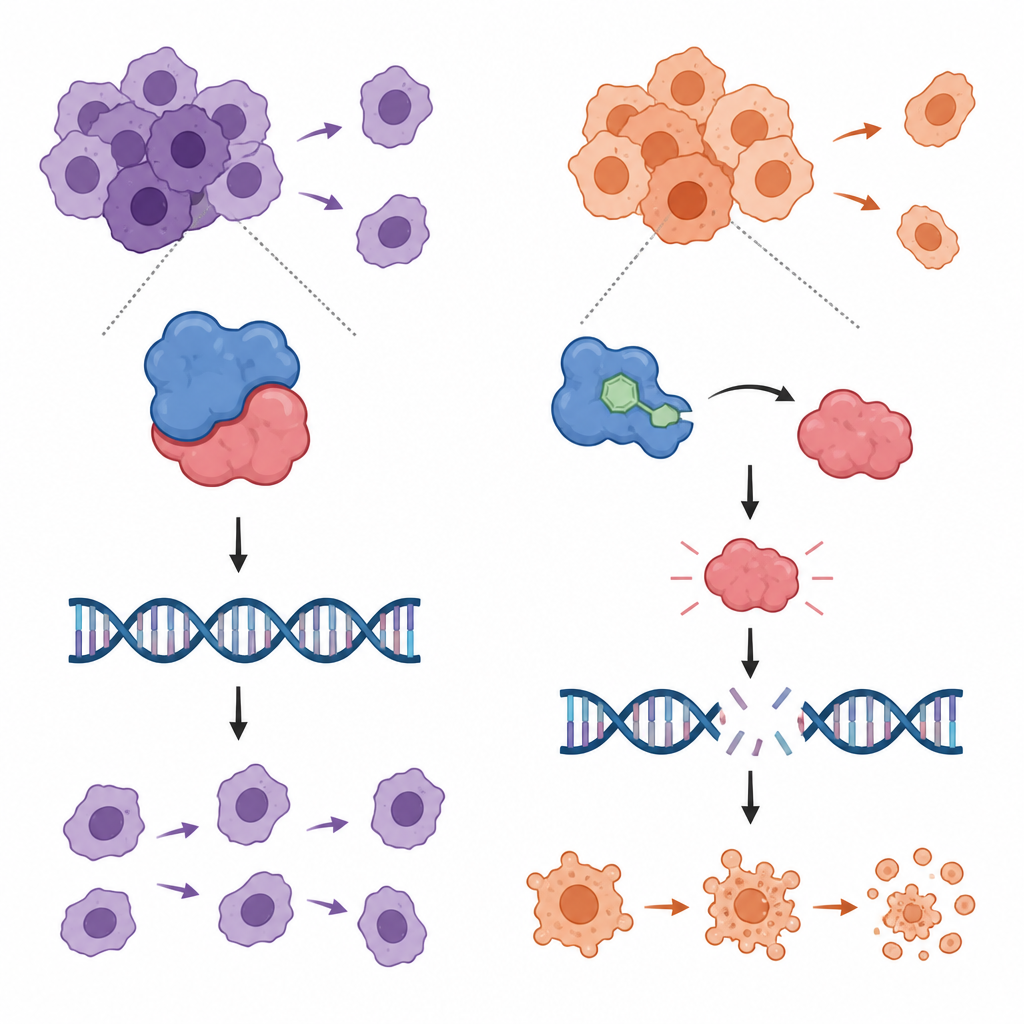
The scientists then tested whether blocking MDM2 could strip away this protection. They created radiation-resistant versions of two human uveal melanoma cell lines by repeatedly exposing them to low doses of radiation. These resistant cells grew faster, moved more easily, and were less likely to die than their original counterparts. When the cells were treated with an experimental MDM2-blocking compound called SAR405838, levels of MDM2 protein fell and p53 levels rose. As a result, the cells became more sensitive to radiation, their growth slowed, and their ability to migrate and invade through laboratory barriers dropped sharply.
How blocking MDM2 helps radiation work
Further tests showed that SAR405838 treatment increased markers of DNA double-strand breaks, such as the protein γ-H2AX, and boosted programmed cell death in the resistant cells. In simple terms, once MDM2 was blocked, p53 could once again sense radiation damage and push damaged tumor cells toward repair failure and self-destruction instead of survival. This shift weakened the cells’ defenses, making radiation more effective at reducing the resistant population in the lab.
What this means for patients
This research outlines a high-throughput, computer-guided way to find drugs that make stubborn tumors more responsive to radiation. By pinpointing MDM2 as a central switch and showing that an MDM2 blocker can restore p53 activity and radiosensitivity in uveal melanoma cells, the study offers a clear, testable strategy for future therapies. While these findings come from cell experiments and still need to be confirmed in animals and clinical trials, they suggest that pairing radiotherapy with carefully chosen MDM2 inhibitors could one day help more patients control this difficult eye cancer and better preserve both vision and survival.
Citation: Zhu, Q., Gong, X., Zhang, S. et al. High-throughput strategy for targeting MDM2 in uveal melanoma to reverse radiation therapy resistance. Cell Death Discov. 12, 221 (2026). https://doi.org/10.1038/s41420-026-02970-x
Keywords: uveal melanoma, radiotherapy resistance, MDM2 inhibitor, p53 pathway, cancer stem cells