Clear Sky Science · en
NF-κB inducing kinase (NIK) deletion accelerates KRAS-driven pancreatic cancer in association with tumor microenvironment remodeling
Why this research matters
Pancreatic cancer is one of the deadliest cancers, in part because it is usually discovered late and wrapped in a tough, hostile tissue environment that resists treatment. This study looks at a lesser-known molecular switch, called NIK, that helps control inflammation and tissue repair in the pancreas. By turning NIK off in mice, the researchers uncovered how small disruptions in this control system can speed the earliest stages of pancreatic cancer and reshape the neighborhood around emerging tumors.
A protective brake in the pancreas
Pancreatic ductal adenocarcinoma, the most common form of pancreatic cancer, often begins when normal digestive cells gradually change into abnormal duct-like structures and then into precancerous lesions and invasive tumors. Most patients carry mutations in a growth-driving gene known as KRAS, but additional changes and chronic inflammation usually push the disease forward. The team focused on NIK, a key player in one branch of the NF-kB signaling network that links inflammation to cell behavior. While related pathways are often thought to fuel cancer, the exact role of NIK in pancreatic disease had remained unclear.
When removing NIK speeds cancer
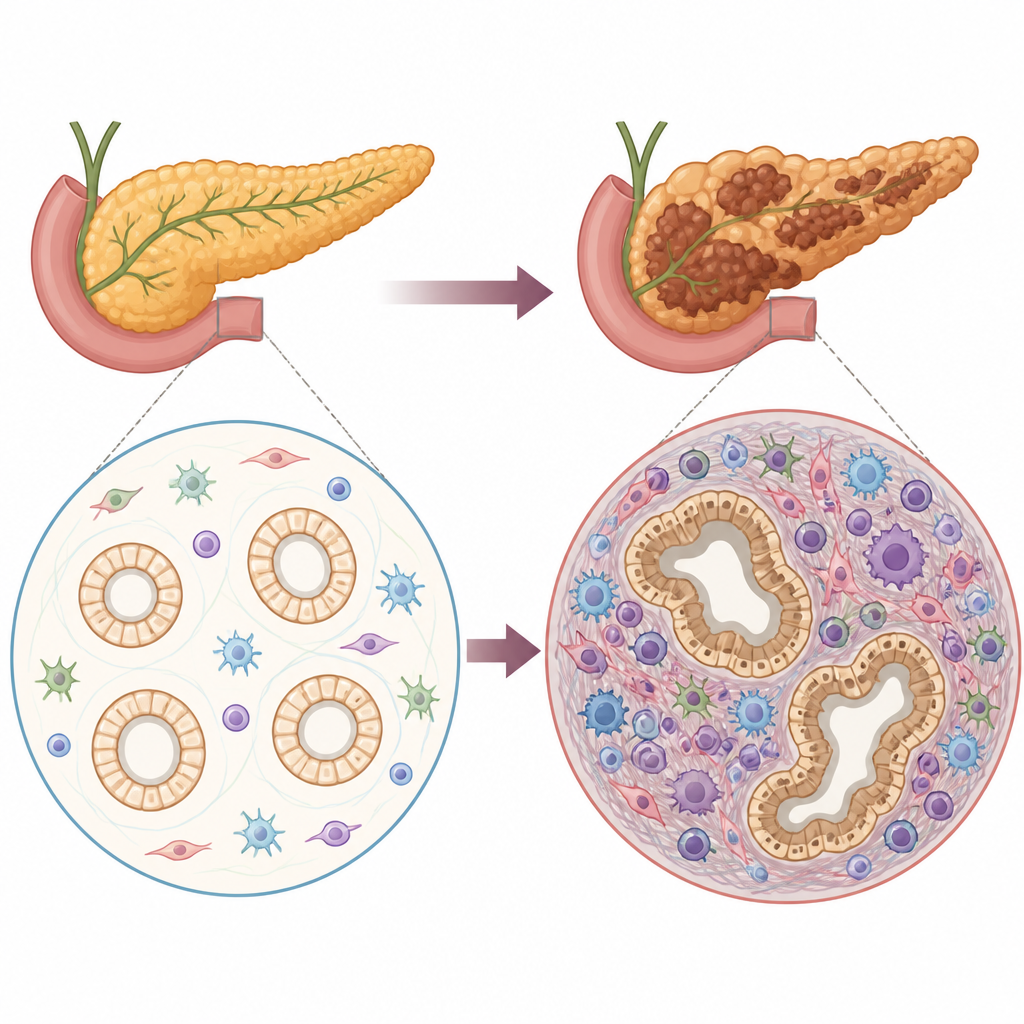
To probe NIK’s function, the researchers engineered mice whose pancreatic cells carried mutant KRAS, with or without NIK, and in some models also lacked the tumor-guarding gene p53. They then examined how quickly lesions formed, how severe they became, and how long the animals survived. Across multiple models, including ones that mimicked human pancreatitis with a drug called cerulein, loss of NIK led to more numerous and more advanced precancerous lesions and earlier appearance of full-blown pancreatic cancer. Mice without NIK developed invasive tumors sooner and had shorter survival, even though tumor size and grade at the final stage looked similar to controls. These observations suggest that NIK normally acts as a brake on early tumor development rather than as a driver of late-stage growth.
Signals that drive growth and survival
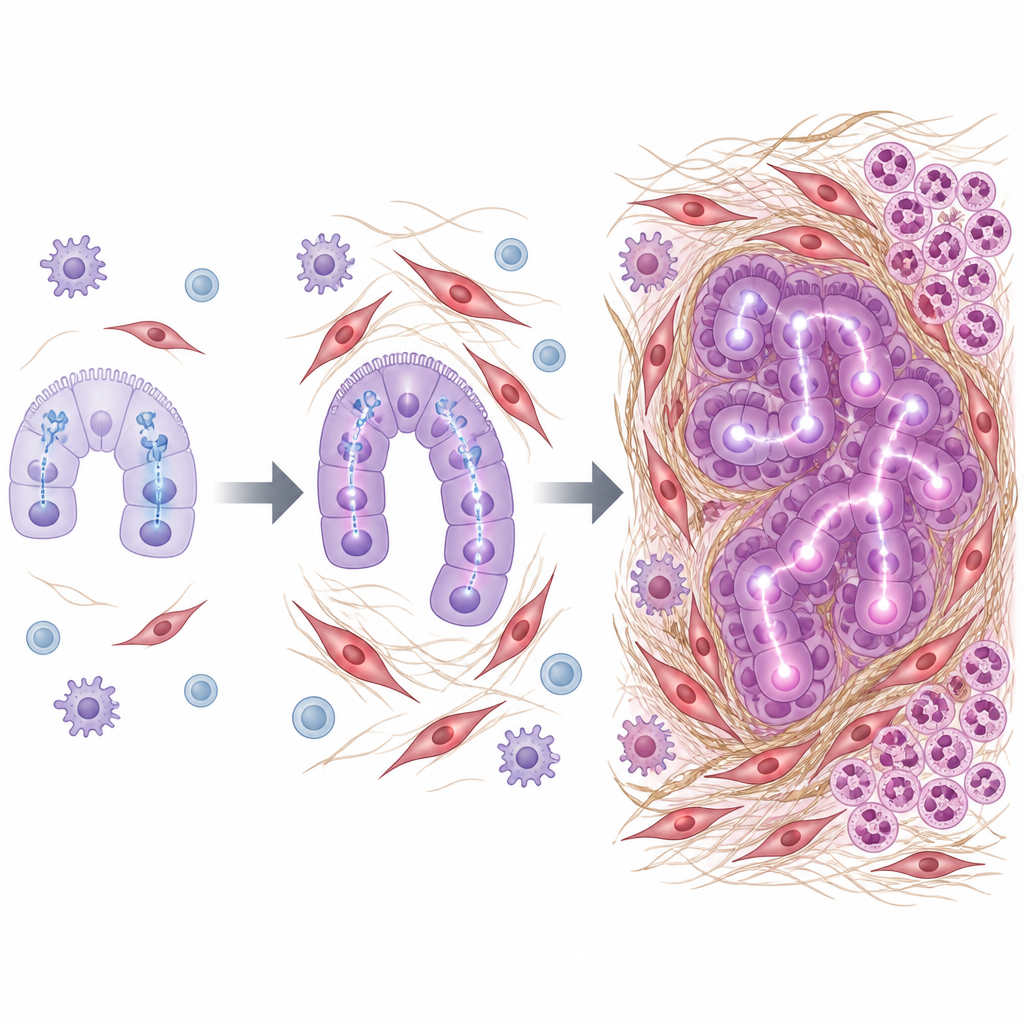
Diving deeper, the team found that pancreases lacking NIK showed stronger activity in the ERK arm of the MAPK pathway, a well-known engine for cell growth. Duct-like cells in lesions from NIK-deficient mice divided more rapidly, while some normal digestive cells were better able to survive injury. Together, this means that when NIK is absent, there are both more cells at risk of transforming and stronger pro-growth signals acting on them. Importantly, analyses of gene activity confirmed that the non-canonical NF-kB route controlled by NIK was dampened, while other growth and stress pathways linked to mutant KRAS were boosted.
A reshaped tumor neighborhood
A major discovery of this work is that turning off NIK does not just affect cancer cells themselves; it also remodels the surrounding tissue, known as the tumor microenvironment. In NIK-deficient mice, the pancreas contained more activated myofibroblasts, a specialized type of cancer-associated fibroblast that lays down dense fibrous tissue. Gene studies and cell culture experiments showed that factors released by NIK-lacking tumor cells pushed stellate cells, a form of pancreatic support cell, toward this fibrotic “myCAF” state. At the same time, signaling pathways such as TGF-beta, Wnt, FGF, and IL6–STAT3 were more active, all of which are linked to scarring, inflammation, and cancer progression. Immune cell counts rose, with a notable increase in neutrophils, but many immune cells accumulated in regions outside lesion cores, suggesting a complex and possibly less effective immune response.
What this means for patients
When the authors examined human cancer data, they found that patients whose tumors had lower levels of NIK tended to have poorer overall survival, echoing the mouse results. Together, the findings show that NIK acts as a context-dependent tumor suppressor in KRAS-driven pancreatic cancer. Rather than simply fueling disease, balanced NF-kB signaling helps restrain early lesion formation and keep the tissue environment from becoming overly fibrotic and inflammatory. For a layperson, the message is that some switches in our cells serve as subtle guardians: turning them off too much, even within a pathway often linked to cancer, can backfire and allow tumors to arise sooner in a more hostile setting. This underscores the need for careful evaluation before broadly blocking NF-kB-related pathways in future pancreatic cancer therapies.
Citation: Du, Z., Büttner, U.F.G., Wirth, H.L. et al. NF-κB inducing kinase (NIK) deletion accelerates KRAS-driven pancreatic cancer in association with tumor microenvironment remodeling. Cell Death Dis 17, 513 (2026). https://doi.org/10.1038/s41419-026-08877-w
Keywords: pancreatic cancer, KRAS, tumor microenvironment, fibrosis, immune signaling