Clear Sky Science · en
Transcription-coupled nucleotide excision repair protects against genomic instability and cell death induced by the liver toxin methyleugenol
Spices, the Liver, and Hidden DNA Stress
Many herbs and spices contain fragrant molecules that make food taste good, but some of them can quietly damage our DNA. This study looks at methyleugenol, a natural ingredient found in basil, tarragon and other plants, and asks how our cells cope with the DNA damage it can cause in the liver. Understanding this defense system matters not only for assessing the safety of everyday foods but also for people who inherit weaknesses in key DNA repair pathways.
How a Flavor Molecule Turns Harmful
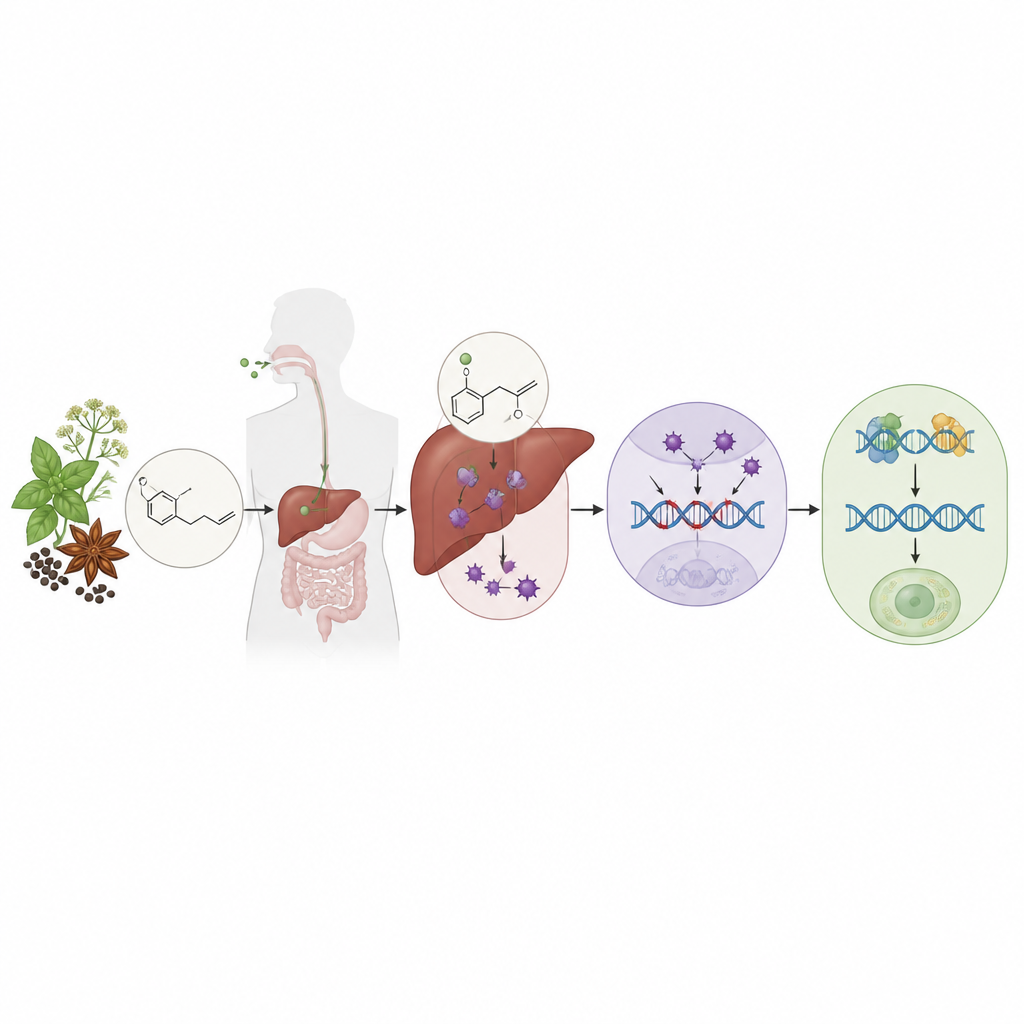
Methyleugenol is swallowed with food and quickly absorbed into the bloodstream. In the liver it is converted by normal detox enzymes into more reactive forms that can chemically attach to DNA. These attachments, called adducts, occur mostly on the DNA building block guanine and to a lesser extent on adenine. The authors show that after liver-like cells are exposed to a methyleugenol metabolite, the number of adducts rises over several hours and then drops only partway. Even three days later, a large fraction of these lesions remain. This persistence suggests that common DNA repair systems either fail to recognize most methyleugenol adducts or remove them only slowly, allowing damage to build up over time with repeated exposure.
When Repair Depends on Active Genes
DNA repair comes in several flavors. One major pathway, nucleotide excision repair, can either scan the whole genome or focus on stretches of DNA that are actively being read into RNA. By disabling key repair genes in human and mouse liver cells, the researchers found that the global scanning arm plays little role in clearing methyleugenol damage. In contrast, the branch tied to ongoing transcription, called transcription-coupled repair, is essential. When this branch is knocked out, methyleugenol adducts accumulate, DNA damage signals surge and cells become far more sensitive, losing viability at much lower doses than normal cells.
Blocked Gene Reading and Cellular Fallout
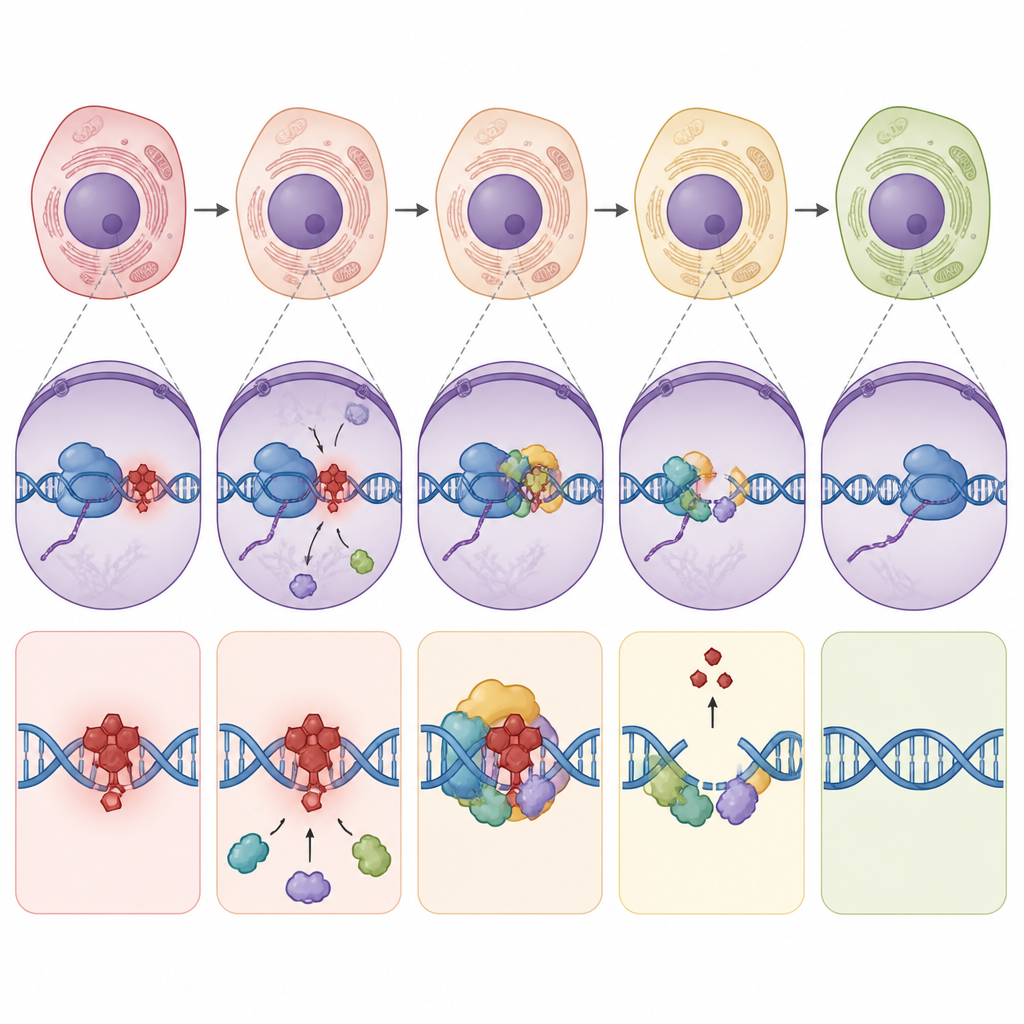
To see what happens inside the nucleus, the team examined how methyleugenol adducts affect the machinery that reads genes. They found that these lesions stall RNA polymerase II, the enzyme that travels along DNA to make RNA copies. As polymerase stalls, its main subunit is released from chromatin, exported to the cytoplasm and marked for destruction by the cell’s protein recycling system. New RNA production drops sharply but gradually recovers once repair has taken place. At the same time, repair factors that specialize in rescuing stalled polymerases are drawn to the damaged sites, confirming that the canonical transcription-coupled pathway has been engaged.
From Stalled Transcription to Genomic Instability
Stubborn transcription blocks can create further trouble. The study shows that methyleugenol exposure promotes the formation of R-loops, three-stranded structures where RNA sticks to its DNA template. These structures are known to threaten genome stability. Their levels climb in liver-derived cells treated with methyleugenol and rise even more in cells lacking transcription-coupled repair. In parallel, the researchers detect more micronuclei, tiny extra DNA-containing bodies that mark chromosome breakage or mis-segregation. Again, this effect is most pronounced when transcription-coupled repair is disabled, linking unrepaired adducts and persistent transcription stress to structural damage in chromosomes.
Why Repair Capacity Matters for People
Taken together, the findings show that methyleugenol-derived DNA adducts are handled mainly when they interfere with genes that are being actively read. The specialized repair system that clears these roadblocks protects cells from long-lasting transcription stress, chromosome instability and cell death. People with inherited defects in this pathway, such as those with Cockayne syndrome, may therefore be especially vulnerable to DNA damage from methyleugenol and similar plant compounds. While the doses used in cell experiments are higher than typical dietary exposures, the work underscores how everyday chemicals from food interact with our DNA and how much we depend on a finely tuned repair network to stay healthy.
Citation: Quarz, C., Walter, R.S., Hens, L.E. et al. Transcription-coupled nucleotide excision repair protects against genomic instability and cell death induced by the liver toxin methyleugenol. Cell Death Dis 17, 483 (2026). https://doi.org/10.1038/s41419-026-08853-4
Keywords: methyleugenol, DNA repair, liver toxicity, transcription stress, Cockayne syndrome