Clear Sky Science · en
Fatty acid synthesis supports tumor progression through facilitating the activity of TORC1 signaling
How Cancer Cells Change Their Fuel Use
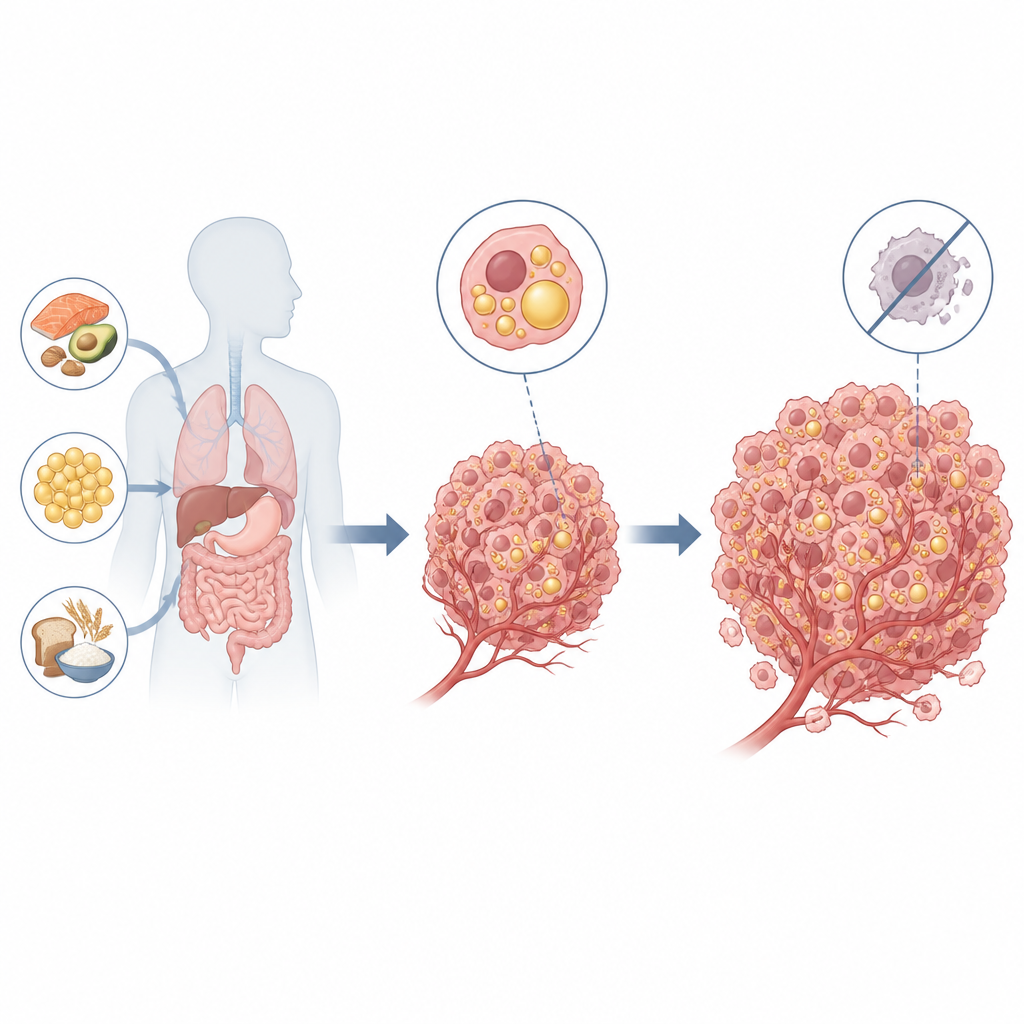
Cancer cells grow quickly and need a steady supply of building blocks to make new membranes and store energy. This study explores how certain tumors do not just rely on fat from food or nearby tissues, but instead make their own fatty acids, and how this homemade fat quietly supports powerful growth signals inside the cancer cells.
Why Fat Making Matters in Tumors
The researchers focused on a fruit fly tumor model that mimics key features of human cancers, such as rapid growth and invasion into surrounding tissue. They examined the cell machinery that builds fatty acids and neutral fats from small carbon units. By turning off, one by one, several enzymes in this pathway only in tumor cells, they could see which steps are truly vital for tumor expansion. This allowed them to separate the needs of tumor cells from the rest of the animal and reveal how changes in fat production affect growth control signals.
Switching Off Fat Production Slows Growth
They found that boosting new fatty acid and fat production is a common feature of these malignant tumors. When they reduced the activity of key enzymes that start or extend fatty acid chains, such as acetyl CoA carboxylase (ACC) and fatty acid synthase, tumors grew much more slowly. An enzyme called Lipin, which helps make a fat called diacylglycerol, was also important: its loss shrank tumors. Yet blocking several other enzymes later in the pathway had little effect, suggesting that only specific steps in fat building are critical for supporting tumor growth. Early in tumor development, cancer cells seemed to burn through their stored fats, while at later stages, they rebuilt fat stores inside small droplets in a way that depended on ACC.
Fats Help Keep a Master Growth Switch On
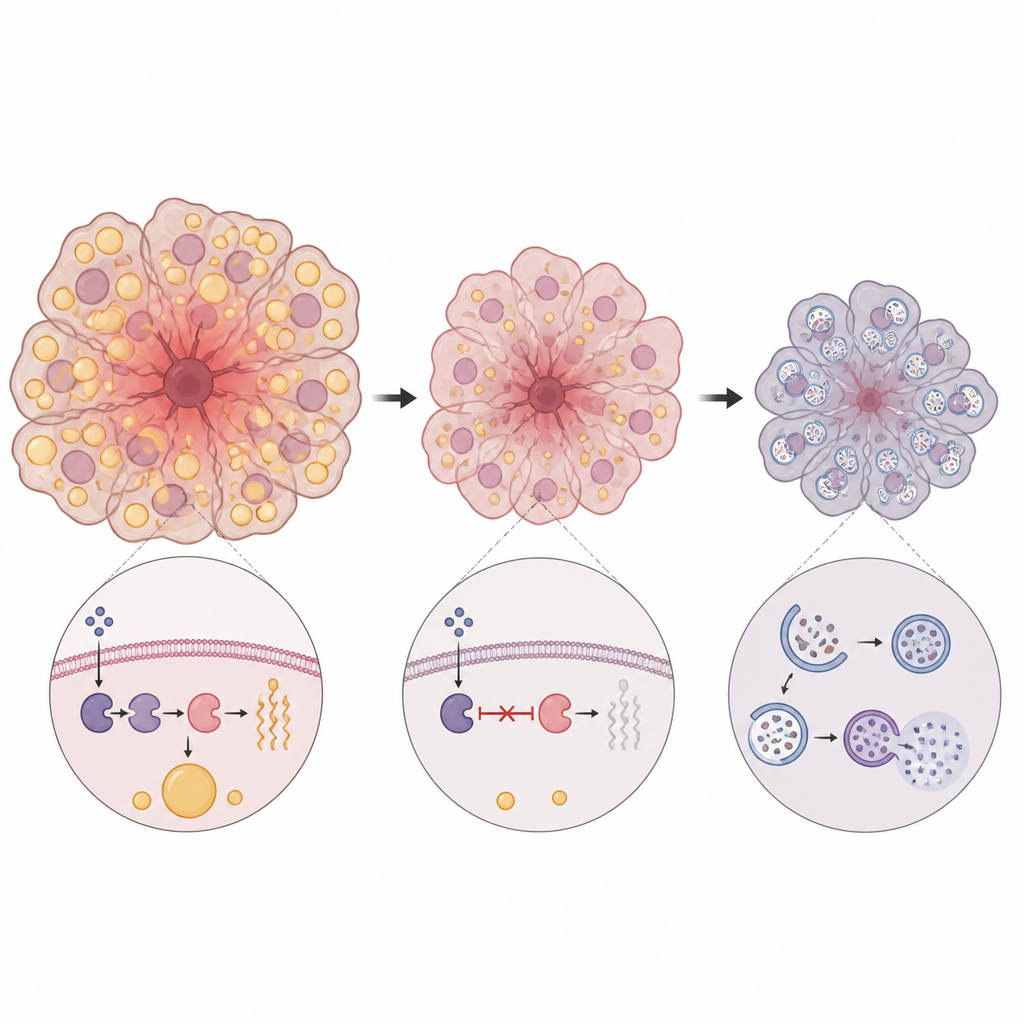
The team then asked how these fat making steps are tied to the main nutrient sensing hub in cells, a protein complex called TORC1 that controls growth and recycling. In normal conditions TORC1 is strongly active in the tumor cells, encouraging them to build proteins and avoid self digestion. When ACC was silenced, TORC1 activity dropped and signs of autophagy, a process where cells break down their own components, increased sharply. Attempts to reactivate TORC1 by pushing upstream signals, like insulin related pathways, or by blocking an energy stress sensor called AMPK, did little to restore growth or TORC1 activity. This suggested that without new fatty acids, TORC1 itself becomes less responsive to usual growth cues.
Changing the Fat Mix Inside Tumor Cells
To see what actually changes inside the cell membranes, the scientists measured many different fat types in normal and enzyme blocked tumors. When ACC was lost, fats built from saturated and monounsaturated chains dropped, while fats containing more highly unsaturated chains, which must come from food, accumulated. This pattern points to a strong loss of local fatty acid production. In contrast, blocking Lipin altered only selected fats. Strikingly, when ACC deficient tumors were kept in a dish with extra oleic acid, a simple monounsaturated fat, they grew larger and their TORC1 activity increased, although not back to normal. Control tumors did not benefit from this extra fat, indicating that only tumors with impaired fat synthesis are limited in this way.
What This Means for Cancer Research
Overall, the study shows that for these tumors, making their own fatty acids is not just about supplying fuel and membrane material. These fats also help maintain a master growth controller, TORC1, in a state that can fully respond to growth signals and restrain self digestion. When fatty acid synthesis is blocked, TORC1 quiets down, autophagy rises, and tumor cells are more likely to die. This work suggests that drugs targeting early steps in fatty acid production could weaken key growth signals in cancers that depend on this pathway, offering a potential way to slow tumor progression.
Citation: Károlyi, D., Bótor, S.B., Neuhauser, N. et al. Fatty acid synthesis supports tumor progression through facilitating the activity of TORC1 signaling. Cell Death Dis 17, 468 (2026). https://doi.org/10.1038/s41419-026-08738-6
Keywords: fatty acid synthesis, cancer metabolism, mTORC1 signaling, tumor growth, autophagy