Clear Sky Science · en
Dystrophins DP71 and DP427 determine cell viability during proliferation and myofibre differentiation
Why this muscle study matters
Duchenne muscular dystrophy is a serious childhood disease that slowly robs boys of their ability to move and shortens their lives. Doctors have long known that it is caused by faults in a single gene, but that gene produces several related proteins whose exact roles in living cells were not fully clear. This study looks closely at two of these proteins, DP71 and DP427, and at their helper cousin utrophin, to reveal how they keep muscle and other cells alive and what happens when they are missing.
Key players that protect muscle cells
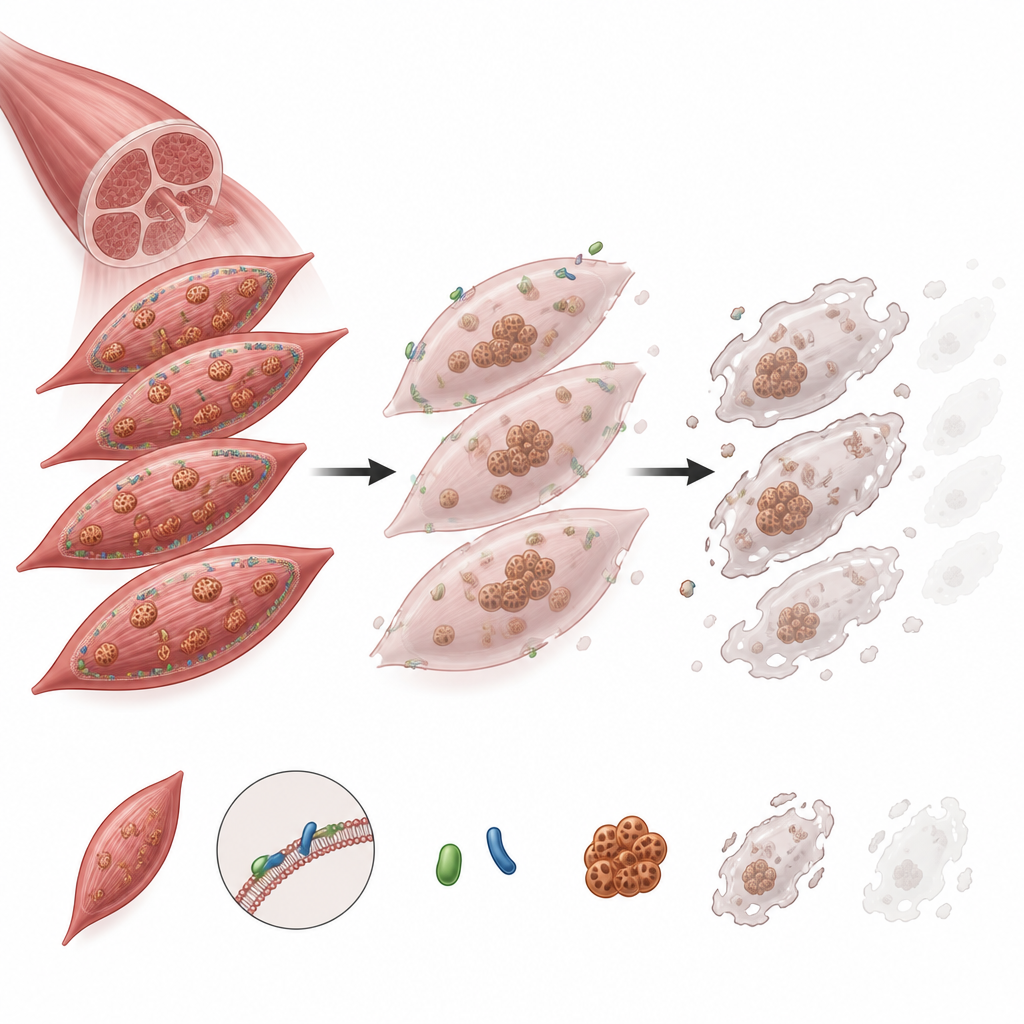
The dystrophin gene makes a family of proteins that help anchor muscle fibers and protect them from damage. DP427 is the long form found in adult skeletal and heart muscle, while DP71 is a shorter form made in many cell types, including brain cells and dividing muscle precursors. A related protein called utrophin, especially its UP395 form, can sometimes take over part of dystrophin’s job. Not all patients lose the same set of these proteins. While every boy with Duchenne lacks DP427, only about one in ten also lacks DP71. The researchers wanted to know how each form contributes to cell health during two critical phases: when cells are actively dividing and when they are fusing into mature muscle fibers.
Experiments in mouse muscles and cultured fibers
The team first studied leg muscles from healthy mice and from mice lacking both DP427 and utrophin, a model that closely resembles severe human disease. After forcing the muscles to regenerate with a toxin, they tracked how dystrophin, utrophin, and associated proteins appeared over time. In healthy muscles, utrophin dominated early and was later replaced by DP427 as new fibers matured, and mitochondrial proteins rose in parallel, reflecting robust energy production. In contrast, double-deficient muscles regenerated quickly at first but then faltered: they formed new fibers that were smaller, contained disorganized mitochondria, and died more often. Importantly, these problems appeared even when fibers were grown from single muscle cells in a dish, away from nerves and other tissue, showing that the damage comes from changes inside the muscle cells themselves.
What happens when support proteins are missing
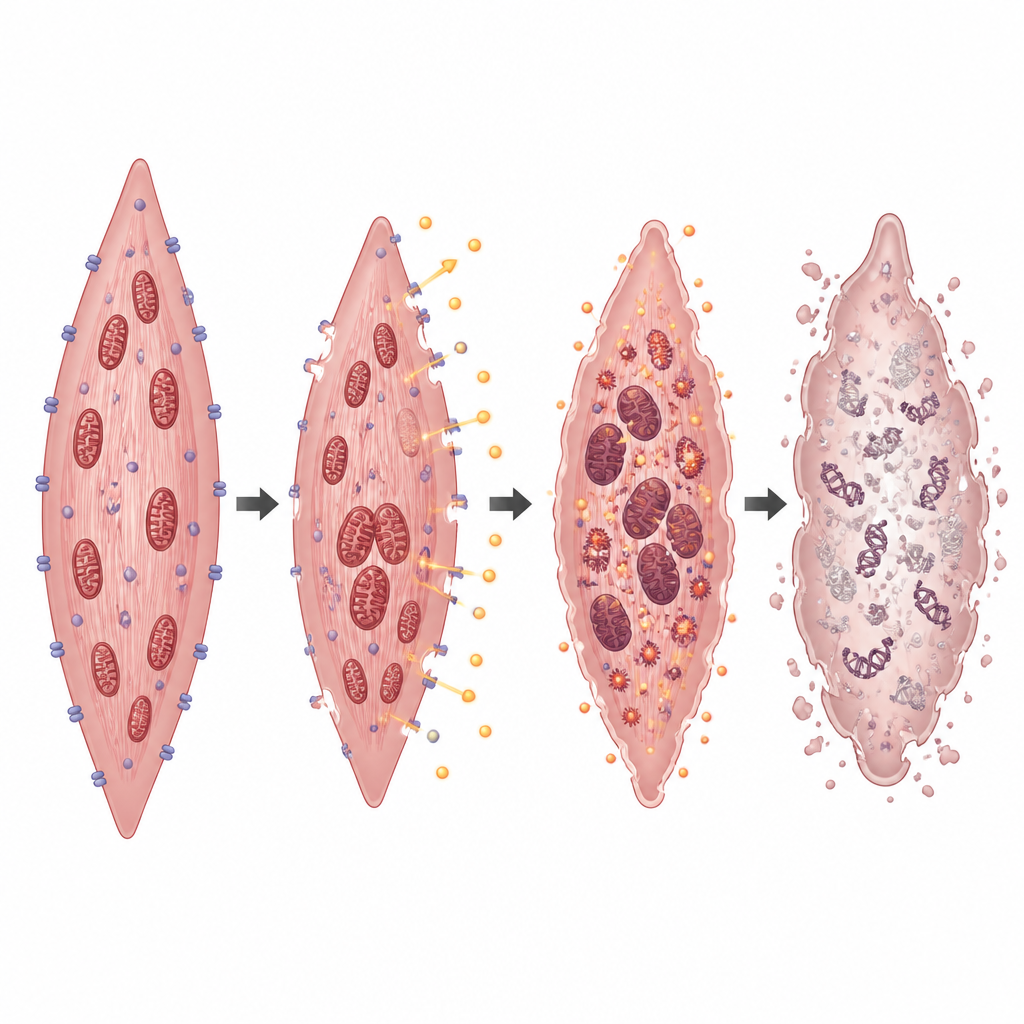
To pinpoint the roles of specific proteins, the researchers selectively reduced dystrophin and utrophin in mouse and human muscle cells grown in the lab. When these support proteins were lowered in dividing muscle cells or in newly formed fibers, several harmful changes occurred. Cell membranes became leaky, letting in extra calcium, mitochondria clumped and lost normal function, and harmful oxygen byproducts increased. DNA damage and signs of cell death also rose, while the ability of cells to fuse into strong, well-organized fibers declined. These effects appeared even without muscle contraction, showing that weakness in Duchenne is not only due to mechanical stress during movement but also to basic failures in cell maintenance.
The special role of DP71 in dividing cells
The short form DP71 turned out to be especially important during cell division. In non-muscle cell lines and in muscle precursor cells, loss of DP71 reduced survival, enlarged nuclei, disturbed the mitochondrial network, and increased DNA damage and oxidative stress. When both DP71 and utrophin were missing, these problems became worse, indicating that utrophin can partly compensate for DP71 just as it can for DP427 in mature muscle fibers. In mixed cultures, normal helper cells supported better muscle fiber formation, but cells lacking DP71 failed to do so, suggesting that DP71-positive neighboring cells also aid muscle repair.
Gene activity changes behind the damage
The team also measured which genes turned on or off when dystrophin and utrophin were removed. In dividing cells, loss of these proteins disturbed genes that control the cell cycle, stress responses, and programmed cell death. In human muscle fibers, it altered genes that organize the internal scaffolding, control contraction, and shape the surrounding support matrix. These shifts matched the physical changes seen under the microscope: struggling cells slowed their growth, altered their structure, and activated defense pathways but could not fully restore balance.
What this means for patients and treatments
Together, the results show that DP71 and DP427 safeguard cells at different stages: DP71 is crucial for the health of dividing cells, while DP427 is vital for the stability of mature muscle fibers. Utrophin can partly back up both, but not completely. This helps explain why some boys with Duchenne, who lack DP427 but still make DP71, fare better than those who lose both forms. It also suggests that future therapies may need to be tailored: patients missing only DP427 might benefit most from treatments that restore or boost long dystrophin or utrophin in muscle, whereas those also missing DP71 could require strategies that protect dividing cells and support tissues throughout the body.
Citation: Szwec, S., Durska, A., Kościelniak-Wawro, P. et al. Dystrophins DP71 and DP427 determine cell viability during proliferation and myofibre differentiation. Cell Death Dis 17, 467 (2026). https://doi.org/10.1038/s41419-026-08725-x
Keywords: Duchenne muscular dystrophy, dystrophin, DP71, utrophin, muscle regeneration