Clear Sky Science · en
ARID1A deficiency reprograms the tumor secretome, enhancing microenvironmental remodeling and metastatic dissemination in endometrial carcinoma
Why this study matters for women’s health
Endometrial cancer, a tumor of the uterus lining, is the most common invasive gynecologic cancer worldwide and its rates are rising. Many women do well when the disease is caught early, but others develop tumors that invade nearby tissue and spread to distant organs. This study asks a simple but important question: what hidden signals help some endometrial cancers become more aggressive, and could blocking those signals slow or stop their spread?
A missing guardian inside tumor cells
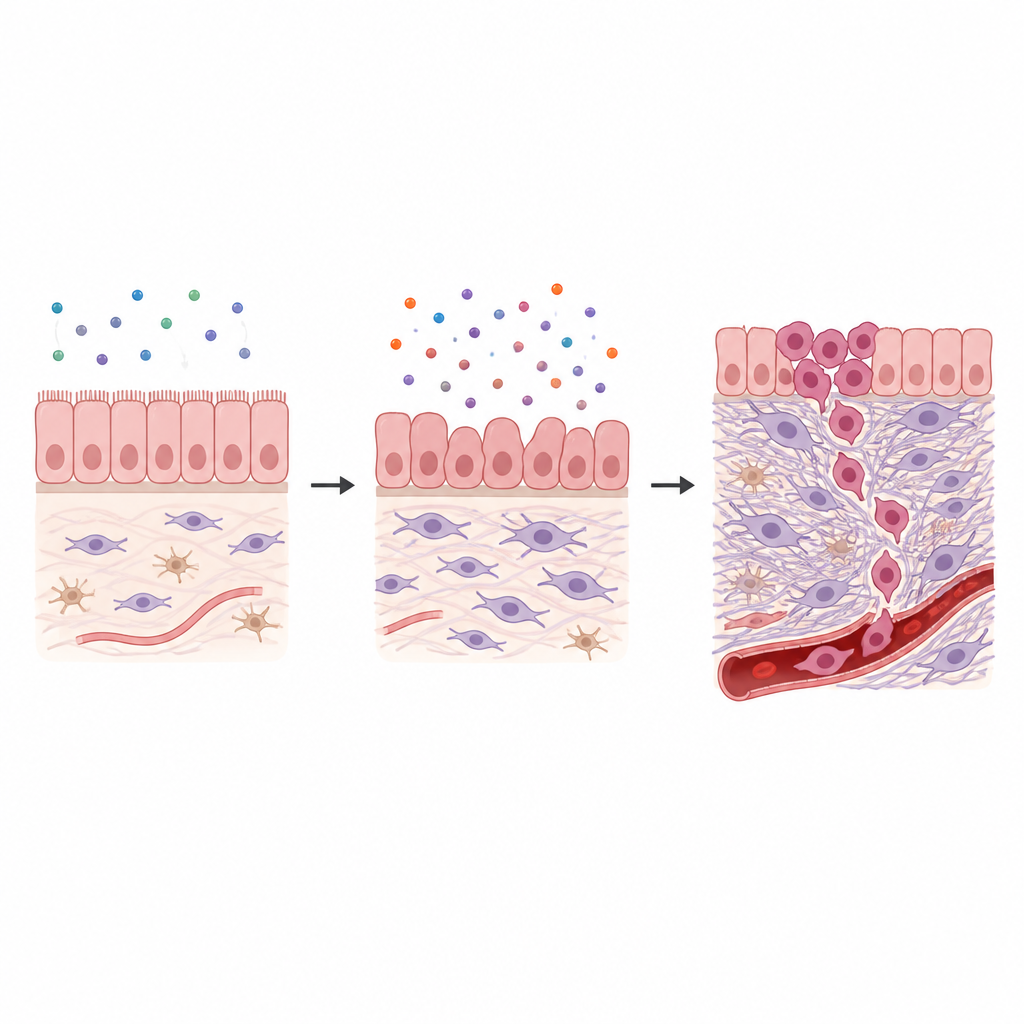
The researchers focused on a gene called ARID1A, which normally helps keep the DNA in cells packaged and read correctly. In many endometrial cancers, ARID1A is damaged or lost. Patients whose tumors lack ARID1A tend to have shorter periods without disease progression, suggesting that this gene acts as a kind of guardian against aggressive behavior. Rather than only looking at changes inside the cancer cells, the team explored how loss of ARID1A alters the way these cells communicate with their surroundings.
Cancer cells that talk louder and harsher
Cancer cells constantly release proteins and other molecules into the space around them, a mix known as the secretome. These secreted factors can act like messages that instruct neighboring cells how to behave. The authors compared the secretions from endometrial cancer cells with and without ARID1A. They found that ARID1A-deficient cells released a reprogrammed set of signals that strongly boosted the movement and invasive abilities of nearby cancer cells that still had normal ARID1A. When these altered secretions, or even blood from mice carrying ARID1A-deficient tumors, were added to otherwise less aggressive cells, those cells began to migrate more, invade three-dimensional gels, and switch from a more orderly, “epithelial” form to a looser, more mobile form linked to metastasis.
A key chemical messenger that stiffens the neighborhood
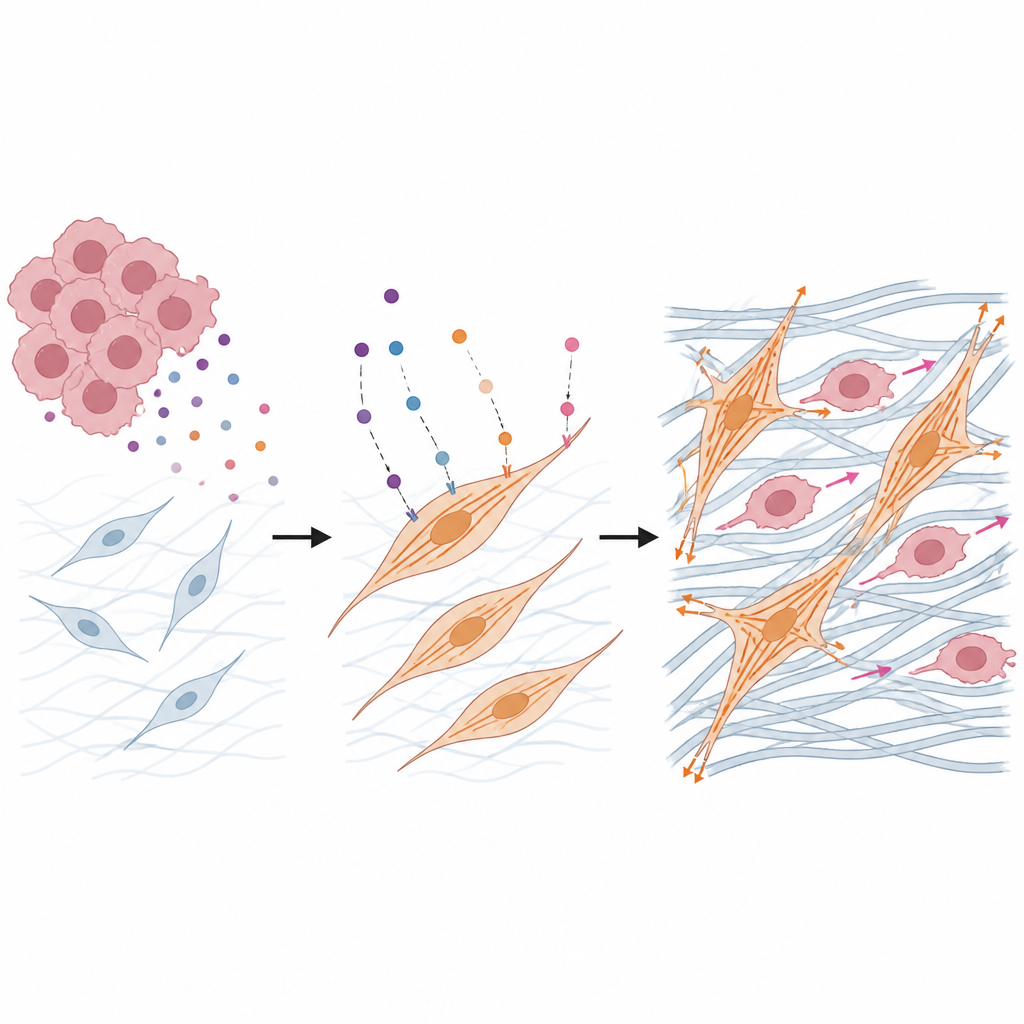
Among many secreted molecules, one chemokine called CXCL16 stood out as the most consistently increased in ARID1A-deficient cells. Chemokines are small proteins that guide cell movement. In this case, boosted CXCL16 acted through its partner receptor CXCR6 to trigger a chain of events inside cancer cells involving well-known growth and movement pathways. These signals strengthened internal scaffolding and contact points with the surrounding material, changes that favor cell migration. At the same time, CXCL16 acted on stromal cells in the uterus, especially fibroblasts, which normally provide structure and support. Under the influence of CXCL16-rich secretions, these fibroblasts elongated, became more contractile, produced more collagen, and took on features of cancer-associated fibroblasts that are known to help tumors grow and spread.
Remodeling the tumor neighborhood in patients and mice
The team combined laboratory experiments, mouse models, and analysis of human tumor data. In mice engineered to lose ARID1A in the uterine lining, both blood and tumor tissue showed high CXCL16 and increased markers of activated fibroblasts in the surrounding stroma. Human endometrial cancers with low ARID1A expression similarly displayed higher levels of CXCL16, CXCR6, and related enzymes, as well as less chemical “silencing” on the CXCL16 and CXCR6 genes, which may help explain their overactivity. Stromal cells from these models remodeled collagen gels more strongly and allowed cancer cells to invade deeper, indicating that the microenvironment had been reshaped into a more permissive, metastasis-friendly state.
Blocking the harmful conversation to limit spread
To test whether CXCL16 was more than just a marker, the researchers blocked this messenger or its receptor using antibodies, small-molecule inhibitors, or genetic tools. In dishes, these approaches reduced cancer cell movement, invasion, and the shift toward a mobile cell type. In mice, silencing CXCL16 in ARID1A-deficient tumors or treating animals with a CXCR6 blocker cut down on lung metastases formed by circulating endometrial cancer cells. Likewise, blocking CXCL16 prevented full activation of fibroblasts and reduced the stiff, scar-like reaction around tumors. Together, these findings suggest that the ARID1A-deficient secretome, with CXCL16 at its core, not only nudges cancer cells to move but also reshapes the tumor neighborhood to smooth their path.
What this means for future treatments
For people with endometrial cancer, the study offers a clearer picture of why tumors lacking ARID1A can behave so aggressively. Loss of this guardian gene rewires the chemical messages that cancer cells send out, boosting a single chemokine, CXCL16, that helps both tumor cells and surrounding support cells cooperate in disease spread. While more clinical research is needed, targeting the CXCL16–CXCR6 communication line may offer a new way to slow tumor progression, especially in patients whose cancers show ARID1A loss and signs of a remodeled, fibrous tumor microenvironment.
Citation: Megino-Luque, C., Albertí-Valls, M., Olave, S. et al. ARID1A deficiency reprograms the tumor secretome, enhancing microenvironmental remodeling and metastatic dissemination in endometrial carcinoma. Cell Death Dis 17, 488 (2026). https://doi.org/10.1038/s41419-026-08723-z
Keywords: endometrial cancer, ARID1A, tumor microenvironment, CXCL16, cancer metastasis