Clear Sky Science · en
OSCAR functions as a collagen I receptor to suppress hippo signaling and reprogram lipid metabolism in clear-cell renal cell carcinoma
Why this kidney cancer story matters
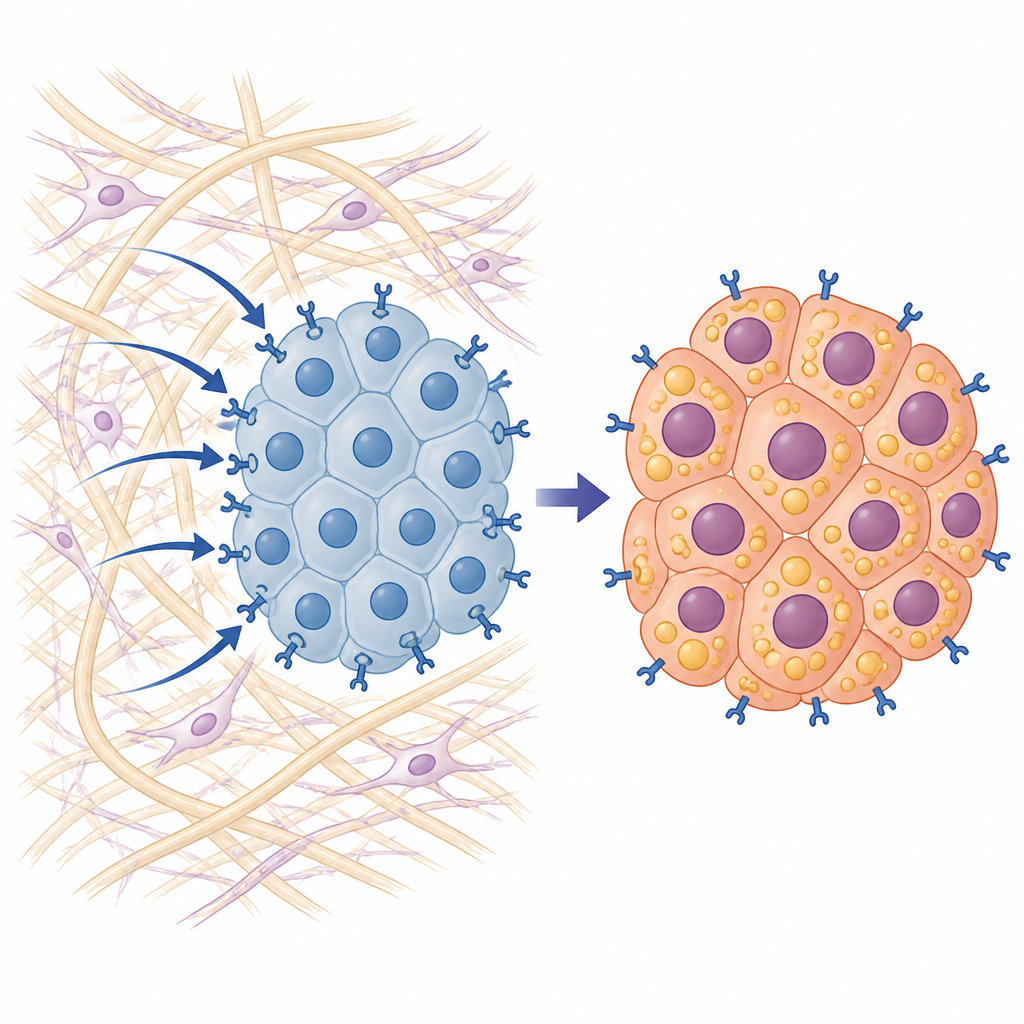
Clear-cell kidney cancer is the most common form of kidney tumor and is often hard to treat once it spreads. A striking feature of these cancer cells is that they look “clear” under the microscope because they are packed with fat droplets. This study uncovers how a structural protein that surrounds cells, called collagen, can talk directly to kidney cancer cells, encouraging them to grow, spread, and stockpile fat. It also tests a new nano-sized drug delivery system that aims to interrupt this harmful conversation.
The hidden scaffold around kidney tumors
Our organs are supported by a web of material known as the extracellular matrix, which acts like scaffolding around cells. In clear-cell kidney cancer, this scaffold is heavily remodeled, and collagen I, a rope-like protein, becomes especially abundant. By examining patient samples and cancer databases, the researchers found that collagen I levels are much higher in tumor tissue than in nearby healthy kidney tissue. Patients whose tumors carried more collagen I tended to have poorer survival, suggesting that this protein is not just structural but actively supports cancer behavior.
A new way collagen signals to cancer cells
Collagen can influence cells by binding to specific surface receptors, which act as “antennas” that convert outside cues into internal signals. The team systematically tested several known collagen receptors in kidney cancer cells and discovered that one called OSCAR was uniquely important for the boost in growth and movement driven by collagen I. OSCAR itself was present at higher levels in tumors than in normal kidney cells, and higher OSCAR levels were linked to more advanced disease and worse patient outcomes. In both cell cultures and mouse models, reducing OSCAR greatly slowed tumor growth and spread, particularly when collagen I was present.
From outside pressure to inside growth switches
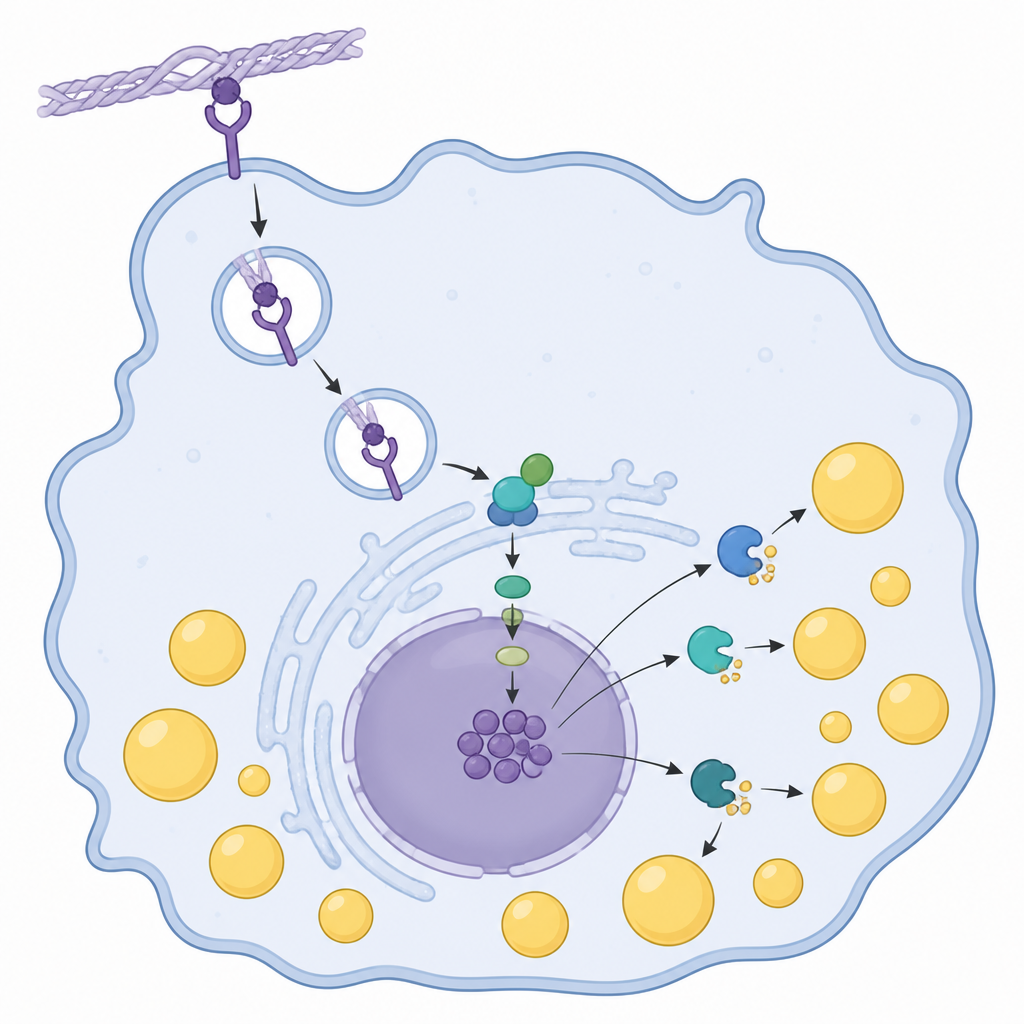
The researchers then asked how the collagen–OSCAR signal is transmitted inside the cell. They focused on the Hippo pathway, a molecular circuit that normally keeps cell growth in check. In healthy cells, a scaffold protein called SAV1 helps keep this pathway active at the cell membrane, which keeps a growth switch protein named YAP out of the nucleus. The study shows that when collagen I binds to OSCAR, the receptor is pulled into the cell and physically binds to SAV1. This keeps SAV1 away from the membrane, weakens the Hippo brake, and allows YAP to move into the nucleus, where it turns on genes that promote cell division, movement, and altered metabolism.
Rewiring how kidney cancer cells handle fat
Clear-cell kidney tumors are packed with fat droplets, and this work connects that trait to the collagen–OSCAR–Hippo signaling chain. When collagen I activates OSCAR, cancer cells ramp up enzymes that build new fatty acids and triglycerides, leading to more lipid droplets inside the cells. Blocking OSCAR, or directly blocking YAP activity, reduced these fat stores and lowered the levels of key fat-making enzymes. Detailed lipid profiling showed that OSCAR affects not just how much fat is made, but also the types of fats and their chain lengths, subtly reshaping the cell’s internal chemistry in ways that support growth and survival.
A nano-delivery strategy to cut the signal
To turn these insights into a potential treatment, the team designed tiny lipid-based particles that carry a short collagen-like peptide. This peptide competes with real collagen for binding to OSCAR. The nanoparticles are coated so that they naturally collect in collagen-rich tumor tissue and release their cargo more readily in the acidic environment around tumors. In mice with kidney tumors, these particles homed to the tumors, restored activity of the Hippo growth-control pathway, reduced YAP-driven signals, shrank tumors, and lowered fat buildup in cancer cells, all without obvious harm to major organs.
What this means for patients
This study shows that collagen around kidney tumors is not just passive scaffolding. By binding to the OSCAR receptor, it can silence an important growth-control pathway and push cancer cells to divide, spread, and hoard fat. By interrupting this interaction with a targeted nanoparticle system, the researchers were able to slow tumor growth in animals. While much more work is needed before this strategy could be tested in people, the findings reveal a new link between the tumor’s physical surroundings, growth control circuits, and cancer metabolism, and point toward fresh ways to treat clear-cell kidney cancer.
Citation: Shi, H., Shi, J., Dong, X. et al. OSCAR functions as a collagen I receptor to suppress hippo signaling and reprogram lipid metabolism in clear-cell renal cell carcinoma. Cell Death Dis 17, 499 (2026). https://doi.org/10.1038/s41419-026-08713-1
Keywords: clear cell renal cell carcinoma, collagen I, Hippo signaling, lipid metabolism, nanoparticle therapy