Clear Sky Science · en
Functional analysis of the human miRNome in non-small cell lung cancer unveils a novel miR-92b-3p/NOTCH3 axis that drives tumor progression
Why tiny molecules in lung tumors matter
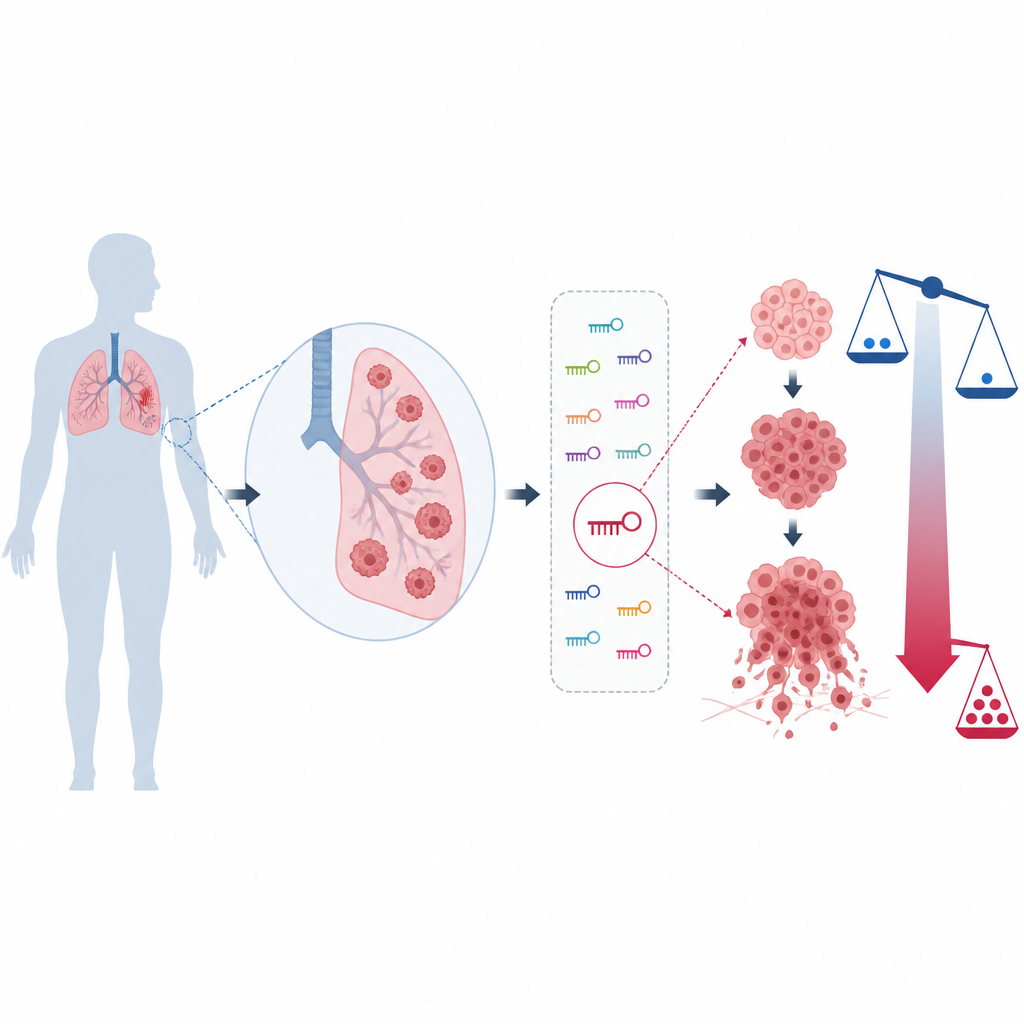
Lung cancer is still the top cause of cancer deaths, in part because many tumors spread before they are detected and because we do not fully understand what drives this spread. This study looks at very small RNA molecules, called microRNAs, that help control how genes work. By testing nearly all known human microRNAs in lung tumor cells, the researchers uncovered a new chain of events that links specific microRNAs to more aggressive lung cancer and poorer patient survival.
Looking across the whole microRNA landscape
Instead of focusing on one gene at a time, the team used a large viral library to boost the levels of about 2,500 different microRNAs in lung adenocarcinoma cells grown in the lab. They then subjected these cells to three key tests: how fast they multiplied, how well they moved, and how easily they invaded through a membrane that mimics tissue. By sequencing unique barcode tags, they could tell which microRNAs became more common in fast-growing, highly mobile, or strongly invasive cells and which ones faded away. This created three functional lists of microRNAs tied to growth, movement, or invasion.
From petri dish signals to patient risk
To see whether these laboratory findings mattered for real patients, the researchers matched their microRNA lists to data from more than 500 people with lung adenocarcinoma whose tumors had been profiled by The Cancer Genome Atlas. They found that some of the microRNAs linked to cell movement and invasion in the lab were also associated with larger tumors, spread to lymph nodes, or distant metastases. Using fifteen of these invasion and migration related microRNAs, they built a combined risk score. Patients whose tumors carried a high score had a much higher chance of dying within three years than those with a low score, even after accounting for age, sex, smoking history, and disease stage.
Zooming in on a single troublemaking microRNA
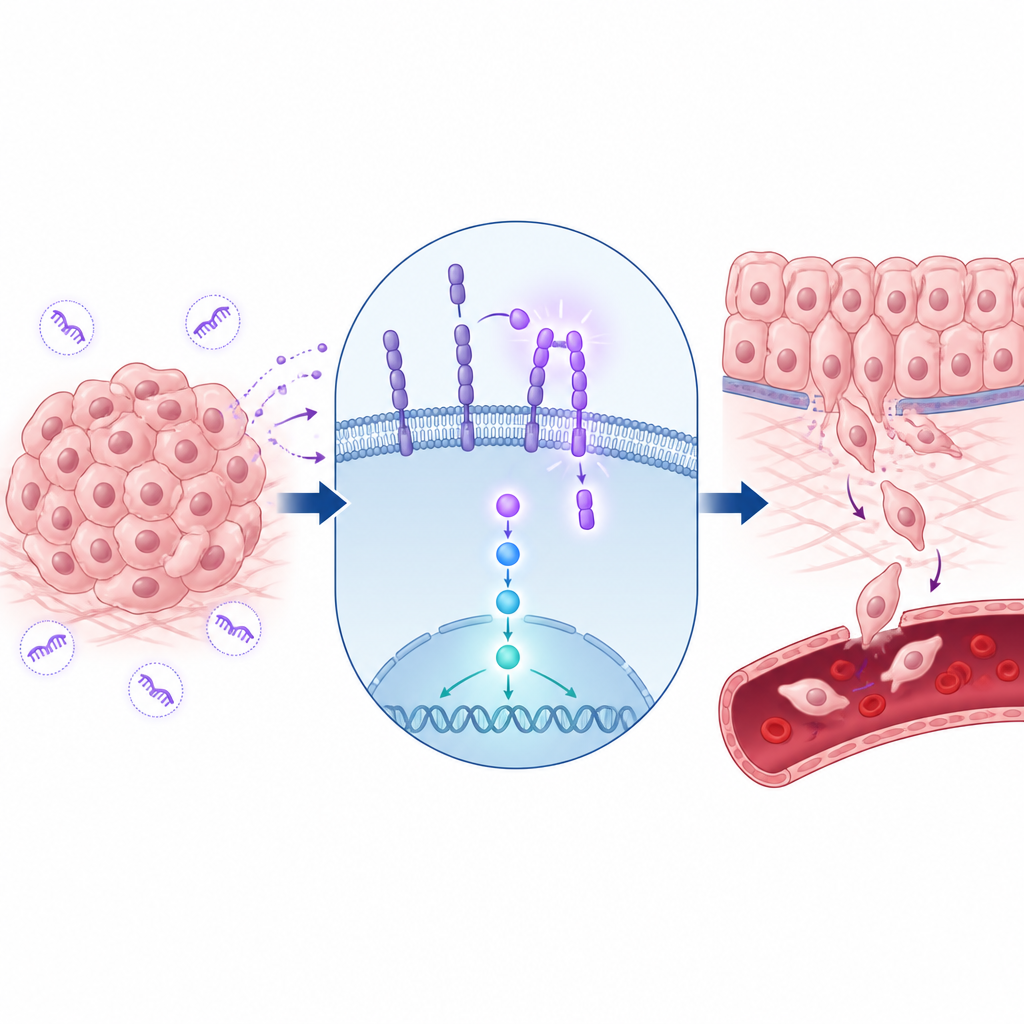
Among these fifteen microRNAs, one in particular, called miR-92b-3p, stood out. It belongs to a family of microRNAs already known to support cancer in other settings, but its role in lung cancer had been less clear. When the researchers forced lung cancer cells to produce extra miR-92b-3p, the cells became much more invasive and, in one cell line, more mobile, while their rate of division changed little. The same behavior appeared in another lung cancer cell line with different genetic changes, suggesting that this effect is not limited to a single tumor type.
How miR-92b-3p boosts a cancer-driving signal
To understand how miR-92b-3p reshapes cell behavior, the team compared gene activity in cells with and without extra amounts of this microRNA. The analysis showed that genes involved in stress responses, inflammation, and tissue remodeling were more active, and that a key communication route inside cells, known as the Notch pathway, was turned up. One player in this pathway, the receptor protein NOTCH3, was consistently higher in cells that overproduced miR-92b-3p, as was one of its target genes. When the scientists blocked NOTCH3 either by silencing its gene or by using a drug that dampens Notch signaling, the extra movement and invasion caused by miR-92b-3p largely disappeared.
Seeing the same pattern inside real tumors
The researchers then asked whether this microRNA driven signal was also present in patient tumors. Using spatial transcriptomics, a technique that measures gene activity at hundreds of tiny spots across a preserved tumor slice, they looked for regions where a gene pattern characteristic of miR-92b-3p activity was high. In all three lung cancer samples examined, areas with stronger miR-92b-3p activity showed higher levels of NOTCH3. A broader patient dataset confirmed that tumors with more miR-92b-3p tend to have more NOTCH3, supporting the idea that this microRNA and receptor form a functional pair in human lung cancer.
What this means for patients with lung cancer
Taken together, this work maps how specific microRNAs, especially miR-92b-3p, can push lung tumors toward more invasive behavior by feeding into NOTCH3 signaling. The fifteen microRNA risk score could help identify patients whose tumors are more likely to spread, while the miR-92b-3p and NOTCH3 partnership offers a potential weak point for future therapies. Although more studies, including animal models and larger patient groups, are needed before this can influence clinical care, the study shows how tiny RNA regulators can have outsized effects on lung cancer progression.
Citation: Cuttano, R., Afanga, M.K., Longo, F. et al. Functional analysis of the human miRNome in non-small cell lung cancer unveils a novel miR-92b-3p/NOTCH3 axis that drives tumor progression. Cell Death Dis 17, 502 (2026). https://doi.org/10.1038/s41419-026-08709-x
Keywords: lung cancer, microRNA, tumor invasion, NOTCH3, cancer prognosis