Clear Sky Science · en
Interaction of IRS2 with PLK1 protects cells from mitotic stress
How Cells Keep Their Genetic House in Order
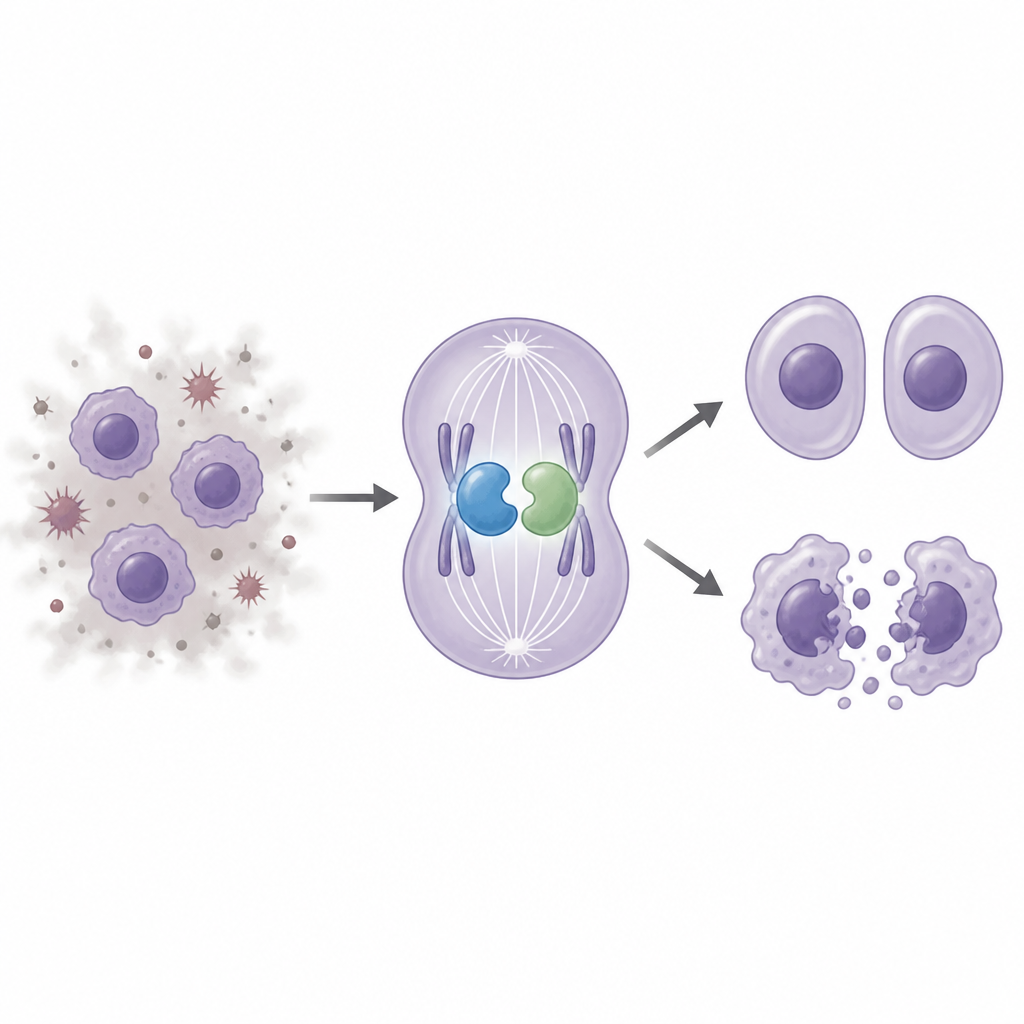
Every time a cell divides, it must hand down a complete, accurate set of chromosomes. When this process falters, the result can be damaged or unstable cells, a hallmark of many cancers. This study uncovers how a little-known partnership between two proteins inside breast cancer cells helps them survive the stress of division and avoid a fatal breakdown.
A Cell Helper with a Double Life
The protein IRS2 is best known as a helper in the body’s response to insulin and related growth signals. In that role, it sits just inside the cell’s surface, passing along messages that control metabolism, growth, and movement. The authors wondered whether this same protein might also take on a very different job when cells enter mitosis, the brief but intense period when chromosomes line up and separate into two new cells.
Watching IRS2 Through the Cell Cycle
Working with aggressive triple negative breast cancer cell lines, the team followed IRS2 levels as cells moved from one stage of the cell cycle to the next. They found that IRS2 protein rises as cells approach division, stays high during mitosis, and then drops once cells return to a resting state. Its chemical “tags” also change: instead of the tyrosine tags used for insulin signaling, IRS2 gained a different set of tags that depend on a cell cycle engine called CDK1. These changes hinted that IRS2 switches tasks, moving from growth signaling in resting cells to supporting safe chromosome separation during division.
Guarding the Division Checkpoint
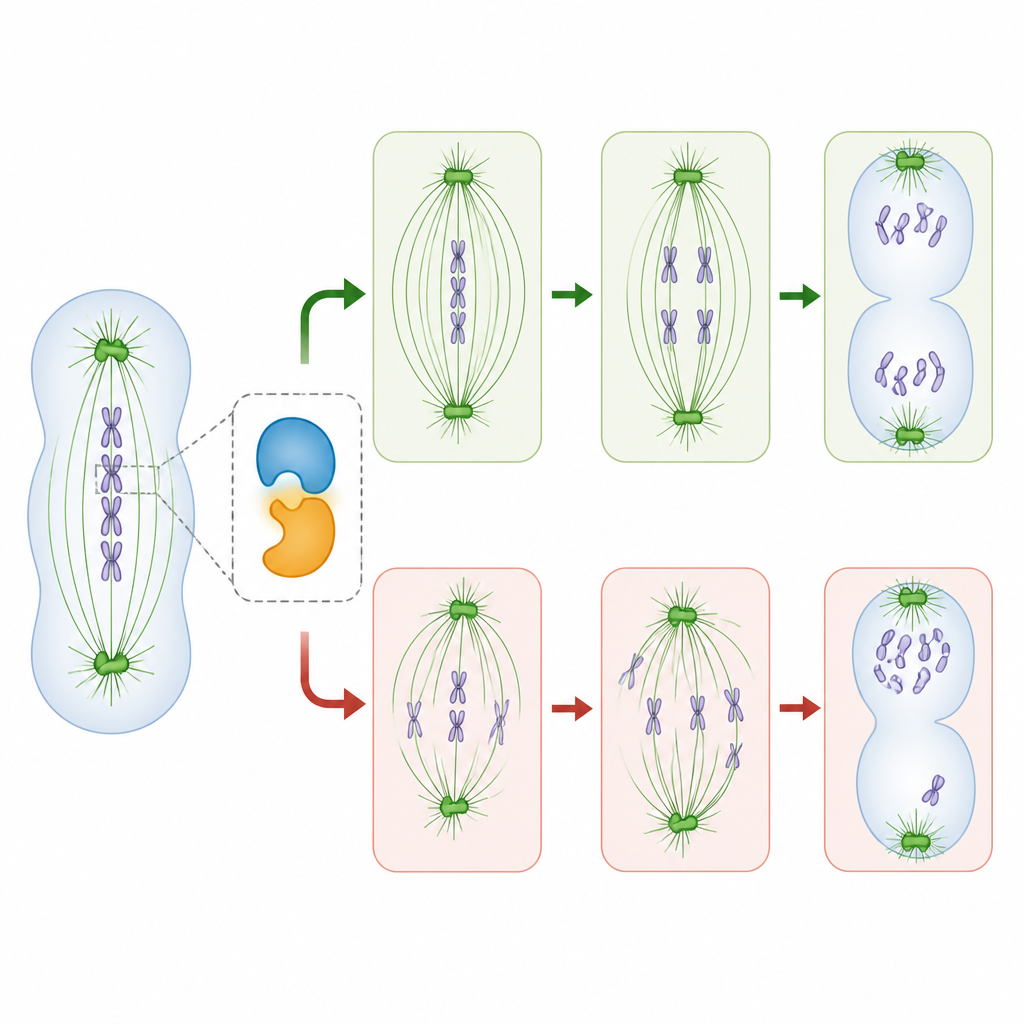
Cells carry a safety system known as the spindle assembly checkpoint that halts division until all chromosomes are correctly attached to the division machinery. The researchers mimicked division problems using drugs that disturb or freeze microtubules, the fibers that pull chromosomes apart. Cells lacking IRS2 slipped through this checkpoint too quickly. Their time in mitosis was shorter, the key checkpoint protein BUBR1 did not build up properly, and cells exited division early. As a result, chromosomes often lagged behind, formed bridges, or split unevenly, and more cells showed fragmented nuclei, a sign of cell death. IRS2, it seems, helps hold the brake pedal down until the division machinery is ready.
A Critical Partnership with a Cell Division Organizer
To understand how IRS2 exerts this control, the team searched for proteins that bind to it during mitosis. They identified PLK1, a major coordinator of early and mid-mitotic events, including separation of the two centrosomes that anchor the spindle. IRS2 and PLK1 bound strongly in cells poised to divide, and this partnership depended on CDK1 activity. When IRS2 was removed, cells more often had only one visible centrosome, or the two centrosomes sat too close together, making it harder to form a sturdy, bipolar spindle. By mapping IRS2’s sequence, the authors pinpointed two serine positions that are needed for strong PLK1 binding. Mutating these spots produced a version of IRS2 that could no longer support normal centrosome separation or sustain the checkpoint, even though its classic insulin signaling sites were left intact.
What This Means for Cancer Cells
Altogether, the findings reveal that IRS2 serves as a mitotic bodyguard: when properly modified, it latches onto PLK1 to help separate centrosomes and maintain the division checkpoint under stressful conditions. Without IRS2, or when it cannot grip PLK1, breast cancer cells struggle to divide cleanly and are more likely to die in mitosis. Because triple negative breast cancers often show high chromosome instability yet rely on a strong checkpoint to survive, their dependence on IRS2 may represent a weakness. Targeting this IRS2–PLK1 partnership could one day make dividing tumor cells more vulnerable to existing treatments that place them under mitotic stress.
Citation: Lee, JS., Bui, Q.T., Jo, M. et al. Interaction of IRS2 with PLK1 protects cells from mitotic stress. Cell Death Dis 17, 495 (2026). https://doi.org/10.1038/s41419-026-08706-0
Keywords: mitotic stress, spindle checkpoint, centrosome separation, triple negative breast cancer, IRS2 PLK1 interaction