Clear Sky Science · en
MLK4 orchestrates macrophage-induced triple-negative breast cancer invasion and ECM remodeling via enhanced paracrine signaling and NF-κB-MMP axis activation
How Immune Cells Can Help a Tough Breast Cancer Spread
Triple-negative breast cancer is one of the most difficult forms of breast cancer to treat, partly because it grows and spreads quickly. This study looks at how certain immune cells that gather inside tumors can unintentionally help these cancers become more aggressive, and how a single signaling protein in cancer cells, called MLK4, may act as a key control switch for this harmful teamwork.
The Tumor Neighbors That Shape Cancer Behavior
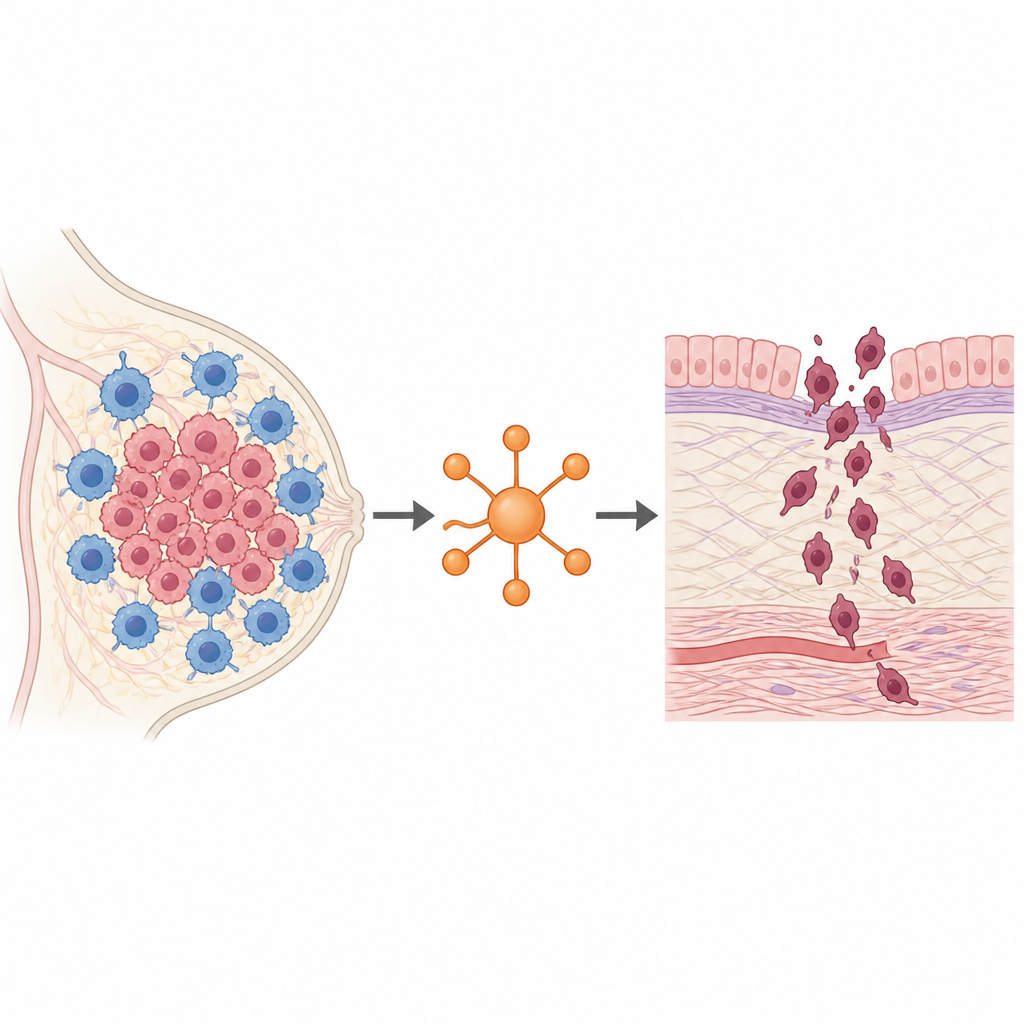
Cancers do not grow in isolation; they live in a busy neighborhood of blood vessels, support cells and immune cells, known together as the tumor microenvironment. Among these residents, a type of immune cell called a macrophage is especially abundant in triple-negative breast cancer and can make up a large share of the tumor mass. Instead of attacking the tumor, many of these macrophages adopt a tumor-supporting state, releasing factors that help cancer cells grow, move and evade immune attack. The researchers set out to test whether MLK4 inside breast cancer cells controls how strongly those cells respond to signals from these tumor-associated macrophages.
A Signaling Switch That Lets Cancer Cells Take Advantage
Using laboratory models, the team grew triple-negative breast cancer cells together with human and mouse macrophages in shared culture systems that allowed the cells to exchange soluble signals without direct contact. When macrophages were present, cancer cells formed more colonies, migrated farther and invaded through a gel that mimics body tissue, all signs of a more aggressive behavior. However, when MLK4 levels in cancer cells were reduced with genetic tools, these macrophage-driven boosts in growth and movement largely disappeared. This showed that the cancer cells needed MLK4 to fully benefit from the help provided by nearby macrophages.
How the Matrix Around the Tumor Gets Reworked
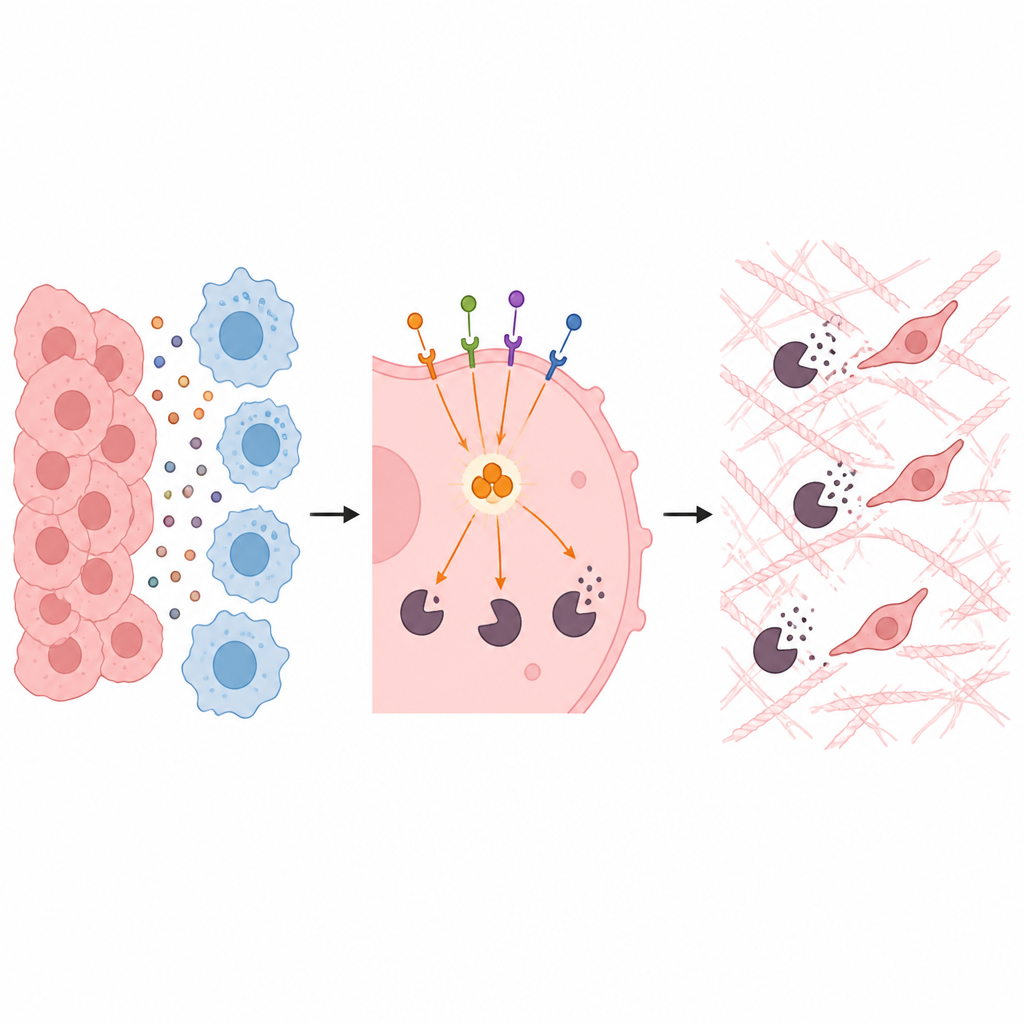
The area surrounding tumor cells is filled with a supportive scaffold known as the extracellular matrix, which cancer cells must remodel to move and spread. By analyzing gene activity, the scientists found that macrophages pushed cancer cells to turn on sets of genes linked to matrix restructuring, cell adhesion and invasion, but only when MLK4 was active. Cancer cells increased the production and activity of matrix-cutting enzymes, including several metalloproteinases, and displayed signs of shifting toward a more mobile, mesenchymal-like state. Silencing MLK4 reduced both the levels and the activity of these enzymes and cut down the ability of cancer cells to invade through matrix-like barriers, indicating that MLK4 is central to how macrophage signals are converted into physical changes in the tumor surroundings.
Chemical Messages That Drive Movement
The study also examined which small secreted proteins, or cytokines, were most strongly boosted when cancer cells and macrophages interacted. Two in particular, CXCL1 and IL-8, stood out as being much higher during co-culture than in either cell type alone. Both cancer cells and macrophages contributed to this increase, suggesting a feedback loop in which each cell type stimulates the other. The chemokine CXCL1, for example, made cancer cells more mobile in migration tests, but this effect was lost when MLK4 was knocked down in the tumor cells. At the same time, MLK4 activity was linked to activation of the NF-kappaB pathway, a major controller of inflammation-related genes, which in turn supports the production of matrix enzymes and mobility-related proteins.
Linking the Lab Findings to Patients
To see whether these lab results might matter in real tumors, the researchers examined data from triple-negative breast cancer patients and samples from mouse models. Tumors with higher MLK4 expression tended to have more infiltrating macrophages, suggesting that MLK4-rich cancers may attract or retain more of these supportive immune cells. In mouse tumors grown from human triple-negative breast cancer cells, reducing MLK4 expression led to fewer macrophages entering the tumor tissue. In additional cell-based experiments, macrophages were drawn toward cancer cells with high MLK4 but showed less movement toward cells in which MLK4 was suppressed, further supporting a two-way relationship.
What This Could Mean for Future Treatments
Overall, the study concludes that MLK4 sits at the heart of a harmful partnership between triple-negative breast cancer cells and tumor-associated macrophages. By helping cancer cells respond to macrophage-derived signals, activate NF-kappaB, release matrix-cutting enzymes and secrete chemokines like CXCL1, MLK4 promotes a cycle of growth, tissue remodeling and invasion. Targeting MLK4 could therefore offer a way to weaken this cooperation, potentially slowing tumor spread while avoiding some of the broader side effects that come from blocking more general pathways.
Citation: Mazan-Bury, A., Mehlich, D., Karpińska, K. et al. MLK4 orchestrates macrophage-induced triple-negative breast cancer invasion and ECM remodeling via enhanced paracrine signaling and NF-κB-MMP axis activation. Cell Death Dis 17, 440 (2026). https://doi.org/10.1038/s41419-026-08689-y
Keywords: triple-negative breast cancer, tumor microenvironment, macrophages, MLK4, cancer invasion