Clear Sky Science · en
The E3 ubiquitin ligase HUWE1 is required for KRAS-induced lung cancer
Why this matters for lung cancer
Lung adenocarcinoma is one of the most common and deadly forms of lung cancer, and many tumors carry mutations in a growth-driving gene called KRAS. Even with modern targeted drugs and immunotherapy, tumors often come back. This study asks a simple but powerful question: do KRAS-driven lung cancers depend on another cellular switch that we could safely turn off to slow or stop their growth?
A cellular tagger in the spotlight
Cells constantly mark their own proteins for recycling or reuse using tiny molecular tags. One of the key tagging machines is a large protein called HUWE1, which can alter the stability and behavior of many other proteins. By examining several large datasets of human lung tumors, the researchers found that HUWE1 is produced at higher levels in lung adenocarcinoma tissue than in nearby normal lung. Higher HUWE1 levels were more common in advanced-stage tumors and, in large patient collections, were linked to worse overall and progression-free survival. Screening data from cancer cell lines also suggested that lung adenocarcinoma cells are unusually dependent on HUWE1 for survival.
Testing HUWE1 in mouse lung tumors
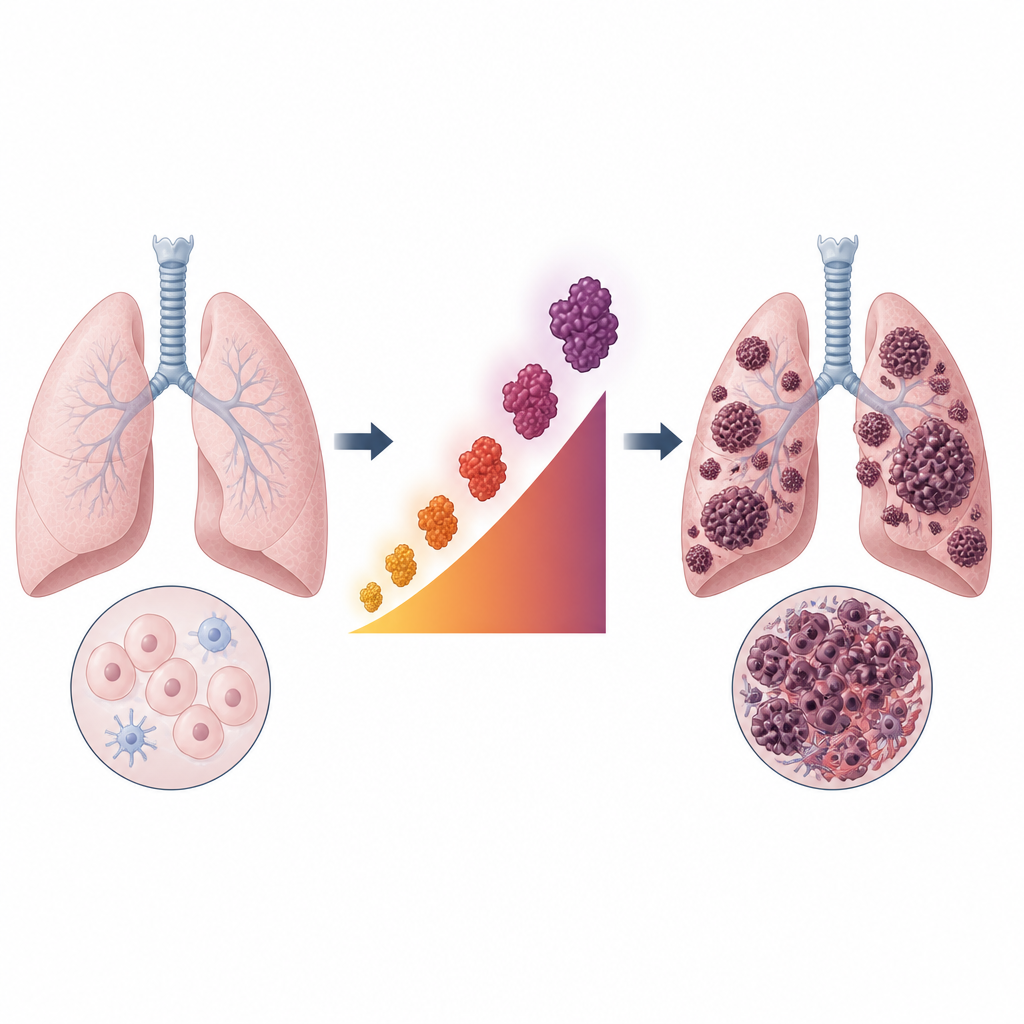
To move beyond correlation, the team used multiple mouse models that mimic human lung adenocarcinoma driven by mutant KRAS. In these models, a virus or a chemical carcinogen is used to trigger tumor formation in the lungs. The scientists engineered mice so that HUWE1 could be selectively removed in lung cells at the same time KRAS was switched on. Across several versions of the model, using different KRAS mutations and both genetic and chemical triggers, loss of HUWE1 led to dramatically fewer lung tumors and smaller overall tumor burdens. Importantly, this strong dependence on HUWE1 remained even when another major cancer guardian, p53, was already disabled, showing that HUWE1 helps drive tumor formation through additional routes.
Safe for normal lung cells, vital for cancer cells
A critical concern for any potential drug target is whether blocking it will harm healthy tissue. The researchers focused on alveolar type 2 cells, a normal lung cell type thought to give rise to many adenocarcinomas. When HUWE1 was removed specifically from these cells in otherwise healthy adult mice, the lung structure stayed intact, cell numbers were preserved, and the animals showed no signs of illness. In sharp contrast, human lung cancer cell lines that carried KRAS mutations and lacked p53 slowed their growth sharply when HUWE1 was depleted. In dishes, these cancer cells divided less, accumulated in an unusual phase of the cell cycle, and did not undergo widespread cell death, indicating that HUWE1 is more important for their continued proliferation than for their immediate survival.
Forcing cancer cells into a quiet state
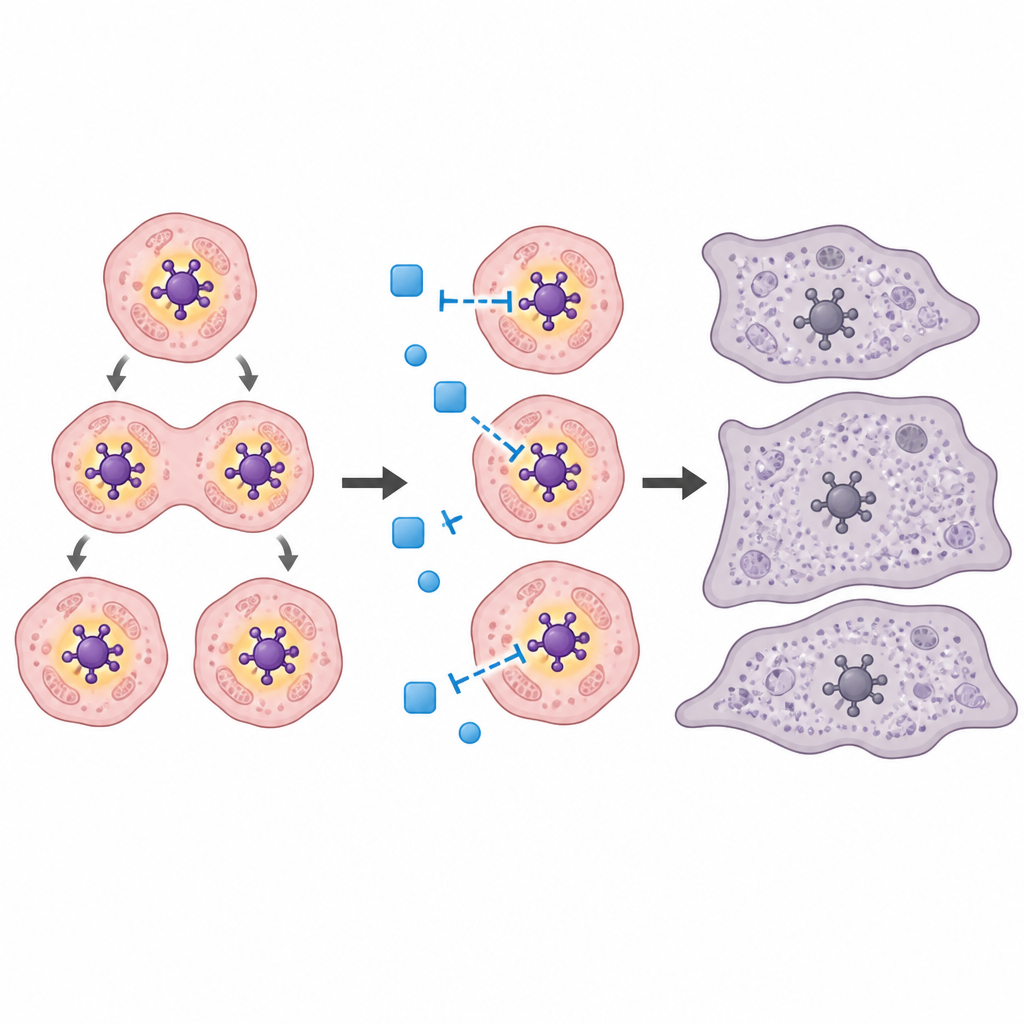
The team then asked what actually happens inside the cancer cells when HUWE1 is lost. Detailed gene activity profiling revealed a broad shift toward inflammatory and stress-related pathways, especially those controlled by NFκB, a master regulator of immune and stress responses. Many genes associated with a cellular retirement program known as senescence were turned on, including those driving the senescence-associated secretory phenotype, in which cells release a mix of inflammatory signals. The cancer cells also showed classic hallmarks of senescence: they became enlarged and flattened, accumulated granular material, increased the activity of a marker enzyme called beta-galactosidase, and raised levels of the cell-cycle brake protein p21. Together, these changes indicate that without HUWE1, KRAS-driven lung cancer cells tend to exit the division cycle and enter a long-term arrested, senescent-like state rather than continuing to multiply.
Slowing established tumors and future directions
Finally, the researchers asked whether lowering HUWE1 could affect tumors that had already formed, a scenario closer to real-world treatment. Human lung cancer cells engineered with switchable HUWE1-blocking molecules were implanted under the skin of mice, where they formed measurable tumors. Once the tumors reached a modest size, HUWE1 was turned off. Tumors with reduced HUWE1 grew much more slowly, and some regressed, while control tumors without HUWE1 loss continued to expand. Because normal lung cells tolerated HUWE1 loss, these findings suggest a useful therapeutic window: drugs that block HUWE1 might selectively curb KRAS-mutant lung tumors while sparing healthy lung tissue.
What this could mean for patients
This work identifies HUWE1 as a central helper that KRAS-mutant lung adenocarcinomas rely on to start and keep growing, yet one that normal lung cells can live without. By pushing cancer cells into a senescent, non-dividing state and reducing tumor growth in mice, HUWE1 stands out as a promising target for future therapies. Current HUWE1-blocking compounds are not yet suitable medicines, but advances in protein structure and drug design, including strategies that recruit HUWE1 itself to destroy specific cancer proteins, may eventually turn this vulnerability into new treatment options for people with lung adenocarcinoma.
Citation: Searle, J., Menotti, M., McDaid, W.J. et al. The E3 ubiquitin ligase HUWE1 is required for KRAS-induced lung cancer. Cell Death Dis 17, 487 (2026). https://doi.org/10.1038/s41419-026-08672-7
Keywords: lung adenocarcinoma, KRAS, HUWE1, cellular senescence, ubiquitin ligase